
State Senate candidates talk policies, plans for office
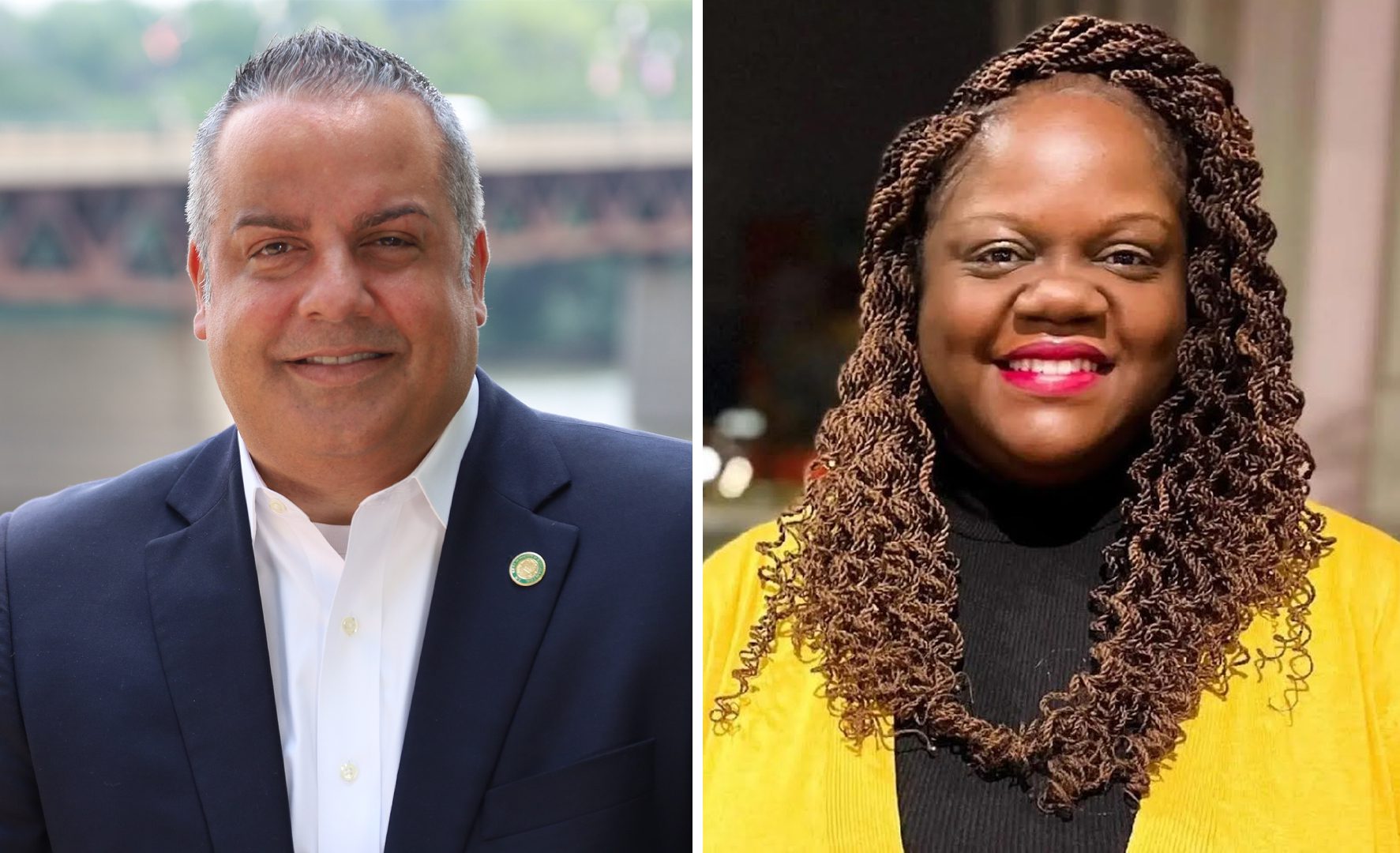
The general election is this month, with early voting running Oct. 29 through Nov. 6 and Election Day on Nov. 8 from 6 a.m. to 9 p.m. Among the races on the general election ballot is for State Senate District 52, which includes Cortland and Tompkins counties and parts of Broome County. Tompkins Weekly asked the two candidates, Republican Rich David and Democrat Lea Webb, a series of questions, which they both answered over email. Their answers are below.
Tompkins Weekly: Why are you running for Senate?
Rich David: I’m running for State Senate because I’m very concerned about the direction our state is headed. I’m specifically concerned about public safety, rising costs of taxes, groceries, gas prices, and the exodus of people and businesses moving to other states with more opportunity. As Mayor, I worked across the aisle to achieve real results on affordable housing, economic development and investing in infrastructure and I want to bring that experience and track record to Albany to deliver results for our community.
Lea Webb: I am running for State Senate because there is a huge disconnect between our elected leadership and the struggles that everyday people are facing in our community. I know how to create more opportunities for equity and inclusion across the state, and I want to be a State Senator so I can work on key policy areas including affordable housing, climate justice, quality affordable healthcare, and jobs for working class people in our district.
I was a community organizer in my hometown of Binghamton, building grassroots power to make the City more responsive to our needs, and was elected to Binghamton City Council. Our state government could do so much more to create a state and an economy that enables all of our people to thrive, and I am ready to bring that vision to the State Senate.
TW: How would you distinguish yourself from your opponent?
RD: I served as Mayor of Binghamton for two terms and President of the New York Conference of Mayors (NYCOM) where I dealt with a wide range of issues from COVID response to economic development. My experience and track record of delivering results separates my opponent and I.
I was proud to secure a grocery store on Binghamton’s northside and expand affordable housing while sadly, my opponent made promises she couldn’t keep. During my time as Mayor, I prioritized cutting taxes for residents & businesses and supported law enforcement by adding more police positions. During my opponent’s time on Binghamton City Council, she led the charge to cut police positions and raised taxes. If this was her record in Binghamton, we can only expect more of the same in Albany.
LW: I have 8 years of experience as a former legislator. During my two terms as a Binghamton City Councilmember, I addressed critical issues that families face. From removing blighted properties and supporting their redevelopment into homes, to addressing food desert issues by establishing community gardens, I worked hard to improve the lives of those I represented on the council.
I also passed legislation supporting equal pay for women, creating a city-based human rights commission, banning fracking and establishing a city-wide climate action plan, and supporting small business development and job creation.
TW: What would you describe as your strengths and weaknesses as a public servant?
RD: I’ve been told that one of my greatest strengths is putting plans into action. As Mayor, when a project came to my desk, it was imperative that we got the plans off the drawing board and into action for the benefit of the community, like infrastructure improvements, housing developments and youth programming. I tend to be a perfectionist and in the past, it’s taken effort to view imperfections as an opportunity to learn and do better in the future.
LW: My strengths as a public servant are that I am a coalition builder, active listener, and a hard worker who intentionally centers the needs of the community.
With respect to weaknesses as a public servant, part of the challenge is addressing long standing institutional barriers (policies/practices), especially as an elected official, that create disparities within a fixed set of time (i.e. one term). This is why it is important for any public servant to stay in consistent communication with constituents not only in their district, their colleagues and other key stakeholders.
TW: If elected, what are your top three priorities as a senator?
RD: My top three priorities when arriving in Albany are improving our economy and making New York more affordable for families and businesses, fixing our public safety crisis, in part, by giving discretion back to judges to keep our communities safe from violent reoffenders and lastly, investing in public education and improving infrastructure.
LW: My top three priorities as a State Senator are:
1) Protecting Reproductive Healthcare and Choice in NY (passing a State Constitutional Amendment to protect these rights)
2) Housing (Quality and Affordable for rural and urban communities, pass Good Cause)
3) Gun Violence Prevention (Strengthening Red Flag Laws, Restricting Access to High Capacity Assault Weapons)
TW: What would you like potential voters to know about you?
RD: I’m the son of an immigrant, bi-racial family. My father, Claude is a retired OB/GYN physician and a registered Republican, and my mother, Ginny is a social worker and a registered Democrat. Growing up with these different viewpoints has given me a unique perspective on my role in government and in life. It’s made me passionate about providing affordable housing and youth programming to underserved neighborhoods as well as delivering public safety, tax relief and improving the business climate. I have a track record of standing up to my party publicly and working across the aisle to get things done.
LW: I was born and raised in Broome County. I grew up in a blue collar household with two parents who were very active with their respective unions and I am a proud Union member of NYSUT/UUP. I was publicly educated and was the first person in my family to graduate from college and earned a degree in neuroscience at Binghamton University.
I have worked for more than 15 years as a community organizer on healthcare, education, environmental, racial and social justice. I made history as the youngest and first African American elected in my city’s history, and I became an award-winning activist who was recognized as one of tomorrow’s leaders by Oprah magazine. Most of all I was able to advance policies that had a positive impact on the community.
TW: How do you plan to address the needs of the different cultures, socioeconomic statuses, etc. that are in this district?
RD: It’s no different than managing a city like Binghamton that’s filled with people of all creeds, colors, religions with a range of socioeconomic statuses. Many issues impact all groups; everyone needs more affordable grocery and utility bills, more economic opportunity, everyone is concerned about public safety and clean water. Addressing those basic issues and investing in education so everyone has the same access and opportunity is critical.
My personal background also helps me understand those needs; I live in the City of Binghamton and I own a business in Cortland. Rural farmers and families in Ithaca may have different priorities but at the end of the day I think there’s a lot more that unites us than divides us and we can work to find common ground as I did as Mayor.
LW: I believe that it is necessary to address how issues of cultural identity, institutional and systemic oppression shapes and influences policies and practices. As an educator and long time advocate on diversity, equity and inclusion it is necessary that leaders create opportunities for having intentional and consistent community dialogues.
As a state senator I would implement this by holding town halls and building collaborations with community stakeholders. I would develop policies that center the diverse needs of our communities, especially those who are historically marginalized, and provide equitable resources on a consistent basis.
TW: How would you ensure that our district has a voice in Albany?
RD: As President of NYCOM, I’ve testified and advocated on behalf of dozens of municipalities and hundreds of thousands of New York State residents. It’s not easy to stand up and speak out to those in power. I have the experience to walk into the State Capitol on Day One and advocate fiercely for our community to ensure we get our fair share of the millions of dollars in state housing, environmental, public safety and economic development grant opportunities available. I worked across the political aisle as Mayor to get things done for our community and I plan to do the same in the State Senate.
LW: I’ve dedicated much of my life to uplifting the voices of our community. As a councilwoman who prioritized standing up for working people, I have made it a point to speak to constituents about the issues that matter to them and translating those needs into solutions. I plan to do exactly the same as a State Senator and always make sure that the laws we pass in Albany will truly benefit the people of this district.
TW: How are you best suited to address the economic and social impacts of COVID-19?
RD: I was Mayor of the City of Binghamton and President of NYCOM during the height of COVID-19 pandemic, an event in our lifetime that many local governments were ill equipped to handle. It was my responsibility to navigate Binghamton and advise cities and villages across New York through a once in a lifetime pandemic. We worked with stakeholders and developed a plan for long and short term recovery and worked to ensure economic development projects didn’t fall by the wayside because of labor shortages, delays and cost increases.
The City also worked with our local health care providers to ensure test and vaccination sites were distributed equitably and equally across the city, specifically to areas that typically lack access to services.
My experience in leading a city during the pandemic gives me the knowledge to move our state forward by getting businesses back on their feet. We need to do things like pay down the Unemployment Insurance Fund balance so businesses don’t face additional costs during these uncertain times and we need to continue outreach and services to historically underserved communities.
LW: In my experience as a former healthcare organizer, legislator, and a current educator, I understand first hand how and why we must utilize equitable and inclusive practices to address the intermediate and long term impacts of COVID-19. This pandemic has further exacerbated existing disparities across our respective institutions (i.e. jobs, housing, environment, healthcare, education, etc.).
One of the ways to address this is by establishing a statewide equity assessment that examines the economic and social impacts on our state. This would also facilitate more inclusive policy development and implementation of strategic and sustainable resource investment.
Related Articles
Street Beat: What are you looking forward to in the new year?
We asked five random people. Here’s what they had to say.

5 things to do in Tompkins County this weekend
Plan your visit and discover what’s happening this weekend.