Student gingerbread house tradition continues
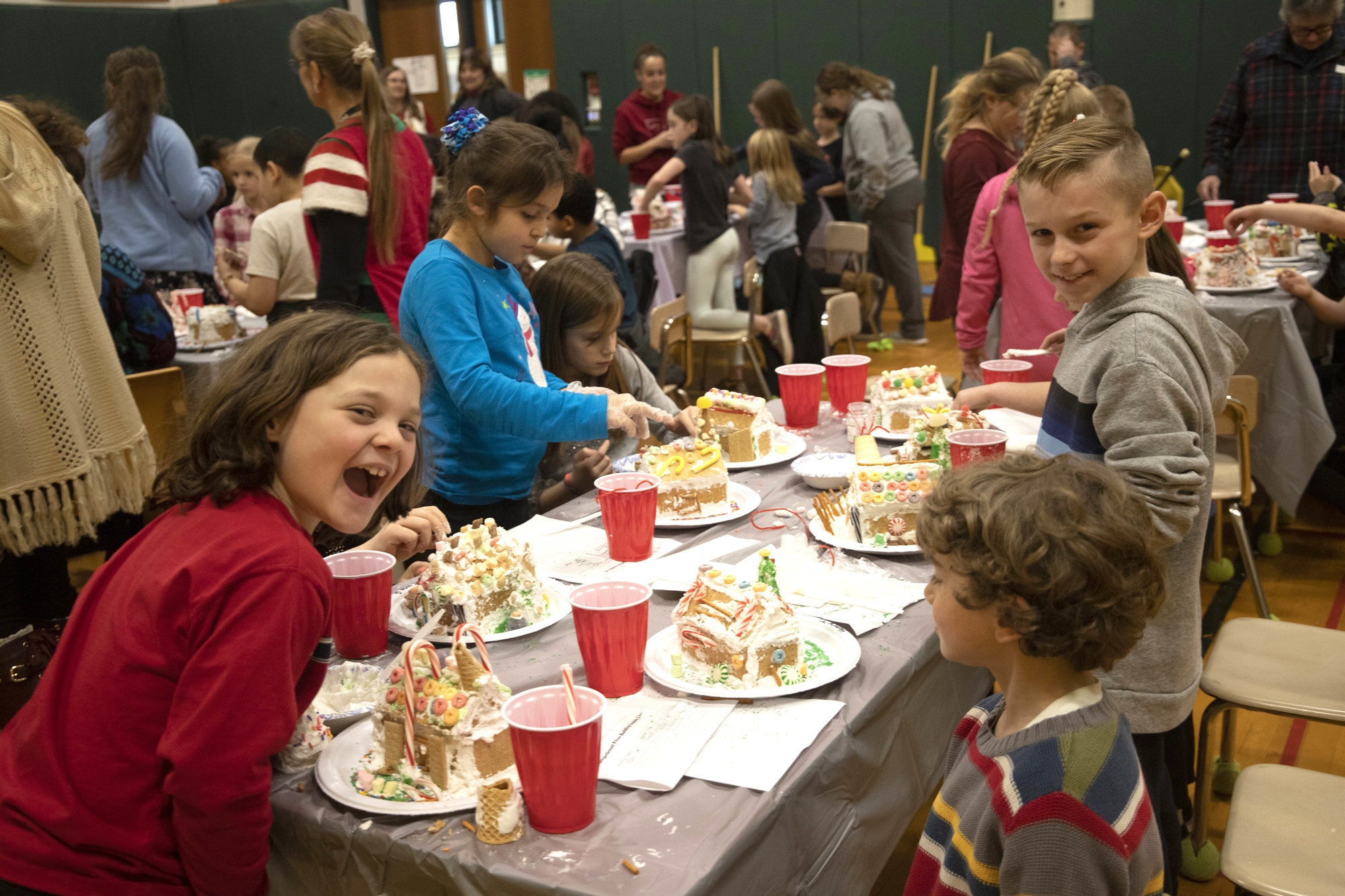
You won’t find these houses in any neighborhood; They exist entirely in the creative minds of third-graders at Newfield Elementary School.
Armed with items from home, such as gum drops, candy canes, mini marshmallows, sprinkles, a box of colorful cereal and graham crackers, all third-graders (about 60 students) recently gathered together in the school’s upper gymnasium to construct and decorate gingerbread houses.
This annual event, now in its 30th year, was started by Newfield teachers Sue Shults, Jon Armstrong (retired), Barb Peck (retired) and Carol Guckert (retired). This year, the adult team was joined by two more retired teaches, Phil Linde and Diane Blakely, as well as teachers’ aides and a number of Newfield High School honor students, many of whom built gingerbread houses when they were in third grade.
Of course, current third-grade teachers, Sue Shults, Louise Furstoss and Jessica Hollenbeck were on hand, along with some parents. The adult team contributed items that went into making the icing, such as cans of meringue powder and cream of tartar, and then whipped up two large batches of icing for the students to use.
Building the houses began with each student creating a blueprint on how they wanted to decorate their house. They used a variety of reading, math and measurement skills to determine the materials they would need and estimate how much was needed of each item.
The houses were each very different, many of them with patios, satellite dishes, decks, yard decorations and hot tubs, all constructed by the students for the house they were building. Once completed, the houses had to sit overnight to let the icing dry.
“This is a wonderful activity where the students can combine their creativity with academics and everyone has such a good time,” Shults said. “We could not do this without the help of several retired teachers, cafeteria staff, the custodial crew, the Newfield High School Honor Society and a number of parent volunteers.”
Armstrong agreed, saying he loves seeing the kids light up at the activity.
“This event is so much fun,” he said. “This year, the building of the houses included fishing ponds, Christmas trees, a clown house and a Buffalo Bills house. I can’t imagine the holiday season without this event.”
Student reactions ranged from Fin Greenlee saying, “I thought the gingerbread house-making was really fun. It was challenging and I could be creative” to Cody Mushatt’s comment, “It was hard to build the roof but easy to build a door!”
“I enjoyed having fun with my friends!” Ellora Quibb summed up the project.
The actual inventor of the gingerbread house tradition is unknown, as gingerbread constructions can be found as far back as ancient Greece and even further in China, but according to The Spruce Eats, a website dedicated to sweet treats, the tradition of making decorated gingerbread houses began in Germany in the early 1800s.
According to certain researchers, the first gingerbread houses were the result of the well-known Grimm’s fairy tale, “Hansel and Gretel” in which two children abandoned in the forest found an edible house made of gingerbread with sugar decorations. After this book was published in 1812, German bakers began baking houses out of lebkuchen (gingerbread).
These became popular during Christmas, a tradition that came to America with Pennsylvanian German immigrants.
As for the past 30 years, Armstrong feels this Newfield Gingerbread House event is one remembered fondly by all those who have participated.
“I am pretty sure I have as much fun as the students do,” he said.