Summer construction resumes for solar farm
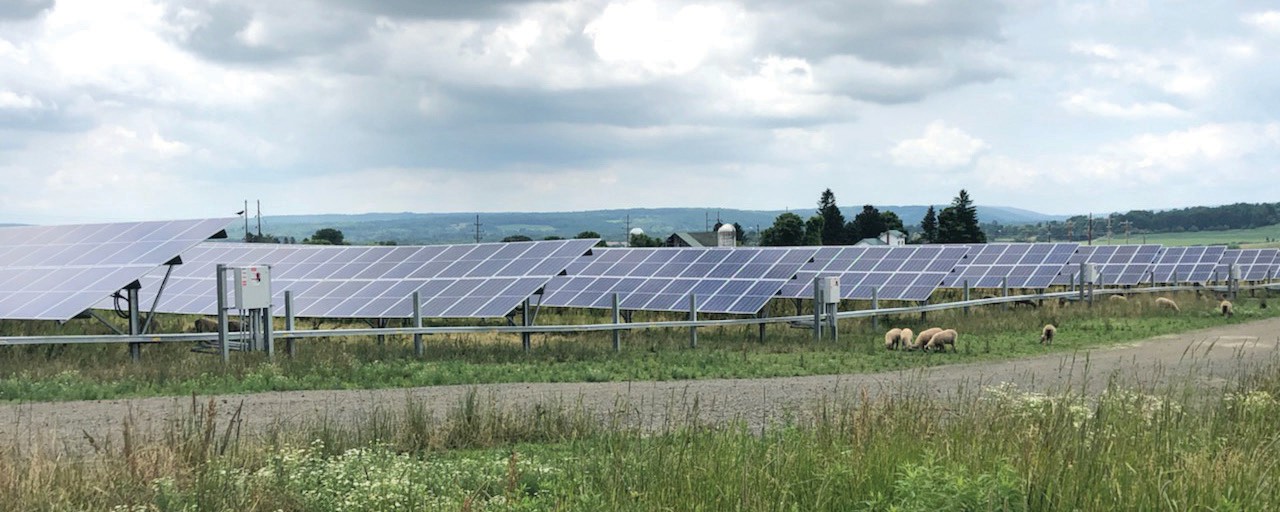
Some Dryden residents and Willow Glen Cemetery visitors may notice the sound of heavy equipment this summer as workers aim to complete an 11 megawatt solar farm by the end of 2020. Once completed, Dryden residents and business owners can choose whether to receive energy from this solar facility.
The facility was first proposed by Distributed Sun, a company that manages, advises and constructs large-scale solar farms. The solar farm – the official address of which is 2150 Dryden Rd. – comes as Dryden’s second solar farm in recent years. The other is an 18 megawatt facility on Turkey Hill Road near Varna, also brought to the Dryden Town Board by Distributed Sun.
The Turkey Hill solar farm is on Cornell Agriculture land and has already been successfully connected to the electrical grid, according to Ray Burger, director of planning for the town of Dryden. Both the 2150 Dryden Rd. location and the Turkey Hill Location were approved by the Dryden Town Board in 2017. Since applying for the facilities, Distributed Sun has been sold to True Green Capital, a renewable energy infrastructure firm.
The 2150 Dryden Rd. facility is located on private land, leased to the Distributed Sun, Burger said.
“While this is a private sector project, the town welcomed the $60 million investment because it epitomizes sustainable economic development,” said Dryden Deputy Supervisor Dan Lamb, adding that town officials will have little involvement with the project once the facility is fully operational.
Until then, the town planning board will maintain communication with the developer, ensuring adherence to the plan which was approved by the town board.
Dryden residents will be able to opt in to receive electricity from the facilities by reserving a certain number of panels. The power produced in the solar farms will travel to the shared power grid and not directly to the buildings of people who opt into the service. Instead, the power generated from a resident’s reserved solar panels will be monitored, and that amount of energy will then be accessible from the grid.
According to Town Supervisor Jason Leifer, after the construction of the 2150 Dryden Rd. facility, there will be enough solar panels in Dryden to power all of the town’s homes and businesses if they chose to opt in.
If a household uses less power than the power produced by their reserved panels, they will receive some money back from New York State Electric and Gas. For all Dryden residents, the solar power from the new facilities comes at a 10% discount, Leifer said.
According to town board member Jim Skaley, others who live in the area can also opt into the energy service but with a 5% discount.
During the application process, the Tompkins County Industrial Development Agency negotiated a payment in lieu of tax agreement, known as a PILOT agreement, according to Leifer.
The PILOT means that in addition to paying the private owners of the land, Distributed Sun pays Dryden an annual fee that exceeds $30,000 each year, according to Lamb.
According to Leifer, the money from the PILOT will be directed toward the school district, the town of Dryden and Tompkins County. Overall, roughly 70% of the PILOT revenue will go to schools, and the town and the county will each receive around 15% of the revenue, Leifer said.
The facilities are particularly beneficial to the private landowners.
“It’s great for farmers to lease bad land. It’s a great way to raise extra money,” Leifer said. “That’s the other benefit for a rural town – [this revenue] is not dependent on the whims of the market, like dairy, vegetables or hay.”
The project was not without controversy. When the solar farms were first proposed to the town board in 2017, many residents objected to what they saw as the negative visual impact of the solar panels, Leifer said. Though the impacts of both the Turkey Hill facility and the 2150 Dryden Rd. facilities were debated, it was the latter that caused the most concern among Dryden residents.
“The visual impact tends to bug some people, but a lot of people in Dryden were willing to give it up,” Leifer said.
He added that with only a few exceptions, most people involved in the discussions supported the move toward more clean energy. In the end, the clean energy benefits, along with the financial gains resulting from the PILOT agreement, overpowered any visual drawbacks.
“We appreciate that some of our residents opposed the siting of the project,” Lamb said. “Frankly, we wish the panels didn’t take up so much space, but we feel that the benefits far outweigh costs of the project.”
The developer took the visual concerns seriously, according to Burger.
“The manager for Distributed Sun, much to his credit, was making a lot of personal contact with the neighbors [of the facility],” Burger said.
The concerns of residents in the early stages of the application process resulted in several drafts of a plan for the 2150 Dryden Rd. facility. The developers added evergreen trees into the plan, which will partially hide the solar panels from view.
The application process for the facility also factored in environmental concerns, including question of the wetlands near the cemetery and the sensitive habitat of the Northern Long Ear Bat, according to Skaley. Burger said that in response to environmental concerns the developers added space between the panels and the nearby creek. Ultimately, the facility was given the go ahead by the Fish and Wildlife Service, Skaley said.
As the Dryden Road facility nears its completion, Burger expressed optimism about the move toward solar beyond the immediate consequences.
“We were one of the first communities to go through this process,” Burger said. “It was a fairly bold undertaking by this community. It shows that Dryden is willing to be a leader in bringing more renewable energy.”