
Supply chain issues affecting T-burg businesses

Carol VanDerzee didn’t want to have to cut dishes from the menu at the Falls Restaurant in Trumansburg. But when the global supply chain crisis reached the door of her folksy American diner, VanDerzee was forced to make difficult decisions. Nearly everything the restaurant needs — from dishes to food — is either unavailable, more expensive or both.

“There’s a lot of out-of-stock products, and we can’t offer as much as we used to,” VanDerzee said. “We’re limited on the number of things we can offer on the menu. There’s a constant shortage.”
VanDerzee’s story is similar for other Main Street businesses in Trumansburg. At Trimmer’s Ice Cream, owner Jane Broadfield has also been facing issues with the suppliers she relies on to continue selling cones at her roadside ice cream shop.
“Deliveries are an issue, and product is an issue too,” Broadfield said. “It’s everything. It’s equipment, it’s also the dairy [and] it’s the food. It’s pretty much everything.”
When the pandemic began in March 2020, businesses around the world reduced supply in order to adjust to a pandemic-era economy. However, when the economy reopened in 2021, suppliers like Sysco — which provides VanDerzee with the food for her diner — could not meet demand, and a crisis in the country’s supply chains began.
This, along with price gouging and the war in Ukraine, has caused an ongoing inflation surge that has raised the cost of almost everything VanDerzee needs for the Falls Restaurant.
Warren Hamilton is an associate professor of economics at Hobart and William Smith Colleges. Hamilton said via email that he has not been following how the supply chain crisis is affecting local economies, but the response by the United States government could deepen the problem.
“In my opinion, at least on the national level, the U.S. seems to be relatively slow in its response [to the supply chain crisis],” Hamilton said. “This is the result of our overextension of reliance on the world economy, which for the most part, we have created.”
VanDerzee’s food supplier, Sysco, is a major multinational corporation that ships food from all over the world. Protesting low pay and unfair labor conditions, the company’s workers began a strike last month (tinyurl.com/2hrscesg), which VanDerzee said has stressed the supply issues that her restaurant already faces.
Sysco has also taken advantage of inflation by raising prices to increase profits (tinyurl.com/2goq8kpn). VanDerzee and her customers end up paying for those price increases.
“I’ve been doing this for 35 years, so I know my customers,” VanDerzee said. “I know what they can afford, and if I keep raising my prices, they’re not going to be able to walk in the door. Just so I can keep them coming in the door, I as an owner am taking more of a hit than anybody.”
The supply chain crisis and the rising costs associated with it are one of the largest problems facing small businesses across America. In a recent survey (tinyurl.com/2el9rubu), almost half of American small businesses (46%) reported having to decrease their inventory since the pandemic began.
Additionally, 89% of small business owners said they have had to raise prices since the pandemic began.
For Kevin McKinzey, the owner of Trumansburg’s Main Street Market, higher prices are something that his store is used to, as Main Street Market emphasizes local, organic food. However, McKinzey said one of the benefits of serving local food is that, for the most part, Main Street Market has been able to avoid the supply chain crisis.
“We’ve kind of built our menu around foods that are locally available and consistent,” McKinzey said. “Compared to other restaurants or eateries, I think, maybe it hasn’t been quite as debilitating.”
McKinzey said the crisis has proved the reliability of having a menu based around local food, as customer loyalty and lower delivery times make navigating higher prices easier.
“This is exactly, exactly the example of how important local food systems are,” McKinzey said. “Everyone has a food system that is based on receiving foods from halfway across the country. These kinds of shortages and slowdowns are far more impacting on them.”
Broadfield said although costs for Trimmer’s Ice Cream are rising, she has not had to pass on the cost to customers yet. Her customer base has been empathetic about the issues that the store faces.
“We have a really great customer base; it’s like a family here,” Broadfield said. “They completely understand and are on our side. They totally have given us great respect and are definitely understanding about everything.”
Trumansburg Connection appears every Wednesday in Tompkins Weekly. Send story ideas to editorial@VizellaMedia.com.
Related Articles
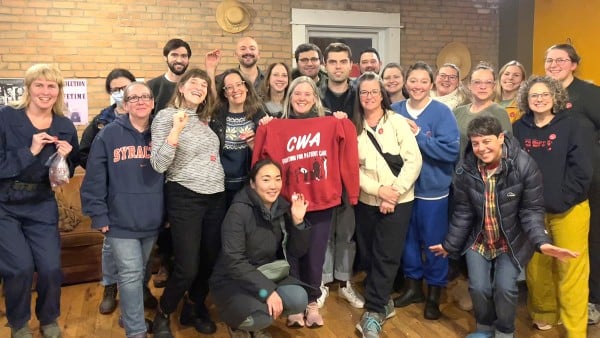
Cayuga Medical Center nurses to rally, alleging anti-union tactics by hospital management
CMC nurses plan a rally, alleging unsafe staffing and illegal anti-union tactics as the hospital highlights recent patient-safety gains.

Dryden Fiber looks back on another year of service
Dryden Fiber reflects on a year of growth as the municipal internet provider expands service across Dryden and Caroline.
Cayuga Medical Center improves patient safety score
Cayuga Medical Center Leapfrog Grade rises to “B,” showing improved patient safety and nursing care quality.