
With enrollment up, Tompkins Cortland Community College pauses culinary programs and focuses on workforce training
TC3 Workforce Training rises with 28% enrollment surge. Explore free courses and paused culinary programs at TC3!
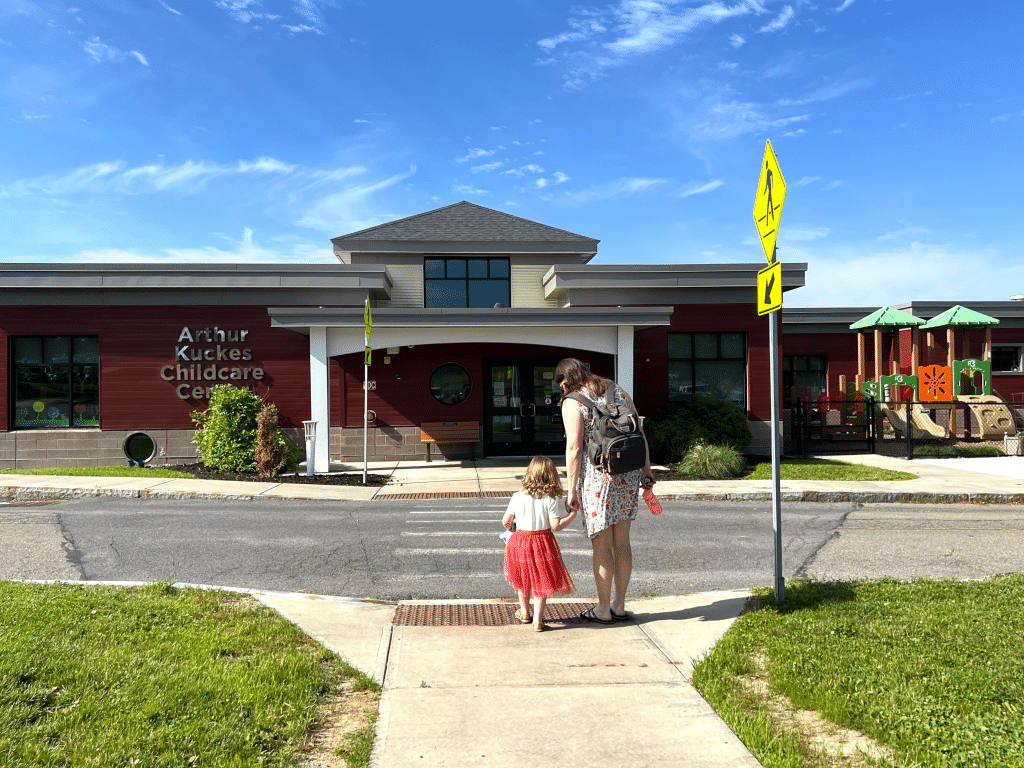
Christine Sislak, of Freeville, drops off her daughter, Abigail Wendel, at Tompkins Cortland Community College’s Arthur Kuckes Childcare Center, where students and community members have access to affordable child care while students in the college’s Early Childhood program have access to real-world learning experiences.
At its June 17 meeting, the Tompkins County Legislature received a presentation on Tompkins Cortland Community College’s (TC3) proposed 2025–26 budget, which comes amid what college officials are calling an “extraordinary” surge in fall enrollment.
TC3 President Amy Kremenek said that the college is making ongoing efforts to align academic programming with regional workforce needs, while the TC3 board of directors has prioritized tightening the college’s budget and increasing its revenue in anticipation of difficult, or at least uncertain, times to come.
This includes deactivating the culinary arts program and decreasing TC3’s physical off-campus footprint, college officials told the legislature.
“I am pleased to report to all of you that we are seeing extraordinary growth in enrollment, particularly for fall,” Kremenek said. “Currently we are up 28%, which is extraordinary. I’ve worked in community colleges for over 20 years, and I have never seen numbers like this at any college I have worked at, and that’s a result of both the support that we receive from our community and from this body as well as a lot of work that’s been done internally.”
“Providing that holds — and we are still about two-and-a-half months away from the start of the semester — you will see a dramatic increase in our core enrollment for fall 2025, both in full- and part-time students,” Kremenek added. “It’s really across the board.”
Where TC3 funding is coming from
Tompkins County Legislator Mike Sigler noted his observation that the 2025-26 budget includes only a $100,000 anticipated increase in tuition revenue.
The enrollment increase in the budget currently is about 1%, “which sounds very different,” Kremenek acknowledged.
“We made a determination to be very prudent with that decision about the projection, which occurs in the spring,” she said. “[This decision was] due to enormous uncertainty that’s out there in terms of the changes that have been proposed in the Pell [Grant] program, which would be a significant detriment to our students. The vast majority of our students are being supported in some way by financial aid.”
One current proposal, included in a bill passed by the U.S. House of Representatives called the “One Big Beautiful Bill Act,” suggests reducing the maximum Pell Grant award from $7,395 to $5,710 for the 2026-27 school year.
“The other area that we’re continuing to watch is just the economy and the overall ability for students to come to college — and we felt, and the board felt, that it was important to be conservative at this time,” Kremenek said.
Tuition increased by 1.7% over last year and is currently $5,664 for an in-state student not living on campus. This is the ninth-lowest rate of the 29 community colleges in the state of New York.
Where TC3’s students are coming from
About 55% of TC3’s core students — those who are not enrolled in high school but are either coming to the college or are enrolled online — are from Tompkins or Cortland County.
About another quarter of TC3’s core students are from the “donut counties,” Kremenek said, explaining that these are the counties contiguous to Tompkins and Cortland. “So all told, the vast majority of our students are coming from our region, and while we do have students from other parts of the state, and in some cases other parts of the world, the vast majority of our students are local.”
A shake-up to the college’s programming
“The academic program mix has been a real priority of ours,” Kremenek said. “We have over 40 programs, which is a lot for a small institution.” Kremenek said that the college is taking a close look at its programming across the board and analyzing which programs are crucial to meeting the job and employment needs of the region.
“Whether it’s for those going direct-to-work or those who are transferring, we have a brand-new program feasibility process that our board has approved in recent months and a new associate of science transfer program in the health sciences, which is designed to transfer to SUNY Upstate in their bachelor’s completion programs in six areas of health professions,” she added.
Jobs in these areas include radiology technician and respiratory therapist; “these things that we know hospitals and health providers in this region need,” Kremenek said.
TC3 also has new transfer agreements with Cornell University, Hobart and William Smith Colleges and Syracuse University.
TC3’s board recently deactivated the college’s long-standing culinary arts program, which formerly included running downtown farm-to-table teaching restaurant Coltivare, which opened in 2014 and closed its doors in January. TC3’s announcement regarding the restaurant’s closure stated that there would be no other changes to the college’s culinary program, but that situation has recently changed, Kremenek said.
“What deactivation means is that it gives us the chance to pause enrollment in the program in its current iteration, take a look at it and make sure that students who are completing that program — the jobs that they are taking — are jobs that require the associate degree,” Kremenek said. “We want to be certain that the time and the money that students are investing in degrees are leading to jobs that require that credential so that they’re better off as a result of being with us.”
The college will work on developing recommendations for the future of the culinary program, which Kremenek said will be due in October.
The college also recently discontinued the general studies certificate, which Kremenek said is a program that not many students were taking advantage of, primarily because it was made up of electives.
“There weren’t a lot of requirements, and it really didn’t have a specific purpose,” Kremenek said.

Student Tyler Smith of McGraw speaks with Bill Frances, Tompkins Cortland Community College enrollment services specialist, at the newly renovated Panther Welcome Center.
Career-focused priority areas
“The SUNY Reconnect program you may have heard about, which is the free community college program for adults ages 25 to 55 in nine high-demand fields,” Kremenek said. “We are seeing an extraordinary amount of interest in this program from adults across both counties.”
The program provides free associate degrees for New Yorkers who are between the ages of 25 and 55. The offer covers tuition, fees, books and supplies.
The degree programs included in the offer are chemical dependency counseling, computer information systems, computer science, computer support specialist, construction and environmental technology, environmental studies, nursing, sustainable farming and food systems, teacher education transfer (adolescence) and teacher education transfer (childhood and early childhood programs).
Kremenek highlighted a few other academic areas that she views as important to the community and the legislature. They include certified nursing assistant, pre-apprenticeship training, direct-to-work advanced manufacturing partnership, commercial driver’s license training partnership, and emergency medical technician training partnership.
The nursing assistant program is a three-week workforce development program designed for students who want to work in nursing homes and health care facilities and as home health aids, taking care of the community’s most vulnerable citizens.
“The pre-apprenticeship training — we are very active in this space with SUNY, using these dollars, working with local employers for incumbent employees,” Kremenek said.
The direct-to-work program is an advanced manufacturing partnership with Ithaca Area Economic Development.
The CDL course starts in July, “so you may see big rigs on our campus,” Kremenek said, “for people who are learning how to become truck drivers.”
“Another area that’s really important to both counties is emergency medical technician, or EMT,” Kremenek said. “We are partnered with a SUNY Upstate sister institution, and they will be offering their EMT program on our campus in the fall, and then in the spring they’ll be at Ithaca Mall with the idea of trying to serve more people in close proximity.”
TC3 tightens its belt
Expenses for the college are down 3%, and in recent years TC3 has worked to reduce its physical footprint, said Dennis Panagitsas, TC3’s vice president of finance.
“We’re selling the Cortland extension center,” Panagitsas said, adding that TC3 is also planning to rent its Ithaca extension center, as well as the Coltivare space. The net positive net effect of all those actions would be an expense reduction of about $600,000, he said.
Currently, TC3 has a fund balance of around $4 million, which is about 15% of the total budget, as opposed to a fund balance of less than 5% in 2015.
Panagitas said that TC3 has decided to grow and preserve its fund balance, rather than digging into it, in order to be prepared for possible difficulties down the road. “We feel that it’s the only responsible thing to do,” he said.
Sponsoring county contributions from Tompkins and Cortland counties, totaling $4,882,882, have stayed the same as last year in the proposed budget and make up about 14% percent of the college’s total revenue.
An enrollment-friendly strategy for the future
The college has a strategic enrollment management plan. “We’ve had one in place for the last couple of years, but there’s so many elements of this plan that are really coming together now,” Kremenek said.
TC3 has redesigned its enrollment process. “This is really important for our students because, as I say, I want to be sure that the hard work they’re doing is the work in the classrooms, not the work getting through our processes,” Kremenek said.
The college redesigned its Panther Welcome Center in January.
“If you’ve been to our campus, you know we have an enrollment center as you come in the front door that has been completely redesigned as a one-stop model,” Kremenek said, explaining that the idea is for students who are coming in the door to get as many questions answered as they possibly can. Then, if a student needs specialized details, the staff can triage from there.
“[We’re] trying to eliminate the numbers of stops that students have to go through to enroll,” Kremenek said. “We’ve been fortunate. We’ve invested in the strategic use of data and technology. It’s amazing what technology can do these days, and we know how to run it now, so we have been able to incorporate personalized communications for students that really tell them where they are in the process, which has made an enormous difference for busy students.”
“It’s good to be able to talk to so many students and try to help them,” Bill Frances, TC3 enrollment services specialist, said on a recent morning in the Panther Welcome Center. “I feel like I see and talk to more students. I was in financial aid before, and now, instead of just talking to people simply when they ask for financial aid, I can throw some of that stuff in there. I can figure out they need [financial aid] without them realizing they need that.”
Frances said many students assume that applying for financial aid is too much of a hassle, or they see the balance of their bill before their financial aid goes through, and they become anxious that they won’t be able to afford their classes. He specializes in clearing up those misconceptions and concerns.
“If nothing else, it makes it so that they sleep a little bit better that night,” Frances said.
TC3 utilizes a proactive territorial management strategy, which means that the college has a presence in nearly every community organization across the region while also prioritizing interaction with local high schools.
In the coming year, TC3 will come up with a new strategic plan. “We’re calling it ‘Sustaining a Vibrant Future.’’’ The three-year transitional plan will be designed to tie up some loose ends, particularly on the property side of things, Kremenek said.
Author

Related Articles
Cayuga Medical Center nurses’ vote for unionization approaches
The Cayuga Medical Center nurses union vote approaches as nurses cite workplace concerns, leadership changes, and national labor issues.


Holiday traditions bring community cheer
Tompkins County holiday traditions light up homes, farms, and schools with festive cheer and community spirit.