The evolution of a business: From journals to mushrooms, Steve Sierigk is growing in a new direction
By Jamie Swinnerton
Tompkins Weekly
The symbol of an acorn is one of possibility, transformation, and natural growth. For over 30 years these have been some of the tenants of Steve Sierigk’s business, Acorn Designs. What started as a small craft business that Sierigk sold next to his art blossomed into a full-blown business with employees, an annual catalog, and an extensive network of artists and customers. But times have changed and Sierigk is ready to move on to something new. Acorn Designs needs to be taken in a different direction if it is going to continue in the digital age, and Sierigk knows he’s not the guy for the job. Not anymore.
Acorn Designs was started in 1981 with no plan to become what it is today. Before the internet and local craft gift shops, Sierigk traveled to craft shows in the area to sell his artwork. Along with his art, he would also sell smaller, cheaper crafts like notecards and bookmarks. At the time, environmental issues and the green movement were exploding onto the cultural scene. Sierigk, who has an undergraduate degree in botany and trained as an entomologist in graduate school, wanted to incorporate the ideals of the environmental movement into his growing business.
“So, I always used the greenest papers I could find,” he said. “Even back then, there were tons of small companies like me that had a real environmental ethic to them. Now, the whole green-washing thing started happening in the late 90s, everything got a little confused, like ‘What’s really green?’”
Many of these other small companies couldn’t compete when larger corporations started selling “green” products. But Sierigk was determined to stick it out and survive. He said he has always used 100 percent post-consumer recycled paper.
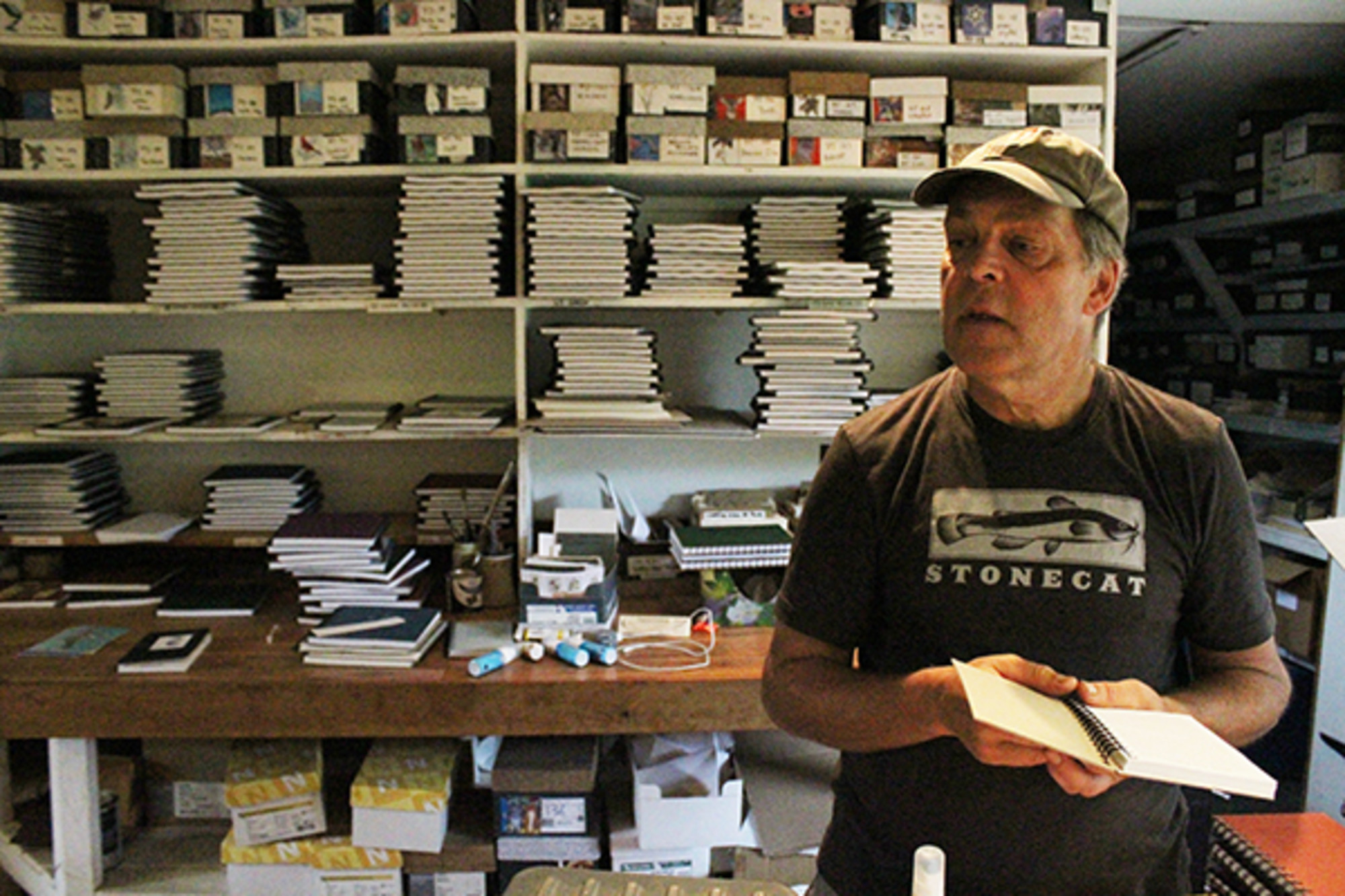
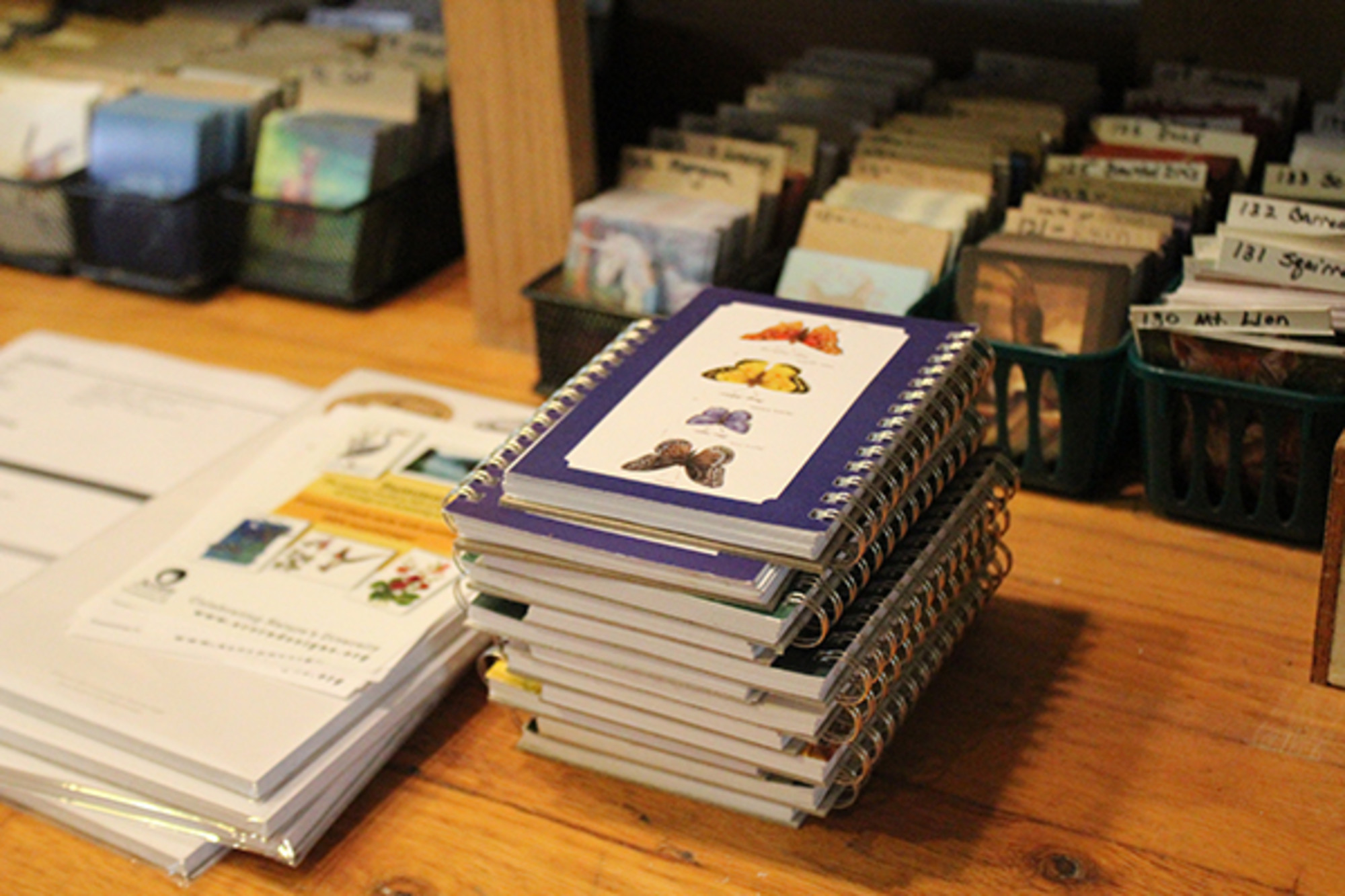
Before he knew it, the Acorn Design line had grown by leaps and bounds and included journals of several sizes, cards, notepads, and even stationary. He started working with other artists and currently works with around 30 other artists to create a diverse line of products. Back in the 80s he was convinced that the internet wouldn’t be able to compete with the quality of the art he and the artists he had connected with were putting out. Around 1986 the business exploded and Sierigk took on several employees, seven in its heyday. The business was taking orders from organizations like Greenpeace, which was buying notecards by the tens of thousands.
“I had to quit everything else,” Sierigk said, including the farming that he had been doing at the house he still lives in up in Trumansburg. “I always farmed a bit on the side.”
For the next five or so years, Acorn Designs flourished with minimal marketing. Sierigk would put out a catalog each year with 60,000 people on the mail-order and get a pretty healthy return. Several of his devoted customers were people he had met face-to-face while traveling the craft show trails, a marketing tactic that almost never happens in this digital age.
One of the missions of the business was to help consumers connect with the natural world. On the back of the cards were stories about nature, often tied to what the art was presenting.
“We sometimes put more work into those stories than we did the image,” he said. “Because I felt like we had people’s attention with the artwork so let’s do this added dimension and really try to wake people up about what’s happening in the world.”
After the green-washing of the 90s began and larger companies were buying up or crowding out the local ones Sierigk had to let several employees go and streamline the business. The mail-order list was cut down to just a few thousand customers who were consistent buyers. Anything and everything to cut the fat was being done to survive.
Since then, the business has survived by staying lean and selling wholesale to big customers like national parks across the country. About 12 years ago with the advent of digital printing Sierigk noticed that more of their customers were leaving for this more affordable option. The catalog was moved to the website only and Acorn Designs was relegated to a side business while Sierigk and his wife Anne Sierigk decided to dedicate more time to their farm, Hawk Meadow. Now, they want the farm to be their only focus. It’s time to let Acorn Designs go. But instead of dissolving the business Sierigk wants to sell it to someone who has the skills to market it in today’s climate. While Sierigk himself doesn’t want to sell through Amazon because of a moral objection, he certainly wouldn’t stop a new owner from forging that path.
“We’re in the middle of this beautiful piece of land so let’s enjoy it,” he said about the decision to move the focus from Acorn Designs to Hawk Meadow Farm, which primarily produces mushrooms for medicinal purposes and tinctures. “My life now is really connected to the cycles of taking care of this piece of land. I really feel like I’m a true steward of the land.”
“We both would just much rather be outside, and sitting in front of a computer is just not fun for us,” Anne said. “What motivates you when you’re young, or what you enjoy, doesn’t have to be the same. People change.”
The land that the farm sits on, and the house that Sierigk and his wife live in, were once part of a commune where several of the members were living on a macrobiotic diet. One of the main ingredients for the diet were shiitake mushrooms, which weren’t really grown in the United States at the time. So, they figured out how to grow the mushrooms themselves. It’s a skill that Sierigk has kept in his back pocket for years and is ready to dive into full-time. Both businesses come from a love of the Earth, Sierigk said, but farming is where he believes his heart truly lies now.
Ideally, he would like to see the business stay local and is willing to either sell it outright or work with the buyer on a transition plan. By the end of the year, he plans to put the business up for sale on the national marketplace. Whoever takes over will have to know about today’s marketing and production strategies, and be able to plan for the future. Acorn Designs is not a simple, little business that just anyone could take up.
“At Acorn I felt like I was on the front lines of environmental change,” Sierigk said. “I like balance, and I think I wouldn’t mind being a part of Acorn if it was more in balance. But, working on the farm makes me feel totally in balance.”
Just as the market for Acorn Designs has changed, so too has the market for mushrooms. Sierigk believes that if they had tried to sell the mushrooms they farm from the forest 30 years ago, there would not have been a market to sustain it. Now, Japanese mushroom sellers have sought him out for his product and the farm is thriving. The culture has advanced enough to understand what mushroom farming and the fungi’s medicinal purposes have to offer. Local customers have embraced Hawk Meadow with a fervor similar to the environmental movement’s embrace of Acorn Designs. So, it’s time to make a change. It’s time to grow in a different direction.
Related Articles
5 things to do in Tompkins County this weekend
Plan your visit and discover what’s happening this weekend.

TC3 reaches transfer agreement with Hobart and William Smith Colleges
TC3 transfer agreement guarantees acceptance and scholarships for graduates entering bachelor’s degree programs at Hobart and William Smith Colleges.