
Three vie for Ithaca mayoral seat to finish Svante Myrick’s term
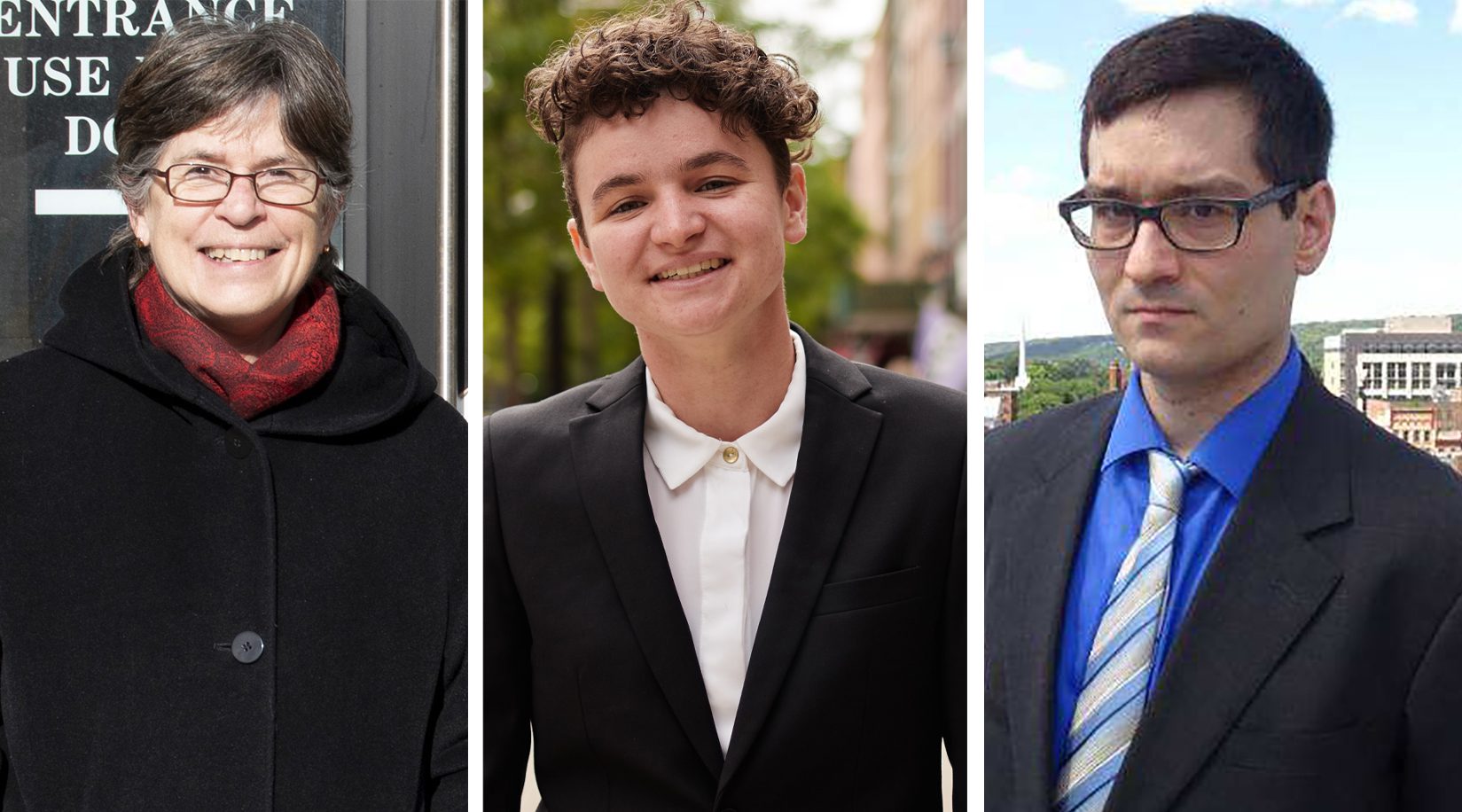
The general election is this month, with early voting running Oct. 29 through Nov. 6 and Election Day on Nov. 8 from 6 a.m. to 9 p.m. Among the races on the general election ballot for Ithacans is for city mayor, where the winner will fill out the term of former Mayor Svante Myrick, who resigned in January.
Tompkins Weekly asked the three candidates, Democrat Laura Lewis, Republican Zachary Winn and Progressive Katie Sims, a series of questions, which they all answered over email. Their answers are below.
Tompkins Weekly: Why are you running for city mayor?
Laura Lewis: I was elected in 2017 and re-elected in 2019 to represent the 5th Ward on Ithaca’s Common Council. I ran for Council initially to continue the community service efforts, particularly housing related, that I’ve supported for many years. As Acting Mayor, I have had the privilege of working with exceptional city staff and interacting with a wide range of constituents; I am dedicated to continuing this work.
Katie Sims: Ithaca is one of the most unequal cities in New York State, and it’s becoming harder and harder for workers and tenants to live in the city. We need a mayor who will put people before profit to stop skyrocketing rents and increase housing availability. As we’re facing climate change, we need to invest in our community, especially the people most affected by fossil fuels, as we transition to renewables quickly. I’m running to bring those priorities to City Hall.
Zachary Winn: Institutions that we have taken for granted are crumbling. On the current path, public services in Ithaca will cease to function. I do not have any confidence in the current leadership to address these issues. Ithaca is my home. I cannot stand idly by while it is destroyed.
TW: How would you distinguish yourself from your opponents?
LL: I have experience managing a student services office at Cornell University, I have been voted onto Common Council twice, I have chaired committees in the city (most notably the Boards of Ithaca Neighborhood Housing Services, TCAT, 5th Ward and City Democratic Committees), and I have developed and presented complex budgets.
KS: I’ve been working on progressive policy from outside of City Hall, and I have built relationships and developed priorities alongside community volunteers. As an organizer and activist, I plan to be a unifying community voice for progressive change in City Hall.
Stagnation has plagued our progressive goals in Ithaca, and I’m dedicated to following through on the commitments we’ve made and plans we’ve set out. As a democratic socialist, I am working toward an Ithaca where we all have a fair share of our city’s prosperity.
ZW: I have no ties to former mayor Svante Myrick. Acting mayor Laura Lewis is Myrick’s handpicked successor. Lewis has also been intimately involved in the Reimagining Public Safety initiative since its inception, voting for its passage, and working in various committees to implement the recommendations now known to be the product of a contaminated process.
Lewis has also worked consistently to stymie legitimate questions about the RPS process, and has engaged outside counsel at taxpayer expense to operate a “investigation” into RPS while her employee, the city attorney, refuses to cooperate with the county probe.
My other opponent, Katie Sims […] is also aligned with the Ithaca Democratic Socialists, an explicitly Marxist organization that uses violence, fear & intimidation to achieve their political ends. Sims has also personally participated in illegal roadblocks on Clinton street on more than one occasion this year. It is difficult to imagine Sims enforcing the law when she makes a habit of breaking it.
TW: What would you describe as your strengths and weaknesses as a public servant?
LL: My strengths include my demonstrated experience, a proven ability to collaborate with others in achieving stated goals, a willingness to listen and to seek input from others whether from city staff or constituents, a respect for the voices of others whose views may differ from my own, a sense of patience and persistence in the face of initiatives moving slower than desired.
One weakness is a desire to see results more quickly than is always possible. I am also more apt to encourage others to take time for themselves than to do so for myself.
KS: One of my major strengths is that I’m a collaborator. I work with other people to develop solutions, because I know that we have the best ideas when we combine lots of people’s experience and knowledge.
It could be considered a weakness that I haven’t served in elected office before. I’m confident my other leadership experience and the support of staff will orient me. And, as we’ve seen recent high-profile staff departures at City Hall, fresh leadership could be beneficial.
ZW: My greatest strength and weakness are that I am not an experienced politician. I come from the world of food service, where people’s needs must be met urgently, problems must be solved quickly, and results are the only measure of success. I am not afraid to get my hands dirty, be it picking up needles in the Jungle, deveining shrimp, or holding public officials to account.
TW: From your perspective, what are the most important issues going on in the city of Ithaca right now? And how do you plan to address them?
LL: a. The need for additional housing in the city, especially affordable units, and senior housing is a critical issue. We have a high percentage of renters in our city and tenants need to be assured of a safe and affordable place to live. Addressing the challenge of providing shelter and supportive services for unhoused members of our community is important and is related to other issues facing our city.
b. I am committed to implementation of the Ithaca Green New Deal, passed unanimously by Common Council in 2019. We are making strides on initiatives such as electrification of city buildings and vehicles in the city fleet, the development of a Climate Action Plan, and partnering with other municipalities on sustainable initiatives.
c. Reimagining public safety so all members of our community feel safe and respected is a priority issue. Our Ithaca Police Department is currently understaffed. We are committed to upholding our department’s high standards in recruiting and hiring the best officers possible. Developing a unit of unarmed responders is another top priority. Additionally, the city is working collaboratively with the county’s Community Justice Center on implementation of joint county-city recommendations.
KS: Housing has been an issue for a long time in Ithaca, and our elected officials have chosen to address it with luxury housing tax breaks. I want to take a different approach and pass protections for tenants and make zoning changes that will make it easier to build medium-sized housing.
Voters all over Ithaca are concerned about public safety, and we need to invest in the evidence-based solutions to reduce violence and crime: housing first, harm reduction and mental healthcare, and conflict mediation.
Now’s the time for Ithaca to follow through on its climate commitments, and we need to ramp up public engagement ASAP.
ZW: Public Safety & Crime are the #1 concern. Without police officers & the rule of law, society will cease to function. This phenomena can already be seen playing out in portions of the community.
Ithaca’s core institutions are crumbling. The police, fire department, ambulance service and public transportation system are hemorrhaging staff at an unsustainable rate. The root causes of personnel losses must be identified and addressed. Wages must keep pace with inflation.
TW: What would you like potential voters to know about you?
LL: I grew up in a single-parent household, the oldest of three. My family had limited financial resources, we were renters with mixed experience with landlords, and I have held a job since I was 16. I am the only member of my family to attend college, an opportunity made possible due to federal and state grant programs. Volunteerism has been a central value throughout my life. My two sons attended ICSD and Ithaca College.
KS: I’m running on the “Progressive” Ballot line. I’m a registered democrat, but I couldn’t run in the Democratic primary because I, like many Ithacan tenants, was dealing with housing instability. After months of campaigning for the Right to Renew Leases, a policy that would guarantee tenants in good standing a renewed lease, I received notice that my lease wouldn’t be renewed. After two months looking for an affordable apartment, I was able to sign a lease in May and begin petitioning to run for mayor.
Tenants face real barriers to stability in Ithaca, and we can’t keep waiting for the protections we deserve.
ZW: More than a year ago I started writing at IthacaCrime.com to better inform the public about the decline I was witnessing. I believe in empowering people with facts, and that understanding a problem is the first step to solving it. I set out to fill the void in local crime coverage, and I am seeking office to put solutions into effect.
TW: How do you plan to address the needs of different cultures, socioeconomic statuses, etc. that are in Ithaca?
LL: In order to address the needs within our city, I think it is most important to first listen to the lived experiences and to learn from others in forming my perspective on various issues. Constantly educating myself while looking for equitable and inclusive solutions is an approach I practice in all that I do. I have built partnerships with those who have relevant expertise on an issue, as well as considering grant funding opportunities to support our residents.
KS: As a tenant organizer, I’ve worked extensively with tenants of lots of different backgrounds in Ithaca. One of my key principles in this work is that people know best what they need. I trust people to understand the issues they’re facing and explain what would make them better, so I seek input and see my role as a public servant to follow through on the expressed needs of people.
ZW: I believe a rising tide lifts all boats. I will govern with the best interest of all citizens, as individuals, in mind. This means a safe community, where business can flourish, jobs are plentiful, and the cost of living affordable.
Making this possible requires addressing the fundamental inequities that affect every private individual in Ithaca. These inequities are primarily financial in nature, and do not discriminate based on race or gender identity. I will not favor an approach of catering to the desires and demands of individual groups and subsets of people.
TW: How are you best suited to address the economic and social impacts of COVID-19?
LL: In my 2023 city budget, I have prioritized supporting city staff who have experienced the most challenging three years in our history due largely to the pandemic. Our community is not unique in this regard; however, I believe we need to invest in our staff who provide services to the public who live, work, study, and visit our community.
KS: Pandemic emergency programs have been the largest investment in social good in recent memory. And they confirmed what progressives have been saying: public health investments, stopping evictions, direct payments, and more outdoor space are good for our communities. As a Working Families Party candidate, these are exactly the kinds of policies that we’ve been calling for long-term, and investing in public goods is the best way to continue our economic and social recovery.
And as we continue to live with a new virus, we have to improve ventilation standards, continue providing hybrid options, and encourage high-quality masks in indoor spaces.
ZW: Ithaca’s small businesses, restaurants & bars were devastated by COVID-19. Closures continue. While Ithaca became a bedroom community for remote work, many service workers fled the area’s high rents, never to return.
The city must do everything within its power to incentivize new businesses to open and allow existing businesses to flourish. With TC3 defaulting on its bonds & a labor shortage hampering recovery, affordable housing for workers could be found in the largely vacant TC3 dorms.
By augmenting the existing TCAT service, housing exclusively for people in the labor pool could be created. An inexpensive place to live and an hour round trip commute would make working in Ithaca a viable option for many more people. To do this will require coordinating many different institutions with radically different cultures. I will bring people together to find solutions and be a Mayor for everyone.
Related Articles
Street Beat: What are you looking forward to in the new year?
We asked five random people. Here’s what they had to say.

5 things to do in Tompkins County this weekend
Plan your visit and discover what’s happening this weekend.