
Tompkins Build offers new pathways to construction careers
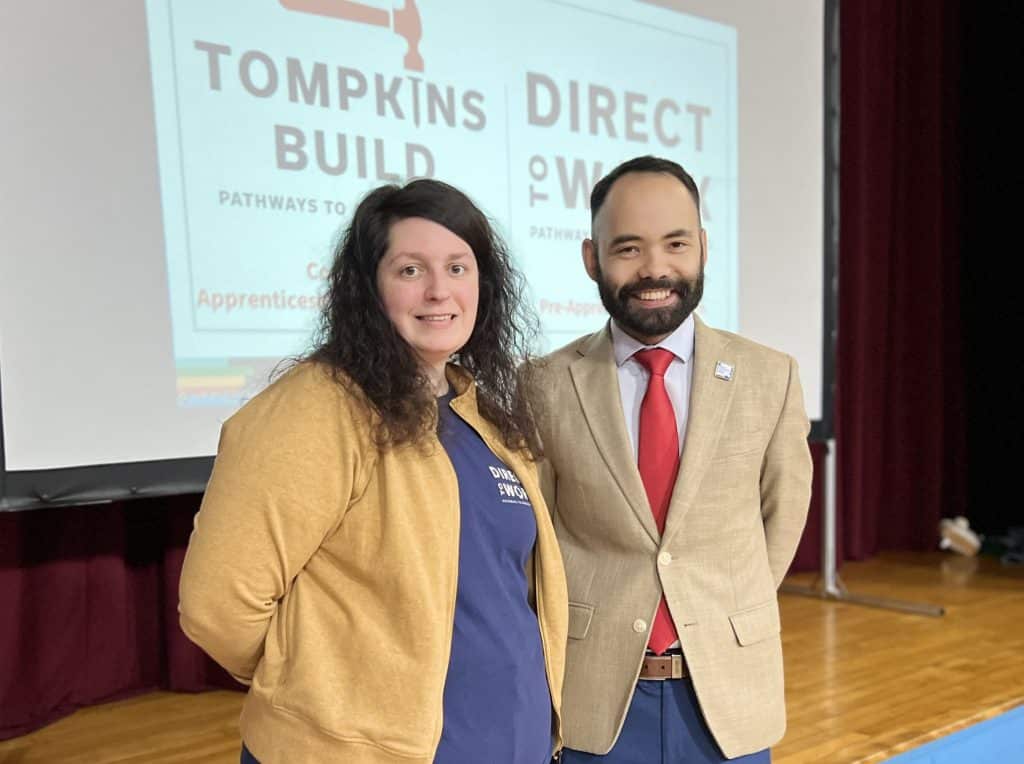
Danielle Szabo, director of Workforce Innovation at Ithaca Area Economic Development (left) and Christopher Sponn, executive director of Tompkins County Workforce Development, at the first of many presentations that Szabo will be making throughout the county in an effort to attract new recruits to the Tompkins Build – Pathways to Apprenticeship program.
Those graduating from high school or looking to switch up their career have a brand new entry into the construction trade, thanks to Tompkins Build — Pathways to Apprenticeship, a new program that aims to equip individuals with the resources, training and confidence to launch successful careers in the construction industry.

“The basic candidate likes physical work, has a positive attitude and wants to learn. Those are the types of candidates that we’re looking for,” said Danielle Szabo, director of Workforce Innovation at Ithaca Area Economic Development (IAED). The IAED partnered with the Tompkins Cortland Building Trades Council to create an opportunity to explore unionized career paths.
For many participants, the program can launch a lucrative career without the need for a college education. Graduates of Tompkins Build can expect to make between $18 and $19 their first year; for some trades like electrical, that first-year pay is closer to $21 or $22 an hour. Not only do participants start off without college debt, but they earn an hourly wage during all of their training, as well.
And the construction trade comes with a sense of job security that many other fields cannot offer.
“You can’t outsource the building trades,” said Todd Bruer, business manager for IBEW Local 241, the local electricians’ union, and president of the Tompkins Cortland Building Trades Council.
Szabo has been with the IAED for three years. She said that with the announcement of the Micron plant in Syracuse, anticipated to create an estimated 40,000 construction jobs, workers in the union trades are more highly sought after than ever in the upstate New York region.
Local opportunities abound as well. SouthWorks in Ithaca aims to repurpose a historic industrial manufacturing site into a destination neighborhood with close to two million square feet of innovation, commercial, maker, residential, public and outdoor space.
“And all of these require a pretty large construction phase and tens of thousands of construction workers, and unions have kind of been preparing how they’re going to respond,” Szabo said.
“A lot of times, unions — they end up paying big money to get people to come from out of state, and we want to make sure we have that talent here, instead of having to bring people in from other areas,” said Christopher Sponn, executive director of Tompkins County Workforce Development.
The question is how to get more people in the pipeline to build up the local pool of qualified construction workers, Szabo said.
Bruer said that his line of work faces an upcoming shortage of employees due to the Baby Boomer and Gen X generations looking at retirement in the near future.
“You’ve got to refill those jobs,” he said, adding that his industry is not unique in this regard.
“We’re all fighting over the same pool of workers, and to get people to work in the trades instead of a traditional job, it really takes a commitment to do that,” Bruer said.
Having seen the Tompkins Build program do well in Syracuse, Szabo hopes its success can be replicated in Tompkins County.
The 11-week paid training program pays hourly minimum wage and offers a comprehensive blend of hands-on experience, classroom learning and direct engagement with local unions. Participants gain foundational skills, earn industry-recognized certifications and build valuable connections within the construction trades.
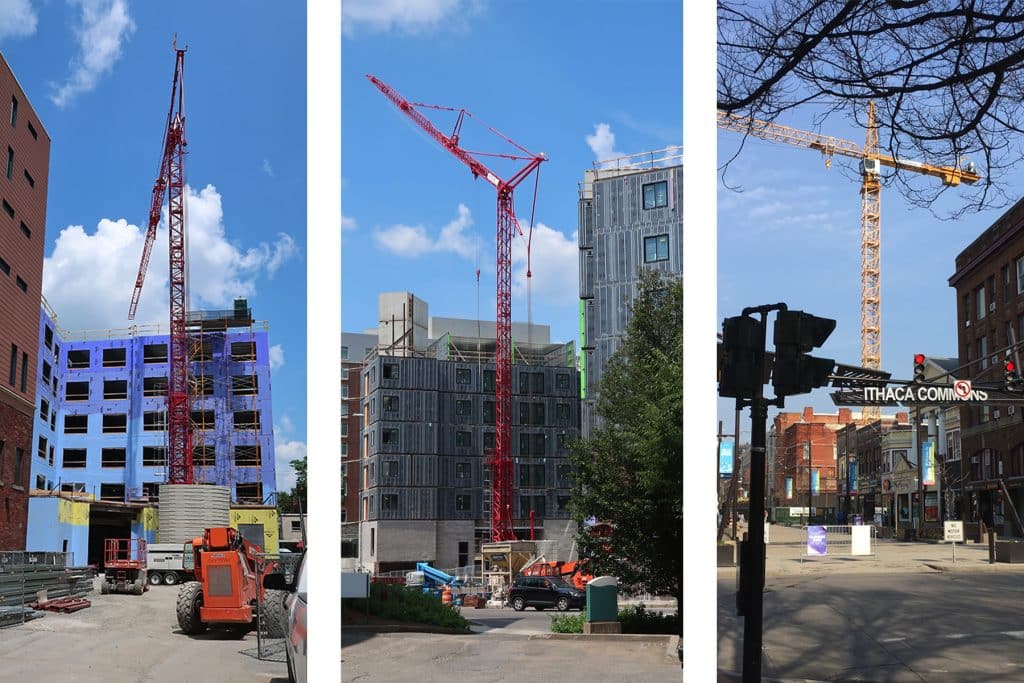
Construction cranes in Downtown Ithaca.
The program runs from March 31 to June 12, Monday through Thursday, from 3 to 8 p.m. at the UA Local 81 Training Center, 701 W. State St., Ithaca.
“Essentially, this [program] is a vetting process for people that are really serious, because if you can’t even commit to 11 weeks full time, how do you think you’re going to commit to a full-time apprenticeship that is full time out in the field?” Szabo said.
Instruction is delivered by active union members, providing participants with insights and mentorship directly from professionals in the field. A professional from the electricians’ union will give basic instruction on their area of expertise, for example, and in another session a welder will introduce the students to their trade.
“It’s hands-on exploration for them,” Szabo said. “Those projects really showcase what the trade really does.”
There is exposure to the actual work, including visiting some active job sites. Some people may not realize how physically demanding some of the construction trades are, or they may think they would be okay with working in inclement weather, but through the training they realize they are more suited to indoor work.
“If someone doesn’t like the weather and working in the elements but always liked painting and is detail oriented, there is still a place for you,” Szabo said. “Painters and glaziers work in a temperature-controlled environment. A whole part of the program is matchmaking, and figuring out what they like and don’t like.”
Graduates leave with a multicraft core curriculum (MC3) certification, which is a nationally recognized credential providing a comprehensive introduction to careers in the construction industry; an OSHA-10 certification, which is training that equips participants with essential knowledge about workplace safety and hazard prevention in construction settings; and first aid/CPR certification.
The program started 20 years ago in San Francisco. It was called City Build and led to 209 Build programs throughout the country.
From veterans to new high school graduates to those looking to start their second or third career, people of all ages, races, genders and socioeconomic backgrounds are encouraged to sign up, including those who have a criminal background.
Almost 50% of participants in Direct to Work-Pathways to Manufacturing have had to overcome some sort of legal barrier, so there are inclusive initiatives to try to mitigate those barriers before such individuals enter the program. The program offers free legal services through LawNY, and many criminal records can be sealed or expunged, or the individual can obtain a certificate of rehabilitation, at no cost to them.
Two of the instructors for the upcoming cohort are female foremen. “We wanted to empower more women to come through the initiative,” Szabo said. “Women may have heard about how tough the worksite can be, or the intimidation, or that their work is not comparable to what men can do. At these locals that I work with, they are like family. The women I talked to felt so supported from the beginning. … It has opened up and created dialogues around diversity and awareness.”
Bruer said that he feels very lucky to have a diverse group of people in his union. One older military veteran works well alongside younger members, some of whom are 18 and 19 years old. “They look at him as a true leader,” Bruer said.
A major part of the program is the inclusion of marginalized individuals, and the program’s facilitators try to think of everything that could be a potential hindrance to success in order to address potential problems and eliminate roadblocks once the graduates start their first apprenticeships.
“With the training being really hands-on, we wanted to make sure people were equipped for that, so they all receive a student tool kit,” she added. That kit includes items like steel-toed boots, a hard hat, a tool belt and tools.
The program also trains its students in life skills such as interview readiness — an important factor for entering the construction trades, because most union jobs require a panel interview.
The program is being instituted in Tompkins County after the county launched a manufacturing counterpart, Direct to Work — Pathways to Manufacturing, several years ago. Sponn has been a strategic partner for both the Tompkins Build and the Direct to Work initiatives.
“The manufacturing program has been a huge success,” Sponn said. “Over the last two or three years, they’ve done a really good job filtering candidates and making sure they’re the right fit. We are really servicing the businesses and looking at how we can be better for the next cohort, and we do see that employers are happy with the program. We’re really here to make their life easier, too.”
“The whole program is an industry partnership model built on that relationship,” Sponn added. “If you give them candidates who aren’t prepared, the whole program collapses.”
The manufacturing program helped Demetrius Cox, of Ithaca, find his niche as a computer numerical control (CNC) machine operator at Stork H&E in Ithaca.
“I think Direct to Work can help out a lot of individuals and help people learn new skills and find certain jobs they’re looking for,” said Cox, a former Walmart employee who transitioned to gig economy work and was a Doordash and Instacart driver when he entered Direct to Work in 2023. He has been working at Stork ever since and will have been there two years in July.

Demetrius Cox uses a virtual reality headset during his training in the Direct to Work program.
Cox said that Direct to Work taught him how to identify and use many tools, skills he can take with him throughout his life, but that the people are the best part of his new job.
“Everyone is really nice and helpful,” he said. “I have a lot of new friends now, so that’s really nice. Really great, actually. … At my workplace, everybody is respectful, and they look at your integrity. If I were to make a mistake, I think they would kind of see that I was working hard, and they would just tell me to try it again.”
He also appreciates the job’s benefits, such as weekends off with the opportunity to make overtime pay on Saturdays and Sundays and double time on holidays.
Matt Nesbitt, business manager for Ironworkers Local 60, said that the Syracuse version of Tompkins Build has been very valuable.
Out of the seven cohorts that have graduated from Syracuse Build, his union has hired around a dozen new employees from the program. “What we’re seen from the ones we’ve taken in is that they apply themselves and they do very well,” he said. “We’re very excited to help launch the one down in Ithaca. We’re going to continue to support [the programs] wherever they decide to spring up.”
Being an ironworker can be a very exciting job for the right kind of person, Nesbitt said.
“We’re best known for erecting steel beams,” he said. “We’re the daring guys who hang on the side of the building, putting in the beams as they are being lifted by the crane.”
His union workers helped construct the new Computing and Information Science building at Cornell University. One of their biggest recent projects was the JMA Wireless Dome (formerly the Carrier Dome) in Syracuse.
“We constructed pretty much the whole roof system that’s on the dome now,” Nesbitt said. “That’s one of the more monumental projects we did.”
Sponn said that both the manufacturing and the construction programs give exposure to career paths that were often overlooked or even discouraged among the more recent generations of high school students.
“A lot of times, kids growing up and going through high school did not have a shop class anymore, so there was no shop teacher explaining all the different types of unions there are — carpenter, plumber, so many different things — and there’s never really a time to discuss those things. … I think it’s just not elevated, not given a fair shake.”
“For people who never thought about [construction] as a career and didn’t have family members in the trades,” Bruer said, “it’s a brand-new opportunity for them, really.”
For more information, reach out to Danielle Szabo at danielles@ithacaareaed.org or 607-273-0005.
CORRECTION: The original version of this story contained an error. It has been changed to reflect the correct information: Almost 50% of participants in Direct to Work-Pathways to Manufacturing have had to overcome some sort of legal barrier. Tompkins Weekly regrets the error.
Author

Related Articles

Holiday traditions bring community cheer
Tompkins County holiday traditions light up homes, farms, and schools with festive cheer and community spirit.
The gift of an experience: Local businesses offer hands-on holiday fun
Holiday experience gifts in Tompkins County include candle making, gourd crafts, and pottery workshops for creative seasonal fun.
Code Blue shelter opens amid praise, concerns and ongoing debate
Ithaca’s Code Blue shelter opens with larger space, showers, and case management to help residents during cold weather.