
Tompkins County 2024 year in review
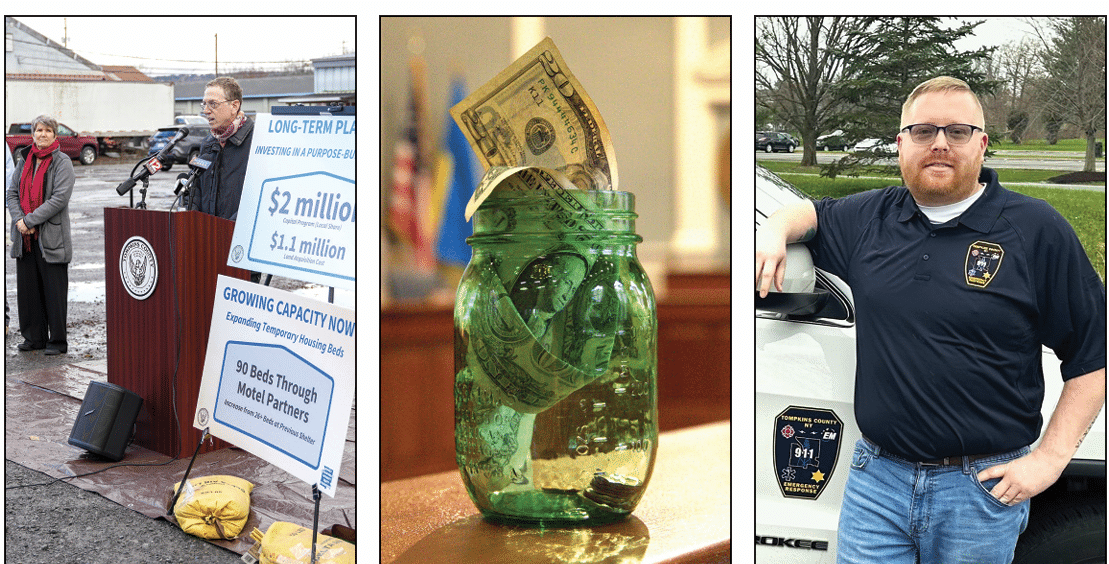
From left to right: Legislature Chair Daniel Klein speaks a recent press conference to announce the county’s purchase of land on Cherry Street in Ithaca for the purpose of constructing a 100-bed homeless shelter while County Administrator Lisa Holmes looks on, the legislature passed a resolution committing the county to the exploration of establishing a local wage and allocated $50,000 to the study of the issue, and Joe Milliman, Tompkins County EMS program manager, stands next to one of the county’s rapid medical response units. Photos left and right provided. Middle photo by Jaime Cone Hughes
By Jaime Cone Hughes
From minimum wage to emergency medical services, this past year saw the county tackle some challenging and complex issues. Below is a look back at some of the biggest news stories to come out of Tompkins County in 2024 – and a glimpse of what’s to come in 2025.
Grappling with local homelessness
“When you ask people, ‘What’s on your mind politically, or what the biggest issues are in our area, homelessness is what people talk about,” said Daniel Klein, Tompkins County Legislature chair. “It’s what impacts them the most.”

Managing editor
This past year, the county’s only permanent shelter closed after St. John’s Community Services informed the county in October that starting in November it would no longer be running the facility. In response, the county contracted with a local hotel to provide rooms for unhoused individuals.
“Like all the municipalities, we’re dealing with it the best we can,” Klein said of the homelessness issue. “It is the most difficult issue, in my opinion, because no one really knows what to do. It’s obvious we need more housing, but that’s easier said than done. And then, when we find the housing, we find that it doesn’t solve everything we thought it would. When you look at the issues at Asteri or Arthaus, it’s not as easy to solve as everyone thought it was. It doesn’t solve all the problems. It creates some new problems, and it’s clear this issue is more than just about providing four walls and a roof.”
The county is charged with providing both long-term shelter and Code Blue shelter, which is an immediate-access emergency shelter during the cold winter months.
In the past, rooms at the Econo Lodge across from the Cayuga Shopping Mall off Triphammer Road served as Code Blue shelter for those in need, but when the Econo Lodge went into bankruptcy, county officials decided to repurpose a county-owned former bank, located at 300 N. Tioga St. in Ithaca, as a temporary solution for 2024-2025. The county plans to tear down the former bank in order to build a new Tompkins County Center of Government.
A new 100-bed homeless shelter will be constructed on property on Cherry Street that was recently purchased by the county.
“It’s worth pointing out that we spend all this time on shelters, and every once in a while someone reminds us this is just a little piece of the puzzle,” Klein said. “But it is a critical piece, and the piece we’ve been specifically tasked with.”
The county has hired a consultant for the new permanent shelter on Cherry Street, and Klein said that he is confident that the planning stages of the project will progress in 2025.
“A lot of pieces of it are in place, so hopefully it will all come together and move the project forward significantly,” Klein said.
Raising the minimum wage?
In 2024, there was discussion of raising Tompkins County’s minimum wage to an amount that is higher than the current statewide minimum wage of $15 an hour. While there was much debate about how much the wage would be raised and potential unintended consequences, in August the legislature passed a resolution committing the county to the exploration of establishing a local wage and allocated $50,000 to the study of the issue.
“There are people interested in moving this forward,” Klein said. “We set aside $50,000, but what we did not agree to do is to put that on a timeline. … We didn’t actually authorize the money to be spent yet, and there is a chance there will be enough hesitation in people’s minds that it is possible the study won’t even happen.”
“I think we will look to hire a consultant to see what it would mean to have a county living wage, and I also know there’s quite a few people in our community who don’t think this is a good idea,” Klein added. “We are far from a consensus.”
In early 2024, the Massachusetts Institute of Technology found that the living wage in Tompkins County has increased to $24.64, a number that Ian Greer, research professor at Cornell University and director of the ILR Co-Lab, said will likely align with the ILR School’s new calculation, which it will release in early 2025.
“That’s a very sobering number,” Klein said. “If [the difference] was 50 cents an hour, it would be easier to visualize a county living wage, but that’s like a 25% increase … It’s going to be a very interesting exploration.”
County welcomes new administrator
In October it was announced that Lisa Holmes will retire from her position as Tompkins County administrator at the end of January, with Korsah Akumfi starting in the role.
Collaboration is key, said Akumfi, current Schoharie County administrator. He said that for years he has viewed Tompkins County as a positive example. “I look up to the county,” he said. “The efficiency and effectiveness of it, some of the programs they have been able to build over time.”
“I am excited about the new county administrator,” Klein said. “I know he’s coming in with a lot of enthusiasm. This is a big step for him, and he’s going to hit the ground running.”
“He has been in another county in New York state, so that’s a great training ground,” Klein added. “There is a lot of structure that is similar, and state mandates are the same. He knows the language and the job, and the challenge will just be to get to know Tompkins County — the cast of characters and relationships are very important in any work … and that’s the part that’s going to take some time for him.”
“I think it’s going to take a while before he makes the county his own,” Klein said. “He will eventually bring it around to the direction he’s pursuing, but that’s going to take a while.”
Holmes is retiring after being employed with the county for 26 years.
“I have been fortunate to grow my career within the same organization,” Holmes said. “I don’t know how often that happens anymore. I have been fortunate to continue to learn and grow: first as a planner, then director for the Office for the Aging, then moving on to work in county administration.”
Implementing Tompkins County Rapid Medical Response program
A new fleet of three SUVs that provide emergency services to the most underserved parts of the county went into service April 2, and Klein said that so far they have done exactly what they were supposed to do — reduce wait time for those in need of emergency medical attention.
“It took a long time to build momentum,” Klein said. “For these really big problems, it takes a lot of money.” Issues have to reach a critical mass before solutions take off, he said, and “EMS reached that point last year.”
Klein said that he is unsure whether or not the program will expand in the future, as it is hard to predict what might happen in terms of state mandates when it comes to EMS. “We have to wait to see what the state does in its budget process,” Klein said.
He added that in 2025 there will likely be more discussion about a countywide ambulance tax, an initiative that he said is currently being pushed by the Tompkins County Council of Governments. There are a number of different ways the tax could be implemented.
“They want us to start planning for it,” Klein said.
Broadband for the whole county?
“Broadband — for me and my constituents — it is the thing I hear about the most, on average once a week,” Klein said. Currently, about 1,000 addresses throughout the county are without high-speed broadband. “It was 1,200 when we did the study, which was less than a year ago,” Klein said. “For the majority of people who have internet, they don’t think about it, but if you don’t have it, you think about it a lot.”
“So I’m hoping 2025 finally solves the problem,” Klein said.
The county submitted a grant request to New York state last spring, and Klein said that he is hopeful the county will hear back from the state soon. The grant would provide a buildout for every unserved residence, minus Dryden and Caroline, which are currently building out their own municipal broadband network.
“If we get the full grant, [construction] will start very quickly,” Klein said. “It might take a few years to reach every single house, but it will accomplish its goal.”
Author

Related Articles
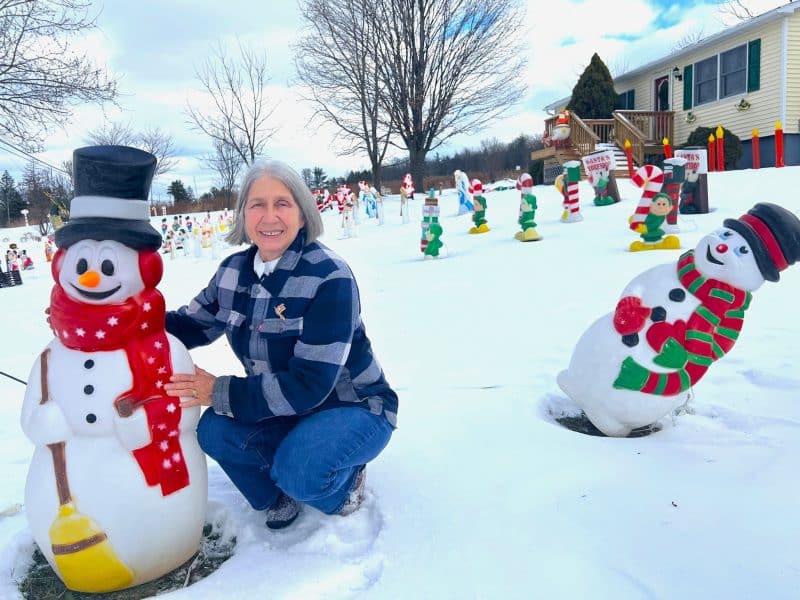
Holiday traditions bring community cheer
Tompkins County holiday traditions light up homes, farms, and schools with festive cheer and community spirit.
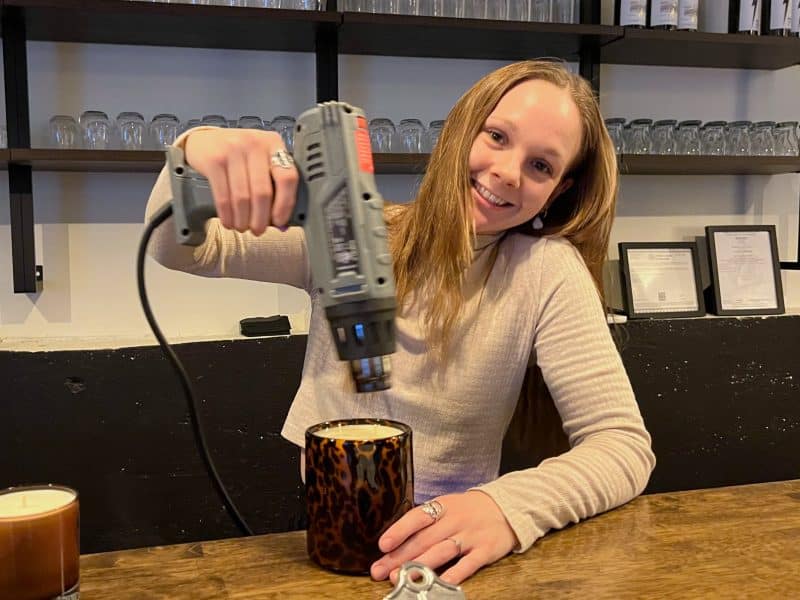
The gift of an experience: Local businesses offer hands-on holiday fun
Holiday experience gifts in Tompkins County include candle making, gourd crafts, and pottery workshops for creative seasonal fun.
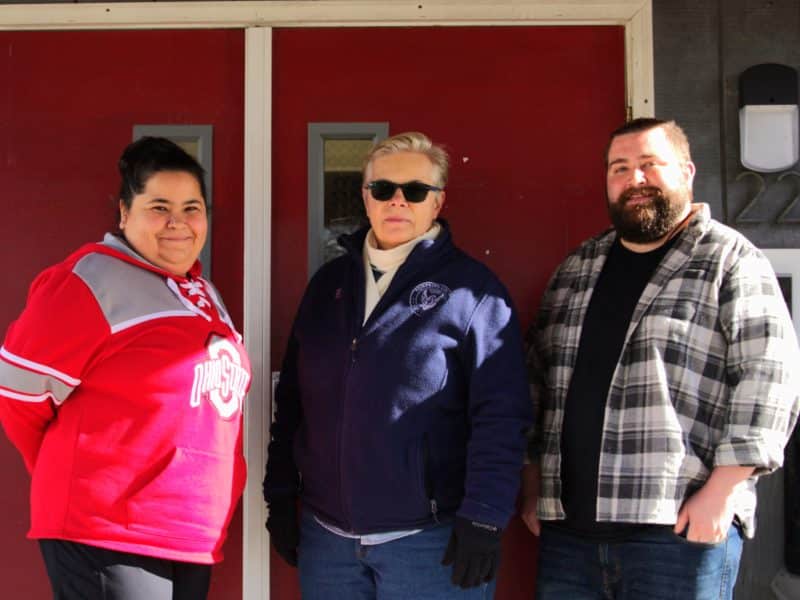
Code Blue shelter opens amid praise, concerns and ongoing debate
Ithaca’s Code Blue shelter opens with larger space, showers, and case management to help residents during cold weather.