Affordable housing hiding in plain sight
Tompkins County Housing tackles affordability with MHCs. Explore solutions for 298 vacant pads in 2025!
Editor’s note: The opinions expressed in this guest opinion are those of author Charles Geisler and are not representative of the thoughts or opinions of Tompkins Weekly.
The most affordable form of single-family housing in Tompkins County is manufactured homes. Manufactured homes cost roughly half of what site-built homes sell for on a square-foot basis. Why aren’t we using them to solve our affordable housing bind?

Across Tompkins County’s 44 manufactured home communities (MHCs), there are currently 246 vacant pads. Those pads are on lots owned by the MHC proprietor. In addition, there are vacant manufactured homes on other pads, for assorted reasons. For example, few departing residents can afford the hefty $3,500-$18,000 moving fee when they leave, so when they exit, they abandon their manufactured home.
In Tompkins County, there are 1722 manufactured homes in MHCs. From walk-throughs, I estimate that 3% of these are vacant. Added to the 246 vacant pads, that’s 298 vacancies. The County’s Housing Strategy has a target of 900 new or rehabilitated single-family units priced below $199,000 by 2026. The nearly 300 MHC vacancies just noted could go a long way to realizing this target for our most cost-burdened population.
But filling MHC vacancies requires real dedication. In Tompkins County, the majority of MHCs are now investor-owned. The vacancies that might have helped Tompkins County meet its 2026 Housing Strategy for low-and-moderate-income people are probably not on the investor-owner agendas. Their websites emphasize “affordability” needs, but for more affluent people less likely to be on fixed incomes or having special needs, that is, the 900 people the County is most concerned about.
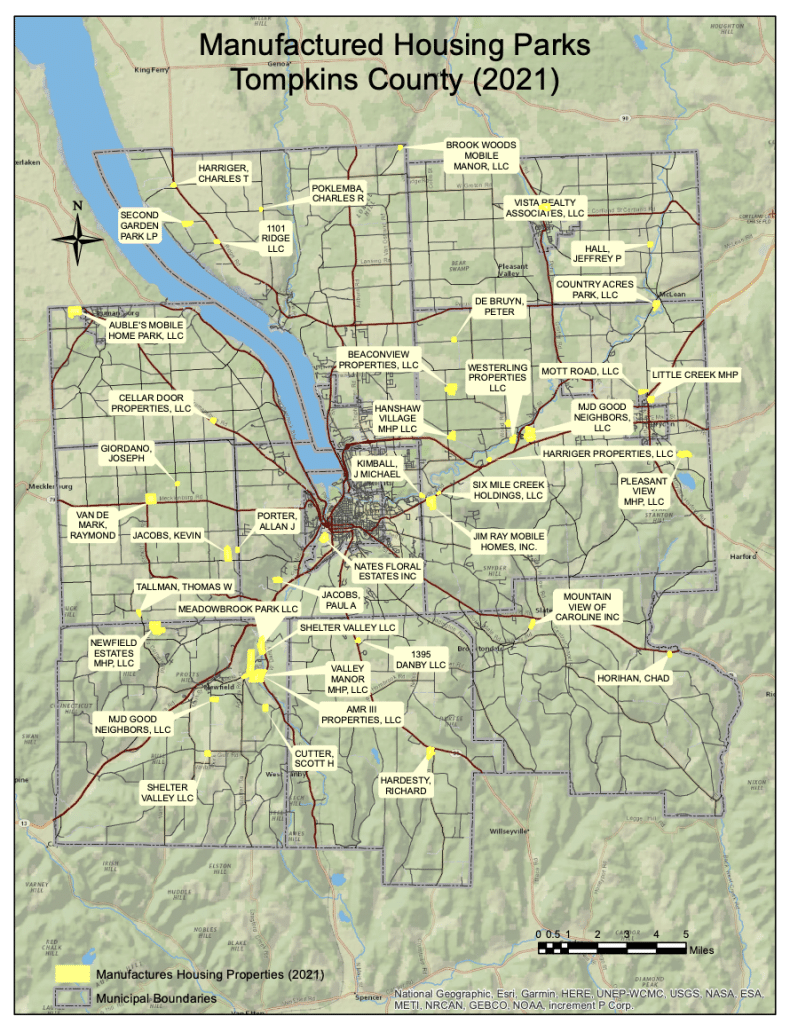
Across Tompkins County’s 44 manufactured home communities (MHCs), there are currently 246 vacant pads.
Tompkins County can be proactive in the breach. In 2009 the Community Housing Development Fund (CHDF) — a partnership between Tompkins County, the City of Ithaca, and Cornell University – was established. CHDF projects include the housing needs of financially burdened households and ways to mitigate costs affecting them. Its partners pledge financial support and receive funds from developers under the Tompkins County Industrial Development Agency.
CHDF could invite proposals from MHC owners genuinely interested in turning vacancies into viable living units. This is consistent with CHDF’s commitment to provide funding “for rehab and construction activity that creates new housing units affordable to low- and moderate-income households.” Such units certainly extend to manufactured housing.
Alternatively, CHDF could fund a new MHC model, finding open space and populating it with affordable manufactured homes. In 2025, CHDF announced that its funds were eligible for the purchase of land or buildings or any other development costs that would reduce the overall cost of housing units, provided they are permanently affordable (community housing trusts or land trusts are encouraged). Cornell University, a CHDF partner, owns approximately 4% of Tompkins County, some of which could be a homestead for this model. A small corner of Cornell land could be sold or leased. Once built, the model would be a boon to cost-burdened families as well as to a large number of Cornell employees currently commuting outside of Tompkins County to find affordable housing.
Affordable housing needs our best thinking. Let’s make MHCs a natural ally and, in making them permanently affordable, we’d bid farewell to the vacancy predicament.
Charles Geisler is an emeritus sociologist from Cornell University and is a member of the Manufactured Housing Working Group of Tompkins County.
Author