
Affordability, housing and living wage take center stage at county legislature candidate forum
Tompkins County legislature candidates debate affordability, housing, and living wage proposals ahead of Nov. 4 election.
Legislature seats to represent towns of Ithaca, Lansing and Dryden are competitive
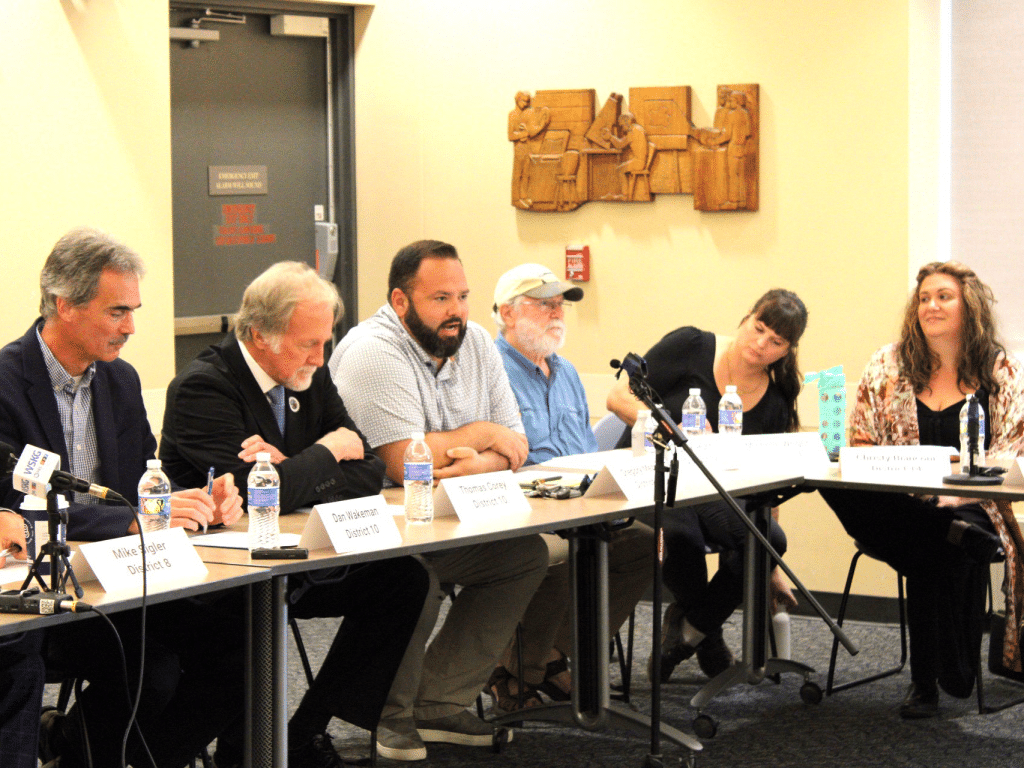
From left to right: Tompkins County Legislature candidates Mike Sigler, Dan Wakeman, Thomas Corey, Greg Mezey, John Hunt, Michelle Wright and Christy Bianconi at a forum focused on affordability issues.
Candidates running for a seat on the Tompkins County Legislature gathered at a forum last week to address affordability concerns in the county, detailing proposals around implementing a living wage, building affordable housing and attracting new industries to bring additional jobs and revenue to the region.
The legislature will see major changes next year as at least half of its members will be new legislators, who each serve four-year terms, and two new legislative districts will be added based on the 2020 Census. Only three of the 16 races appear competitive heading into the general election on Nov. 4.
The two-hour forum, which took place on Sept. 29 at the Tompkins County Public Library, was jointly presented by the Community Foundation of Tompkins County, the Ithaca Board of Realtors and the Tompkins Chamber.
Bolstering revenue without raising property taxes
The first question candidates addressed was how they planned to generate tax revenue for the county without increasing property taxes.
The county has frozen property assessments on most homes until 2028 to help create consistency in homeowners’ property tax bills amid declining home sales in the county. Last year, the average assessed value of a single-family home in the county increased by 26.7%, or $53,388, with that number ballooning to 75.4% over the past decade, according to reporting by the Ithaca Times.
Christy Bianconi, the Democratic candidate running to represent part of the town of Ithaca in District 14, said that she’s seen her property taxes increase by more than 20% over the past five years.
“I know it’s hurting me,” Bianconi said. “It’s hurting renters. It’s hurting seniors. It’s hurting everyone in our community, and I think we can all agree that this is not sustainable.”
Bianconi said that she would help raise revenue without burdening property owners by finding ways to generate more in sales taxes. She said the county welcomes about 35,000 college students every year and suggested creating a student discount card for them to shop at local businesses, as well as launching a restaurant week that encourages tourists and community members to explore the area’s culinary offerings, a move adopted by cities like Binghamton.
Michelle Wright, an independent candidate running against Bianconi in District 14, said that she wanted to research and amend policies that disproportionately benefit wealthy individuals in the county, such as raising fees associated with private jet usage at the Ithaca Tompkins International Airport.
Wright also said she wanted to “acknowledge that our taxpayer dollars at the federal level are being used to fund a U.S. war machine, including the genocide in Palestine. If we lived in a country where our federal government cared about people over profit by using taxpayer dollars to support the people most in need, this question might not even need to be a priority today.”
Tompkins County Legislator Shawna Black, a Democrat who’s running unopposed to represent Northeast Ithaca in District 6, said that the county needs to diversify its economy.
“Year after year, we’ve put all of our cards in academia as well as tourism,” Black said, noting that Cornell University is the largest employer in the county.
In August, leaders of the Ivy League school issued a letter saying that they would continue budget cuts, layoffs and a hiring freeze into the academic year due to “acute fiscal pressure” from the federal government. The Trump administration froze $1 billion in funding to the university, according to an April report by The New York Times.
Black, who has served on the legislature since 2018, including two years as its chair, said that the county should reach out to companies in the tech and industrial sectors to boost economic development and job growth. She also said that deep federal cuts to Medicaid and the Supplemental Nutrition Assistance Program (SNAP) will require the county to pay more toward those services, and she anticipated that legislators might have to dip into the county’s “rainy day” fund of about $40 million to do so.
“It doesn’t matter if you’re a Republican or a Democrat,” Black said. “We’re all trying to do the same things up here. We’re trying to have safe schools, safe communities, good social services — and I think that’s the thing we really try and focus on.”
Democratic candidate Adam Vinson, a recent Cornell graduate who is running unopposed to represent Ithaca’s Collegetown in District 4, said that he supports efforts to bolster the city’s nightlife to bring in more sales taxes. He suggested allowing bars to stay open an hour later until 2 a.m. — a proposal known as “Tompkins Til 2” — and expressed general support for a measure the county has considered to evict unlicensed cannabis shops to increase business at licensed dispensaries.
Vinson, who pledged to strengthen communication between the legislature and the county’s college students, would be the body’s youngest member at the age of 22 if elected.
After initially choosing not to run for re-election, Tompkins County Legislator Deborah Dawson announced a write-in campaign to represent parts of the towns of Lansing and Ithaca in District 7. The Democratic nominee in the race, John Dennis, will still appear on the ballot despite suspending his campaign and endorsing Dawson shortly after her announcement.
Dawson said one reason local property taxes are high is because homeowners are “subsidizing” Cornell, which owns more than 40% of the county’s property value but doesn’t contribute annual funding to the county due to its tax-exempt status under state law. The school pays $4 million to the city of Ithaca and $425,000 to the town of Ithaca, both on a voluntary basis.
“Tompkins County should lead an effort to get the state to reconsider that law,” Dawson said, a sentiment many other candidates echoed. “[On-campus] bookstores, dining halls, dormitories and on-campus hotels should be subject to property tax, just like our off-campus stores, hotels and restaurants. Meanwhile, we need to try to get Cornell to the table to negotiate.”
Dawson, who has served on the legislature since 2018, added that she would assist municipalities in obtaining grants to develop their downtown and shopping centers to boost tourism and the county economy.
Balancing a living wage
The second question candidates addressed was how they would balance implementing a countywide living wage for employees and employers.
The living wage for a county resident working full time is $51,000 a year, or $24.82 an hour, according to a study released in March by Cornell’s School of Industrial and Labor Relations. This was an increase of more than 30% from the previous county living wage calculated in 2023, the last time the study was completed. The state minimum wage is currently $15.50.
Nearly half of all workers in the county earn less than the newly calculated living wage, with Black residents disproportionately living under this threshold, according to the study.
The legislature voted in July to fund a study on the feasibility and impacts of instituting a countywide minimum wage, a measure sponsored by county Legislator Veronica Pillar, a Democrat running for re-election to represent part of the city of Ithaca in District 2.
“I believe that everyone getting paid at least a living wage is the correct world to strive for, and I think it’s an ethical thing,” Pillar said.
Rachel Ostlund, a Democrat running unopposed to represent the towns of Ulysses and Enfield in District 16, said implementing a living wage “could be a really exciting opportunity” for the county, specifically to promote worker productivity and retention.
Ostlund, who is a small business owner, said that the legislature can begin by requiring the area’s largest employers to pay a living wage, as well as any company that receives financial assistance or contracts from the county. She added that the county can then provide financial guidance to small businesses to help them absorb the cost of implementation over time.
However, county Legislator Travis Brooks, a Democrat running for his second term to represent part of the city of Ithaca in District 1, said that raising the minimum wage won’t address underlying affordability issues in the county.
“At what point in time are we paying people $30 an hour?” Brooks said. “Businesses can’t do that. That cost is passed down to the consumer.”
While workers may bring home more income, Brooks added that the new living wage may hurt some residents in the long run by making them ineligible for public assistance programs like SNAP, Medicaid and Section 8 housing.
Thomas Corey, an independent candidate running to represent part of the town of Dryden in District 10, described a countywide minimum wage as a “foolish performative act” that would hurt small businesses, nonprofits and nursing homes that are primarily supported by Medicaid.
Corey, who said that more county dollars should go toward municipal police departments than major projects like the controversial $50 million Center of Government office building, added that he would offer an alternative for residents who feel like they “don’t have a voice” in largely Democratic county politics.
Democratic candidate Dan Wakeman, a member of the village of Dryden’s board of trustees who’s running against Corey in District 10, agreed that implementing a county minimum wage would not adequately address the high cost of living.
Wakeman said that creating more job-training programs would go further to give residents the skills they need to advance in the workforce. He cited the SUNY Reconnect program as an important elevator. The program provides free enrollment for associate degree programs — including computer science, construction, nursing and sustainable farming — and has been credited for helping Tompkins Cortland Community College’s enrollment reach its highest numbers in over a decade.
Legislator Greg Mezey, a Democrat running unopposed to represent part of the town of Dryden in District 11, said that raising the minimum wage is a state issue and that the county could invite a lengthy court battle if it went through with implementing a new minimum wage.
Mezey, a small business owner with 11 employees, agreed that job-training programs, such as Tompkins Build, are vital to addressing affordability because “not every job is a $24-an-hour job.”
“I know that’s hard for people to hear, but that’s the reality of it,” he said. “So we need to be giving people skills so they can advance themselves and employers will take the responsibility to do what’s best for their organization.”
Promoting development and collaboration
Several candidates discussed their plans to promote more business development and affordable housing projects as well as stronger collaboration between the county and municipal governments.
Tompkins County Legislator Mike Sigler, a Republican seeking to continue representing the town of Lansing in District 8, said he would encourage more development with “ready-made sites” by investing in water, sewer and road work to make the county more attractive to large companies.
“That’s how Micron is going into Central New York,” Sigler said. “They made it site-ready.”
Jamie Perkins, a Democrat running against Sigler in District 8, was unable to attend the forum but said in a written statement, which was read aloud, that he would address affordability issues by investing more in tourism initiatives and “check with local, state and federal government for tax incentives or support programs for businesses that commit to fair wages. Another option would be exploring the possibility of forming a partnership between business and local nonprofit organizations.”
Tompkins County Legislator Lee Shurtleff, a Republican running to represent the town of Groton in District 9, and Irene Weiser, a Democrat seeking to represent the towns of Caroline and Danby in District 13, were also unable to attend.
Legislator Randy Brown, a Republican running unopposed to represent the towns of Newfield and Enfield in District 15, said that he would support more manufactured housing in the county, an effort Gov. Kathy Hochul has pushed in recent years. The cost of a factory-built home is significantly less than those built with traditional construction methods, and Brown estimated that there are about 1,800 manufactured homes currently in the county.
Brown added that the county and municipalities should collaborate more to address mental health and youth recreational services.
Judith Hubbard, a Democrat running unopposed to represent Cornell Heights in District 5, said that she would invest more resources into improving public transit and affordable housing projects, while also raising property taxes on big box stores that she says haven’t been taxed as heavily as the average homeowner.
John Hunt, a Democrat running to represent part of the town of Ithaca in District 12, said that the county and municipal governments collaborate well to run agencies like Tompkins Consolidated Area Transit and emergency services, but that there are still communication gaps. Hunt cited when the county recently backed out of jointly operating a shelter for homeless individuals due to timeline and cost issues, which he called a “fiasco.”
“The details should have been discussed earlier in the year or explored in more depth,” Hunt said.
Democratic District 3 candidate Iris Packman, who’s running to represent Ithaca’s Belle Sherman and South Hill neighborhoods, said that she would foster more communication between the county and the Ithaca City School District to address overlapping issues, such as Cornell’s contributions to both entities in lieu of taxes.
“It’s not about how to reallocate the pie,” Packman said. “The question is how to make the pie bigger.”
CORRECTIONS: The original version of the article “Affordability, housing and living wage take center stage at county legislature candidate forum” in the Oct. 7 edition of Tompkins Weekly contained two errors. Irene Weiser, a Democrat running to represent the towns of Caroline and Danby in District 13, is not a county legislator. The newly calculated living wage in Tompkins County is $24.82. Tompkins Weekly regrets these errors.
Author

Related Articles

5 things to do in Tompkins County this weekend
Plan your visit and discover what’s happening this weekend.

Tompkins County to temporarily relocate Office for the Aging and Department of Assessment during Center of Government project
Office for the Aging and Department of Assessment temporarily relocate to Lansing during Center of Government construction.