Tompkins County offers diverse STEM opportunities for young explorers
By Jamie Swinnerton
Tompkins Weekly
For those unfamiliar with the acronym, STEM stands for science, technology, engineering, and math. Across the country STEM initiatives for kids have exploded in popularity, but there are some groups who still don’t see themselves largely represented in professional STEM fields. Here in Tompkins County, nearly everyone can find a program, a class, or a group that was made for them, wants to include them, or even looks like them, working in a STEM field.
According to a study from the Economics and Statistics Administration of the United States Department of Commerce, although women fill 47 percent of all U.S jobs in 2015, they only held 24 percent of STEM jobs. While this may be a better number than when Diane Pamel, Director of Southworth Library in Dryden, was getting her degree in Mechanical and Aerospace Engineering from Cornell University, they’re not what she was hoping to see. That’s why she jumped through the necessary hoops to become a facilitator of a Girls Who Code program at Southworth.
“When I was an engineer I was very much a minority as a woman and I had thought that it had changed and it was a pretty level field,” Pamel said. “Turns out, girls don’t stick with it and by the time they go to college they’re not doing engineering or coding, as much. It was very surprising to me.”
Girls Who Code is now in its third year at Southworth and going strong. When Pamel became a facilitator, she reached out to her alma mater to find some Cornell students willing to help teach young girls to code. She had concerns that the rural placement of Southworth might make finding someone hard, but each year female coding students have come to the library once a week to run the program.
Since it began the program has been a mix of public school, private school, and home-schooled girls from around the Dryden area. There are even a few repeats each year.
“It’s just a great way for the kids to connect,” Pamel said. “There are some kids who have done it consistently and they have a skill set the others who are just starting don’t, and so we’re really trying to encourage them to help teach each other.”
This year, the program has been making good use of the library’s 3D printer. Sometimes it’s the situations where the printer doesn’t give the girls what they asked for that turn into the best teaching moments, Pamel said, as they go over their code to figure out what went wrong.
But for those who might be saying, what about boys? Southworth also hosts Hour of Code programs open to anyone with an interest in learning how to code. Pamel said the program is easy to run because it’s based on a website, hourofcode.com, with different apps that teaches the user sequential programming at several levels using Scratch programming.
“Anyone, any parent, any library can do coding programs without a lot of extra stuff,” Pamel said.
But STEM includes more than coding, and the library is ready and eager to help expand kids interests in all sorts of the included fields.
“Anything that we do anymore always has a STEM component in it because science is so much fun,” Pamel said.
New this year, about twice a month the library hosts the Nick and Tesla book club. The books, by authors Steve Hockensmith and Bob Pflugfelder, include science and engineering projects within their pages. Pamel managed to convince some of the engineers that work with her husband at nearby Cargill to join the kids for story time, helping them build, create, and experiment along with the book’s characters.
“What I like about these is that it’s really engineering,” Pamel said. “It’s not just the exploration of science, which is also very fun. But they’re actually making gizmos”
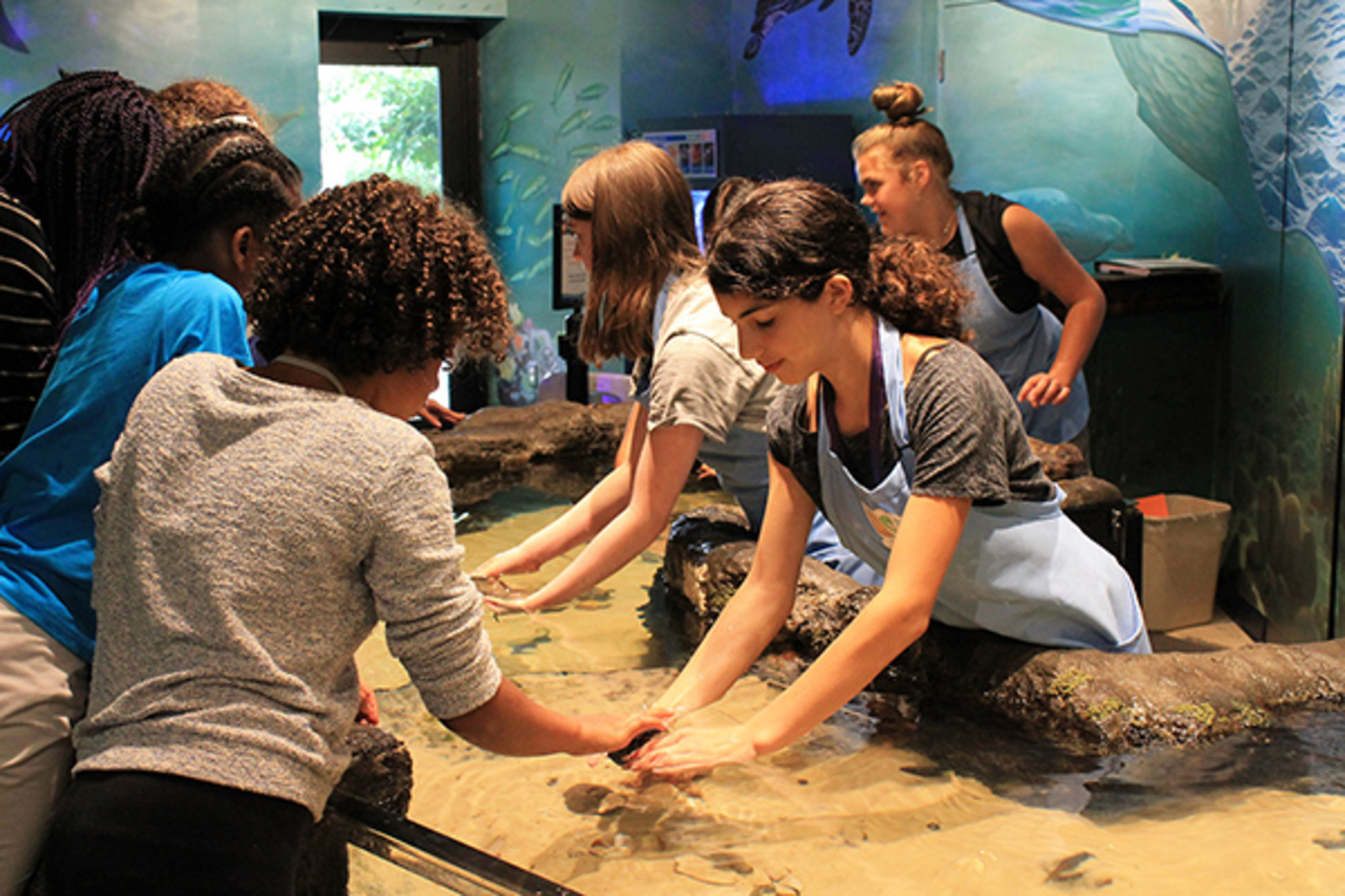
Down in Ithaca, many residents of Tompkins County have taken advantage of the local science resource that is the Sciencenter. Like Southworth, the Sciencenter offers coding classes for kids, but don’t aim them to be exclusively for girls. They’re called Coding For All and they’re a microcosm of the Sciencenter’s motivation behind diverse programming. The center doesn’t do any girl-specific programming. Instead, they’ve done research and changed some of their programming to be more inclusive and welcoming for everyone.
“It’s things like programs that are more open-ended, more social, more based on real-world problems as opposed to theoretical things,” said Michelle Kortenaar, Senior Director of Engagement and Learning at the Sciencenter, of what makes a program more welcoming to girls.
Since doing the research, the Sciencenter has integrated these findings into one of their most popular middle school programs, the Future Science Leaders. More than half of the kids who participate in the program, both in the summer and during the school year, are girls. This fits comfortably into the range that Kortenaar was going for.
“If it tips too much, like if it becomes 90 percent girls, then boys won’t feel welcome,” Kortenaar said. “And if it becomes 90 percent boys then girls won’t feel welcome.”
The program is about six years old and was started with funding that Kortenaar said was interested in finding ways to make programming more inclusive. But the Sciencenter didn’t create the program all on their own, they understand they are not the experts on all things. So, they reached out to local groups like the Society for Women Engineers, the Society for Black Engineers, Ithaca Youth Bureau, Southside Community Center, and the Greater Ithaca Activities Center, to figure out what the center could do to make the program inclusive and what inspired these groups.
“We really have thought a lot about how to make it as inclusive as possible,” Kortenaar said.
Future Science Leaders helps train middle school students to lead their own science explorations, to become leaders in science education. During the school year, the FSL participants work with the staff at the Sciencenter on Saturday afternoons, or on weekdays all summer long, and create hands-on activities, exhibits, and digital media as they create their own scientific research project.
“The point is to communicate science to a broader audience,” Kortenaar said. “It’s all about the empowerment of learning to communicate, of being an expert.”
The Sciencenter has also changed some of their exhibits to be more open and inviting to all children, based on research that found what helps make exhibits more welcoming to girls. Kortenaar said that making their exhibits more welcoming for girls has not in any way affected how boys react to them, allowing for more children to take part in all that the Sciencenter has to offer.
Along those lines, the center has also been trying to make their programming more available to children with sensory needs who may be neurodivergent, meaning not neurotypical.
“We’re trying to be more inclusive of children with a more diverse set of needs,” Kortenaar said. “That means also sort of neurodiversity. So, we now run a program – it’s slightly more than quarterly – for children with sensory processing issues and that’s a program that we run before we open on Sunday mornings that’s quiet, we put up special signage.”
But the center has also been looking for ways to be more inclusive day-to-day. At the front desk, little explorers can check out noise-canceling headphones, sunglasses, and fidgets. Sometimes the Sciencenter partners with Racker Center, bringing in some of the organization’s staff to talk to families and run a quiet space. Kortenaar said the Sciencenter is always looking to work with other organizations in order to make their programming accessible and inclusive.
In a college town like Ithaca, resources, experts, and volunteers with STEM knowledge are fairly easy to find. For students of the Society for Hispanic Professional Engineers (SHPE), giving that knowledge to the community is an integral part of what they do. For about five years the club has been hosting Dia de Ciencias, a family-oriented event full of kid-friendly science activities, located in the Ithaca community. This year’s event, on March 17, was in the Greater Ithaca Activities Center, but in past years the club has also hosted their event at Ithaca High School.
As a chapter of a national organization, SHPE is required to have some sort of keystone event. As an organization, they also have an interest in reaching out to the community. Dia de Ciencias worked for both of these goals.
“Part of being up here at Cornell we do have access to this community and as far as SHPE is concerned we do a lot of stuff on campus and a lot of professional development for students, but we do want to make sure that we are involved and engaged with the Latino community as a whole, and not just within Cornell,” said Zach Tretler, SHPE’s academic chair and a Mechanical Engineer major. “Dia de Ciencias allows us to reach out to the local community.”
The focus of the event, an all-day science fair, is on teaching the next generation. At this year’s event, young participants could learn about numerous STEM-related fields of study through kid-friendly activities. Cornell Steel Bridge built miniature bridges out of tongue depressors and Solo cups while across the room kids could learn about how magnets work with a home-made version of Wooly Willy.
“There’s not too much diversity in these fields,” said Luis Verdi, Director of Community Outreach for SHPE. “So, we’re really trying to push getting these minority groups more involved in STEM and seeing what it’s all about because for a lot of them they’re growing up and they don’t have much exposure to these kinds of things.”
Diversity, Verdi said, is an important part of teamwork, which is an important part of the engineering process. He himself was inspired to become an engineer through a similar outreach program when he was younger. But it’s not just racial diversity that SHPE wants to encourage.
“SHPE, obviously the focus is on Hispanic engineers for this club specifically,” Tretler said. “But you can also see the women in engineering and these young kids can get his sense of diversity. They can say ‘We don’t have to be the normal, typical white male. We can be women, we can be Hispanic, we can be black, we can be whatever and still major in STEM, we can still make a career in STEM.’”
In the past SHPE has tutored local high school students through a relationship with the National Society of Black Engineers junior at Ithaca High School, done SAT prep, and participated at other science fair’s in the Ithaca Central School District. But they want to expand their outreach outside of Ithaca and use their platform to tell more high school-aged students about available scholarships to help them enter whatever STEM field they choose.
Tompkins County has numerous resources for STEM programs for kids of all backgrounds at local libraries, middle and high schools, through the local colleges, and local organizations. Young residents hoping to become scientists, engineers, and mathematicians will find support, and programs, to feed their curiosity.
Related Articles

5 things to do in Tompkins County this weekend
Plan your visit and discover what’s happening this weekend.

TC3 reaches transfer agreement with Hobart and William Smith Colleges
TC3 transfer agreement guarantees acceptance and scholarships for graduates entering bachelor’s degree programs at Hobart and William Smith Colleges.