
Tompkins County prepares for Micron’s arrival in wake of $6.1 billion in federal funds
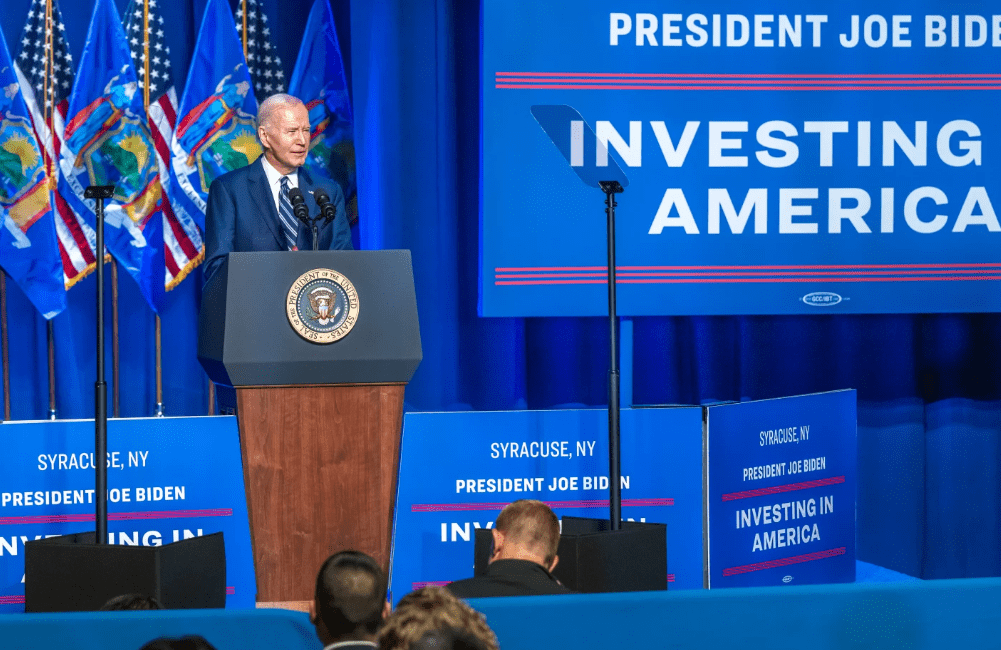
President Joe Biden visited Syracuse Thursday to officially announce the allocation of billions of dollars in federal funding to Micron Technology, Inc., an American producer of computer memory and computer data storage headquartered in Boise, Idaho, that will open a new Syracuse facility.
“You know,” Biden said in his speech, “during the pandemic, folks, everyone learned about supply chains. You may remember we had a global shortage of semiconductors — smaller than the tip of your finger, and now it’s even smaller than that — that would help power everything in our lives from smartphones to cars to dishwashers, satellites.”

“We invented those chips here in America. We invented them. We made them move. We modernized them. But over time, we stopped — we used to have 40% of this market. And over time, we stopped making them,” Biden said. “So, when the pandemic shut down the chips factories overseas, prices of everything went up at — here at home. That semiconductor shortage drove one third of the surge in inflation in 2021, caused long wait lines of all kinds of products. Folks, I determined that I’m never going to let us be vulnerable to wait lines again.”
Biden said this drove his determination to work with Chuck Schumer, Democratic U.S. Senate Majority Leader, to develop the CHIPS and Science Act in 2022.
“We used to invest significant amounts of money in research and development. We stopped doing it, but I was determined we were going to do it again,” Biden said. “It’s one of the most significant science and technology investments in our history.”
The week before Biden’s visit, Senate Majority Leader Schumer announced that Micron was set to receive $6.1 billion in grants from the U.S. Commerce Department to help pay for domestic chip factory projects.
“This monumental and historic federal investment will power and propel Micron to bring its transformative $100-plus billion four-fab project in central New York to life, creating an estimated 50,000 jobs,” Schumer said, adding that Micron plans to build a complex of chip plants in New York over the next 20 years.
“To all those who have had their doubts, believe it — Micron is here, Micron is real,” Schumer said. “And now, with billions in federal investment from my CHIPS & Science law, we are taking the next steps to get shovels in the ground to transform the Syracuse region and all of Upstate into a global hub for the chips that will power America’s future.”
With the announcement official, policy makers, industry leaders and microengineering educators, as well as those working to further economic development in the areas surrounding Syracuse, say they are ready to put their heads together and strategize about how best to take advantage of the opportunities Micron could create if Tompkins County positions itself well in the upcoming years.
“Everybody is going to have to roll up their sleeves and work collaboratively,” said Andrew Fish, senior vice president of member and business experience for CenterState Corporation for Economic Opportunity (CEO).
Fish said that CenterState CEO, the largest membership organization for business leadership and economic development in Central New York, is poised to help the entire region, including Tompkins County, capitalize on Micron’s opening in Syracuse.
Fish said he is aware of the perception that Micron has been lacking in outreach to the Finger Lakes and Southern Tier regions. He said he suspects some of this has to do with the anticipation of the recently announced funding. Now that the $6.1 billion in federal dollars has been announced, Fish predicts that the wider region is likely to see Micron increase and expand its outreach efforts.
Micron is still in the process of securing environmental permits, Fish said. That process is expected to wrap up this October or November, and construction is slated to begin in late 2024 or early 2025.
In Ithaca, the Cornell NanoScale Facility (CNF) provides a state-of-the-art space where micro engineers can learn skills and develop and test products, but the facility also invites in more than 500 individuals every year, including undergraduates, graduate students, postdocs and professionals, both novices and those experienced in nanotechnology. Projects range from pure university research to product development for small and large companies.
“I was very excited this week to hear about Micron getting additional funding,” said Thomas Pennell, CNF research support specialist, adding, “Biden and Schumer did us a real great service, bringing this to our doorstep. This is going to be decades of impact.”
“I have to say, putting this facility in Syracuse is great for our region, but it’s also great for Micron,” Pennell said. “I grew up in Central New York, worked in factories here, and people in Central New York work very hard. They are an excellent employment base, and this is going to change Micron for the better.”
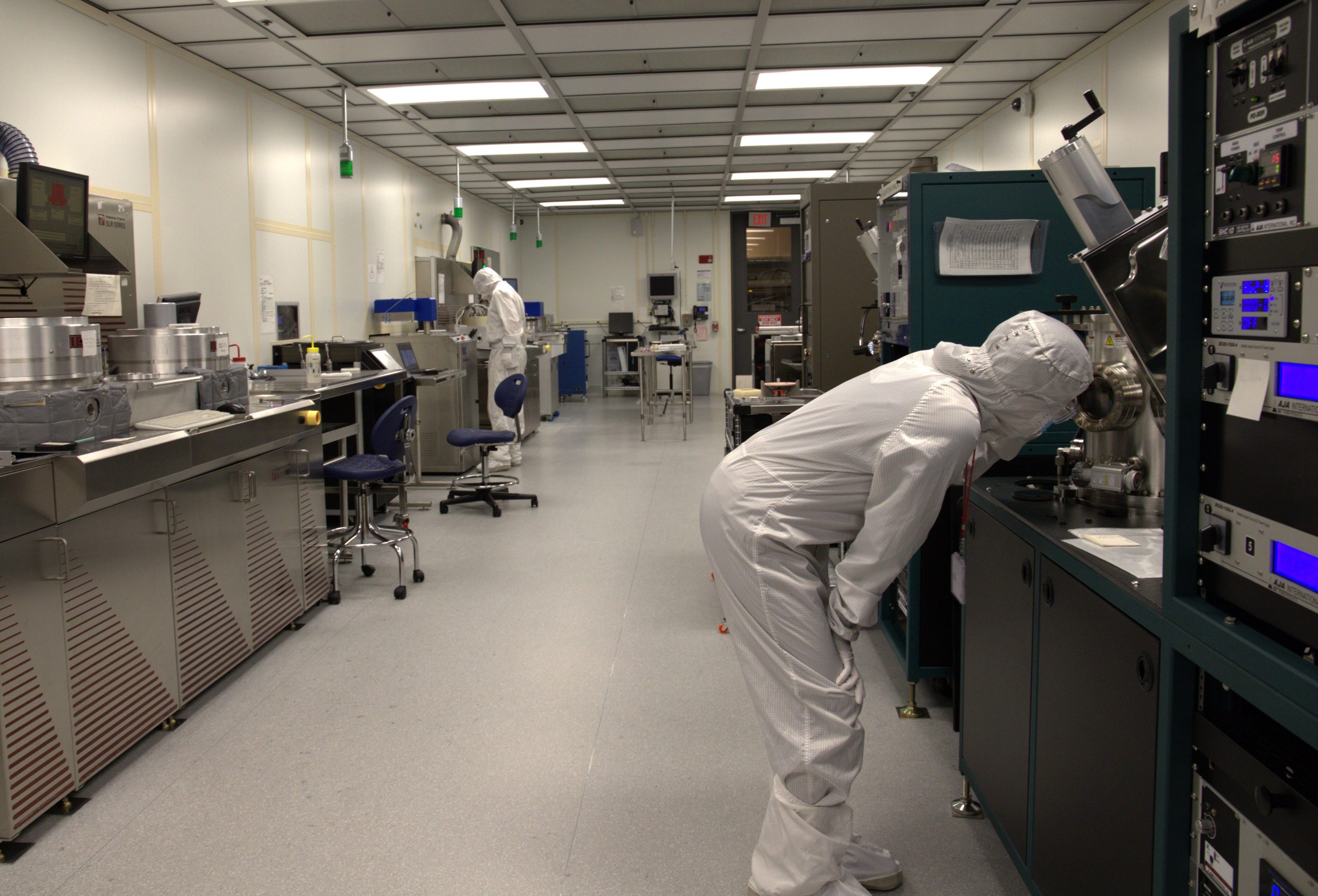
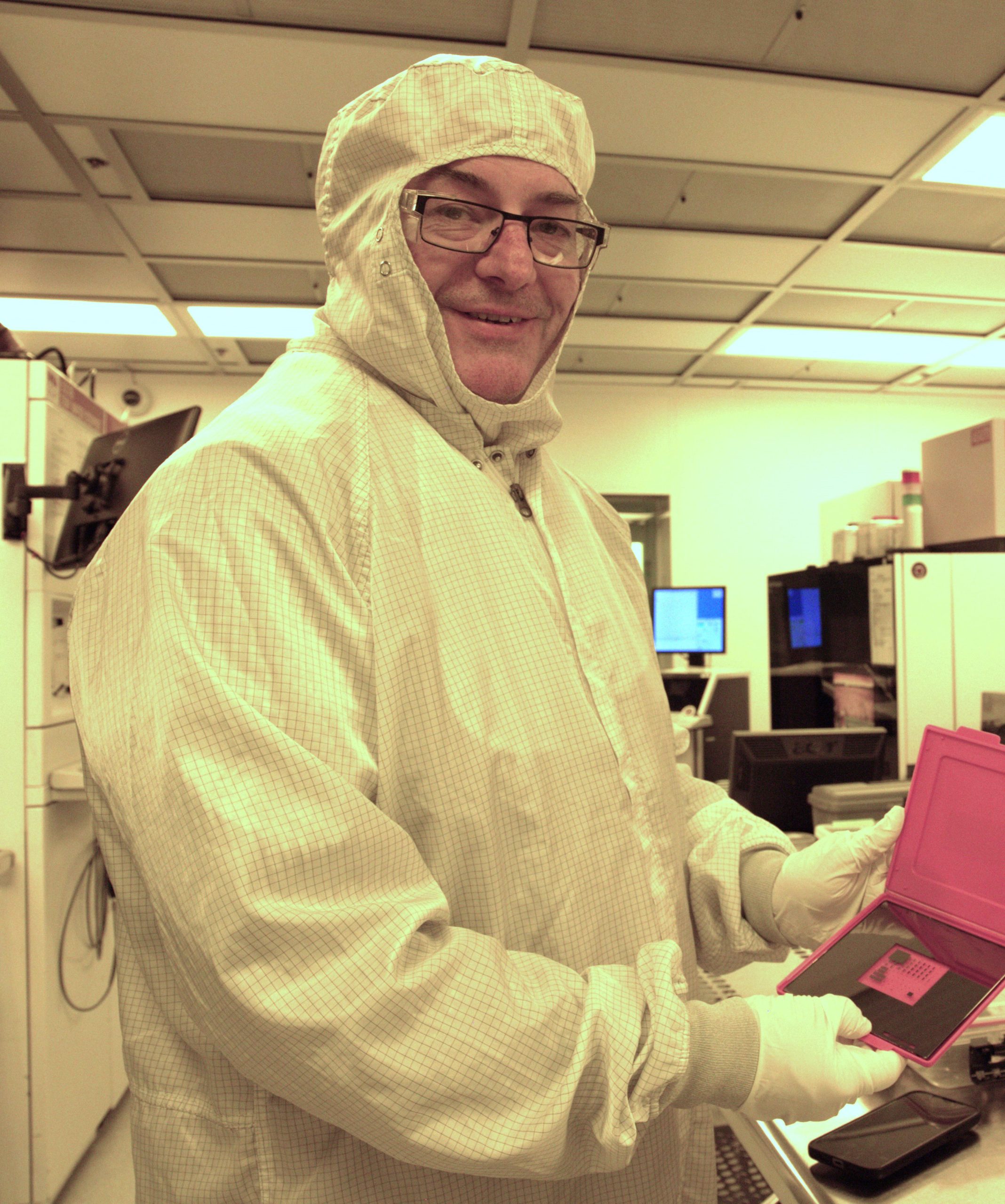
On a recent afternoon, Ron Olson, CNF’s director of operations, donned the facility’s requisite booties, hood and coveralls to give a tour of the facility’s cleanroom, where he spoke about his enthusiasm for Micron and the new possibilities it creates for the region.
“We’re in a perfect scenario, perfect condition to really help with workforce development and to help with lab-to-fab transmission, to work with initial research going on and to really help the United States get to where it needs to be,” Olson said.
Pennell and Olson have been working closely with Tompkins Cortland Community College (TC3) and Tompkins-Seneca-Tioga (TST) BOCES to develop educational opportunities in the world of microengineering.
At TC3, Carrie Whitmore, director of continuing education and workforce development, has been working with Olson to secure capital funding for the educational equipment required for classes that teach microengineering, including vacuum systems and leak checkers.
“These are not something a community college would normally have around, so we’re working very closely with them to get the right equipment,” Pennell said.
TC3 developed a Micro-Nano Fabrication Safety Credential with CNF in 2022, before the CHIPS Act was announced.
The college is also launching, in fall 2024, a Veterans Training Program in partnership with Cornell and Penn State, and is one of the seven partnerships nationwide providing this programming to veterans and their dependents. Recruitment is underway and interested individuals may apply online at www.tompkinscortland.edu/academics/micronano.
Pennell also spearheaded a new program at TST BOCES, launching the Accelerated Training for Labor Advancement in Semiconductors (ATLAS) program in the fall of 2022. This program brings high school seniors from the TST BOCES New Visions Engineering program for an in-depth look at the world of micro- and nano-fabrication.
TST BOCES has also started an ultra high purity welding program, teaching a skill that is critical to installing the equipment in an ultra high purity cleanroom, providing education in a skill that was lacking in the Tompkins County area prior to this program, Pennell said. The program has been so successful that two branches of BOCES in neighboring counties are also planning to implement it in the near future, Pennell said.
Pennell is passionate about educating younger students and frequently leads interactive talks and demonstrations at local public schools.
“We need to look to all age groups for this,” Pennell said. “There’s a heavy lift that needs to happen.”
Fish agrees. “There are 9,000 jobs being brought online in this 20-year project,” he said of the new Micron plant. “We’re talking about half that workforce coming online in the second half of that timeframe. We’re talking about people coming out of college with technical degrees and the opportunity to work for [Micron] — or even two or four-year degrees — who are between 10 and 16 years old right now.”
Micron understands the importance of reaching younger audiences that will one day become its employees, Fish said.
“From a future workforce standpoint, elementary schools and middle schools are the pathways to the future workforce for Micron, and they recognize that, which is why their first investments were partnerships with community colleges, children’s museums here, Chip Camp [a Micron children’s day camp] and Women in Tech programs in public schools throughout New York,” Fish said.
Tompkins County has already landed a significant contribution to the microengineering industry in Menlo Microsystems, located on Thornwood Drive in Ithaca. The company has committed to a multi-year investment of $150,000 to fully onshore production of the Ideal Switch. The Ithaca location is expected to begin production this year, creating more than 100 high-tech jobs within the next five years.
Menlo Micro is retrofitting the building, which was an essential part of the company’s decision to come to Ithaca, said Heather McDaniel, Ithaca Area Economic Development (IAED) president.
“They had been manufacturing semiconductor chips called the Ideal Switch overseas, so they’re reshoring that and bringing it in-house, so that’s really exciting for us,” said McDaniel, who added that Menlo Micro had been looking at Texas and had narrowed its search to handful other states, but the existing building on Thornwood Drive, the former home of Kionix, was key to why the company decided to relocate here. The building already had a high-tech cleanroom and some of the necessary equipment, which McDaniel said “drastically reduced the cost to entry.”
“This was a really great collaboration,” McDaniel said of the successful pitch to Menlo Micro, which she said was made not just by her office but the offices of Sen. Schumer and Gov. Kathy Hochul, as well as Empire State Development, to provide resources and help make the case for Ithaca as an ideal location.
Micron opening in Syracuse could be a huge benefit to Tompkins County, making it a prime location for smaller companies like Menlo Micro.
“I could see over the next several years, even decades, so much going into research and development and workforce training,” McDaniel said.
The state-of-the-art facilities and educational opportunities make Tompkins County poised for success in the area of microengineering, but the region lacks some key factors vital to attracting large manufacturers, McDaniel said.
“Where we struggle is we don’t have vacant land that’s ready to be built on,” she explained. “Site selectors aren’t looking at us because we don’t have shovel-ready sites.”
If county leaders could “start to plan ahead and identify that next business park or 50 to 100 acres of land to build infrastructure and attract companies, I think that we could do well here,” she said.
To that end, one of her main tasks for 2024 is identifying locations where vacant land exists in Tompkins County with enough acreage and relatively inexpensive potential for adding infrastructure, then marketing those sites to companies that may be a good match.
“There are companies that are looking for a certain number of acres and a certain amount of acres next to the highway with access to rail, and I can’t even respond to them because I don’t have anything that meets the needs,” McDaniel said. “When we do have vacant buildings, we’re able to fill them. … We are an attractive place to be in terms of quality of life.”
To maximize opportunities created by Micron, adjacent communities will have to work together, said Jennifer Taveres, president and CEO of Tompkins County Chamber of Commerce.
“I think it’s going to require a lot of strategic work between municipalities and other organizations if we want to try to set the stage for capitalizing on those opportunities over the next decade,” Tavares said. “I think the biggest thing I am concerned about impacting the local economy and the entire region are increasing demands on housing stock and on the workforce. With my understanding of our local economy and all our challenges and attributes here, we already have a workforce shortage and a housing shortage.”
With a significant portion of Tompkins County’s workers already commuting from surrounding counties, Tavares said she is concerned that Micron could create a drain on the already strained local workforce.
But overall, Tavares said she views Micron in a positive light.
“I think this is a really exciting opportunity for upstate New York,” she said, “and I’m really interested in some forward-thinking, growth-minded strategies for our region to be able to take advantage of it.”
Author

Related Articles

Holiday traditions bring community cheer
Tompkins County holiday traditions light up homes, farms, and schools with festive cheer and community spirit.
The gift of an experience: Local businesses offer hands-on holiday fun
Holiday experience gifts in Tompkins County include candle making, gourd crafts, and pottery workshops for creative seasonal fun.
Code Blue shelter opens amid praise, concerns and ongoing debate
Ithaca’s Code Blue shelter opens with larger space, showers, and case management to help residents during cold weather.