
Tourism officials celebrate recognition amid projections of fewer visitors next year
Tompkins County tourism thrives with fall festivals, awards and economic growth, but officials brace for 2026 declines.
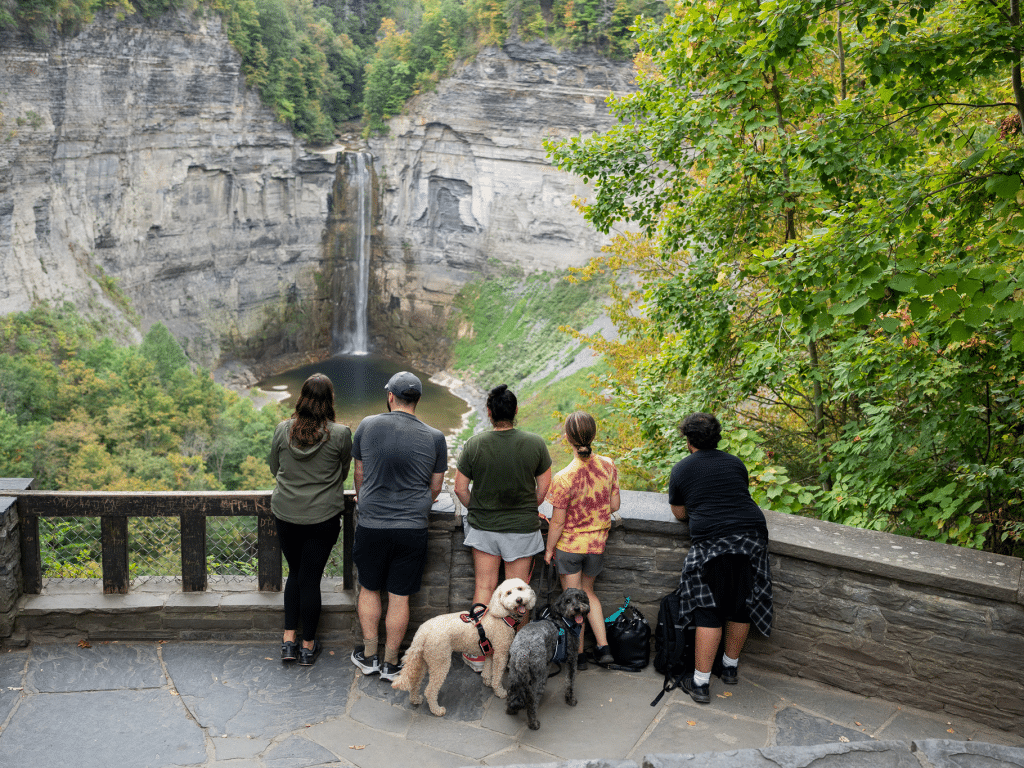
A group of tourists and their dogs take in the view at Taughannock Falls State Park in Ulysses.
Fall tourism is thriving in Tompkins County, with vibrant foliage, returning students and the highly anticipated Apple Harvest Festival drawing visitors well into October. This momentum comes as Visit Ithaca’s Visitor Experience team earns statewide recognition for its role in welcoming travelers and strengthening the region’s reputation as a top destination.
“Fall is an exciting time for us,” said Rob Montana, Ithaca/Tompkins County Convention & Visitors Bureau communications manager. “Students are back. Fall brings all the people looking for foliage. The tourism season continues through October; where it used to be a little lesser in the fall, now it doesn’t slow down — fortunately for all of our lodging partners.”
Fall also brings thoughts of the Apple Harvest Festival, which comes to downtown Ithaca this year Sept. 26 to 28.
“We think about the Apple Harvest Festival as a huge event,” Montana said, “and think about that connection between all the agricultural places around here, including how we connect with the restaurants. … There are a lot of options to get fresh produce, and it’s nice to see how restaurants incorporate fresh ingredients into what they’re serving.”
Visit Ithaca’s Visitor Experience team receives the Excellence in Tourism Marketing Campaigns, Projects Programs
The Visitor Experience department was selected to win this award from the New York State Tourism Industry Association based on the quantity and quality of visitor engagements, from travel planning through assisting visitors while they are in Tompkins County and inspiring return travel.
The team staffs the Downtown and Taughannock Overlook visitor centers and also connects with people at campus events, over the phone and through online chat and email.
“I’m thrilled our Visitor Experience department has won a 2025 NYS Tourism Excellence Award. Our team works incredibly hard each day to be present, informed and welcoming to visitors from all 50 states and over 80 countries,” said Jodi LaPierre, director of visitor experience for Visit Ithaca. “They are out in our communities, familiarizing themselves with events, restaurants and points of interest.”
“In addition to staffing our two visitor centers, they are tabling on our college campuses for family weekends, prospective and accepted student visits, at our local conference center and hotels for meetings and conferences (when requested) and responding to online chat inquiries, phone calls and emails,” she added. “They are constantly exceeding expectations, and I’m thrilled to see them get recognized for their commitment to our thriving tourism community.”
Ithaca #1 on CNN
Montana said that while Visit Ithaca and the Chamber of Commerce had pitched ideas to CNN for the article naming Ithaca as the number-one town to visit in the country, it was a surprise to everyone when the article was published and Ithaca came out on top.
“We didn’t know until we got an email that morning saying, ‘The list is out, and congratulations — you’re number one,” Montana said.
It was a result that could not have occurred without the partnering efforts of the area’s multiple tourism teams, including that of the Tompkins County Tourism Program.
Why does Tompkins County have a tourism program?
“We’re not mandated or required to have one,” said Nick Helmholdt, Tompkins County Tourism Program director.
He said there are two big pieces to the program: to enhance the quality of life for county residents and to maintain and enhance our county’s appeal as a destination for visitors.
“Where we try to focus our efforts is where these two [goals] intersect and overlap,” Helmholdt said, adding that the purpose behind the county tourism program is economically driven.
“We have a local economy that’s relatively focused on higher education and academic employment,” he said. “Investing in tourism and developing the sector is a way to diversify and grow our local economy.”
In 2024, the county generated $29 million in tax revenue attributed to tourism, according to Helmholdt.
This amounts to a tax benefit of $680 per household and 3,218 tourism-related jobs.
The study showed that 757,500 people visited Tompkins County in 2024, amounting to $380.5 million in direct visitor spending for a total economic impact of $429.4 million.
“Tourism is a significant player in our local economy, and that’s also, I think, a major reason why we continually invest in this sector,” Helmholdt said.
“But,” he added, “how we do that is, I think, a matter of debate, and one of the ways we settle that is with our strategic tourism plan.”
The first tourism strategic plan was adopted roughly five years ago.
“Generally, the tourism program works because it has a dedicated funding source at its disposal,” Helmholdt said, explaining that the funding source is a 5% room occupancy tax paid by guests at hotels, motels, inns and vacation rentals, “generally anything with a roof over its head that you are in for less than 30 days.”
Tax revenue is allocated to programs and grants that address goals in the strategic tourism plan. That allocation is made by the legislature both in the annual budget and through individual grant awards.
“Myself and the strategic tourism planning board evaluate the outcomes of these investments and recommend changes as appropriate,” Helmholdt said.
Tourism tax dollars have been increasing steadily since 2021, well surpassing 2019 in 2022.
The third quarter (June, July and August) brings in the most revenue, followed by the second and fourth quarters, which are roughly the same. The first quarter has lagged behind since 2015, the first year of the graph that Helmholdt shared at the meeting.
“The first quarter includes December from the prior year,” Helmholdt clarified, with the second quarter starting at the beginning of March and the rest of the quarterly calendar flowing from there.
When it comes to hotel room occupancy tax revenue, the second quarter of 2025 saw a decline in revenue compared to last year, according to a report that was submitted to the committee at its August meeting.
The report covered the period from March 1 to May 31. The room tax collected was $1,077,315, which is a 3.3% decrease from 2024. The drop is largely attributable to the April 2024 total solar eclipse and tax delinquency, according to the report, which also stated that while occupancy declined slightly, rates increased significantly.
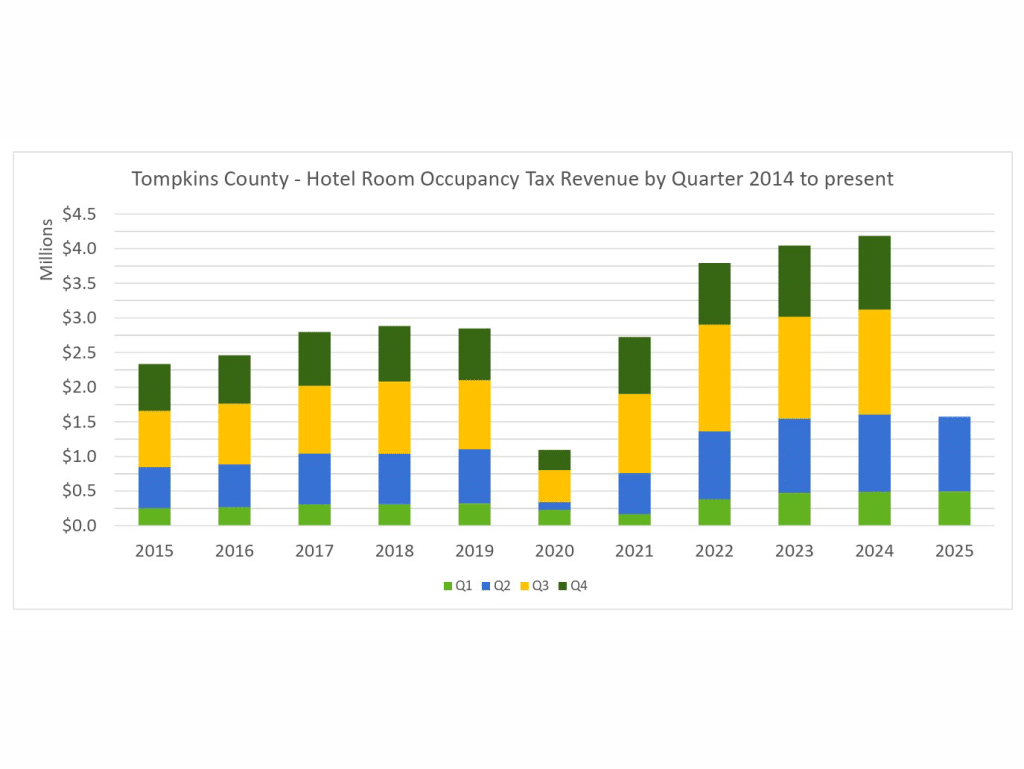
This bar graph shows the overall increase in the Tompkins County hotel occupancy tax collection over the last 10 years and demonstrates that the summer months of June, July and August (in yellow) exceed all other times of the year.
Tourism budget breakdown
Fifty-seven percent of the $4.3 million tourism program budget goes toward long-term contracts.
“These are agreements for the Convention Visitors Bureau and the conference center,” Helmholdt said.
Thirteen percent goes toward grants, 10% toward general operating support and 7% toward annual programs.
Some of the programs that run through the Tompkins County Tourism Program are the Convention and Visitors Bureau, Community Beautification, Downtown Ambassadors and Activation, Hospitality Employment Training and Market the Arts.
There is a Strategic Tourism Planning Board, with 18 voting members and eight nonvoting members, that meets on the third Wednesday of each month.
An uncertain year ahead
Some issues that are coming up for the Tourism Program are the implementation of a new short-term rental registration system, a new downtown activation program launching in 2026, revised Arts & Cultural Organization Development grant guidelines and an update to the Strategic Tourism Plan.
The forecast for 2026 predicts a 2.5% decrease from the current annual forecast.
“We’re anticipating some headwinds in tourism going into the next year,” Helmholdt said. “These are primarily being driven by international travel and potentially less academic-related travel and discretionary income in the coming year — all those [are] affecting occupancy and potentially driving our room tax collection down in the next year.”
Helmholdt said that Tompkins County is already seeing a decline in international travel. “We expect that tendency will continue,” he said. “We are expecting that academic-related business is going to be affected, and actually we’re already seeing this in the market, with various meetings and conferences being either postponed or canceled, and I think there’s just a concern.”
Tompkins County has also seen a decline in visitation from Canada, a big drive-in market for Ithaca, according to Helmholdt.
He also noted that at the time when the 2026 proposed county tourism budget was being developed, tariffs and the impact they could have on discretionary income were in the news.
“This latest round of tariffs is promising to be problematic,” Helmholdt said.
“We’re in a position with our hotel room occupancy tax reserves where we are not needing to draw on those at this time,” he added.
Short-term rental law
The new short-term rental law that requires short-term rentals to register went into effect around December of 2024 and was implemented earlier this year. This established a legal framework in the state for regulation of short-term rentals.
“[The law] establishes a process by which counties that have existing occupancy tax laws can modify their local laws to incorporate short-term rentals as a taxable unit of lodging,” Helmholdt said.
At the July meeting, minor revisions to the local law were passed by the Legislature. Greg Mezey (D-Dryden), chair of the Housing and Economic Development Committee of the Tompkins County Legislature, asked Helmholdt if there was consideration or reconciliation for institutions of higher learning acting as short-term rental operators, or to address the times when Cornell, Ithaca College or Tompkins Cortland Community College would rent — for non-academic purposes — their rooms or define them as short-term rentals for events like alumni weekends, sports camps or other events that fall outside of the academic nature of the institutions.
“That’s something that we can go back and modify,” Deputy Tompkins County Attorney Holly Mosher said.
Downtown Activation Program
The Downtown Activation Program is an effort on the part of the Downtown Ithaca Alliance to increase activity on the Ithaca Commons through a revamped busking program, street art and sidewalk showcase activities.
“This is partly in response to a retail study that they are in the process of wrapping up that demonstrated a need for more lively activity on the Commons,” Helmholdt said.
Author

Related Articles
Holiday traditions bring community cheer
Tompkins County holiday traditions light up homes, farms, and schools with festive cheer and community spirit.

The gift of an experience: Local businesses offer hands-on holiday fun
Holiday experience gifts in Tompkins County include candle making, gourd crafts, and pottery workshops for creative seasonal fun.