County faces tight fiscal year with 1.4% tax rate increase
Tompkins County proposes its 2026 fiscal plan with a 1.4% tax increase to manage rising costs and fund essential services.
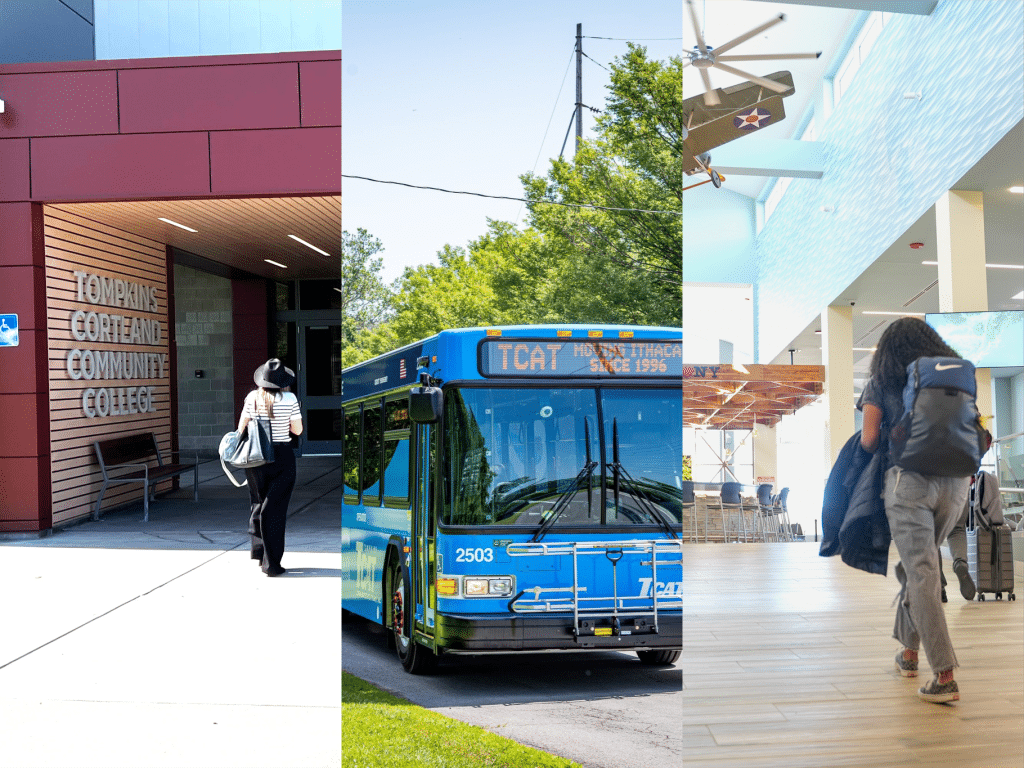
Three major topics of conversation among Tompkins County legislators during 2026 budget discussions were Tompkins Cortland Community College (left), Tompkins Consolidated Area Transit (middle) and the Ithaca Tompkins International Airport (right).
Tompkins County lawmakers are weighing a 2026 budget that grows by $8.1 million from the previous year amid rising inflation, payroll costs and federal funding uncertainties. County officials say that the proposal reflects difficult trade-offs as they balance essential services, investments in public infrastructure and emerging community needs.
Budget overview
The 2026 proposed Tompkins County budget recommended by County Administrator Korsah Akumfi was $239.8 million. This represents an $8.1 million increase over the 2025 adopted budget.
“This budget is crafted during a period of undeniable fiscal headwinds,” Akumfi said in a message to the legislature.
“The main driving forces [of the budget increase] are just regular inflation and also payroll increases and other contractual increases that we are seeing,” Akumfi told Tompkins Weekly last week.
After concluding department and agency budget presentations at six previous Expanded Budget Committee (EBC) meetings, the legislature held three EBC voting sessions, during which legislators proposed and voted on changes to the county administrator’s recommended budget.
After the conclusion of the most recent and final voting meeting of the Tompkins County Expanded Legislature Committee on Oct. 8, the increase in the tax levy stands at 3.31%, which is an increase in the tax rate of 1.4%.
The dollar figure increase in the tax bill on a median-priced home in Tompkins County, assessed at $300,000, is $20.08.
“It’s not going to be the final number, but it doesn’t usually change a lot [after the last voting meeting,” Tompkins County Legislature Chair Dan Klein said.
Comparatively, the levy went up 2% for the 2025 budget, 2% in 2024 and remained level the two years prior to that, Klein said.
While the county has historically maintained a conservative tax levy increase, averaging less than 1.18% over the past five years, expenses have consistently grown at a rate exceeding inflation, Akumfi explained, saying that this structural imbalance has created fiscal pressures that can “no longer be sustainably addressed without a modest adjustment.”
“We are faced with a tough budget year where we have to make cuts no one feels good about, and we’re also facing the weight of impending federal cuts and what that will bring at federal level, and it’s largely unknown right now,” Akumfi said.
Airport funding sparks debate
One large line item in the budget that divided legislators was funding for the Ithaca Tompkins International Airport.
Akumfi recommended approximately $2 million in county funding for the airport. “There was a lot of discussion about that, and where we ended up was $853,000,” Klein said.
Akumfi proposed allocating to the airport $1.1 million from new short-term sales tax revenue, $500,000 from room tax revenues and $371,000 from the tax levy.
“Together, this $1.97 million commitment, funded primarily by tourism-related revenues rather than property taxes, would stabilize the airport’s operating budget, reduce passenger fees and fund incentives to attract new airline services,” Akumfi stated.
Akumfi told Tompkins Weekly that the county has a commitment with the Federal Aviation Authority, based on the funding allocation made to the county, to keep the airport running for years to come.
“The airport is a significant driver for tourism and business, and also, we have two colleges who are among our top employers,” Akumfi said. “It is essential that we provide an opportunity for people to be able to get here and get here easier.”
Legislator Shawna Black (D-Ithaca) moved to remove $371,000 in airport funding from the tax levy, which passed eight to six, with Legislators Michael Lane (D-Dryden), Ann Koreman (D-Ulysses, Enfield, Ithaca), Greg Mezey (D-Dryden), Lee Shurtleff (R-Groton, Dryden, Lansing), Randy Brown (R-Newfield, Enfield) and Michael Sigler (R-Lansing) opposed.
Legislators who were opposed referred to the airport as an economic driver and argued that there is a need to lower the cost of enplanement to compete with other small, regional airports, while those in favor noted the importance of the airport but also highlighted other significant needs in various areas that the county is mandated to support.
Black moved to remove $500,000 in airport funding that would have come from the county’s room tax reserves. The motion passed 12 to 2, with Sigler and Brown opposed.
Black proposed reducing the projected additional sales tax revenue from short-term rentals that would be used to fund the airport from $1.1 million to $500,000. Mezey proposed an amendment to lower the funding from $1.1 million to $853,200 instead, which was approved 10 to 4, with Klein, Deborah Dawson (D-Lansing, Cayuga Heights), Champion and Black opposing.
Klein said that the additional funding recommended by the administrator for the airport would have gone toward decreasing the cost of enplanement, bringing it closer to industry standard and increasing airlines’ interest in bringing new flights to Ithaca. Some legislators are skeptical of this plan, he said, as there is no guarantee it will work.
“We’re a speck in the ocean of all the factors that are affecting the airline industry, so it would be a big gamble for us to pop millions of dollars into lowering their cost in the hope that they would come here — and what if it doesn’t work out?”
Increased support for TCAT
Black moved to increase Tompkins Consolidated Area Transit (TCAT) funding from the tax levy by $500,000 if the other underwriters (Cornell University and the city of Ithaca) support the increase as described in the three-way agreement.
Brown moved to reduce the proposed increase to $250,000, but the motion was defeated 12 to 1.
Black’s original motion passed 12 to 1, with Shurtleff opposed. The legislators discussed the importance of investing in public transportation and maintaining service and routes, according to a county press release.
Klein said that all three underwriting entities have to contribute the same amount. “If one of the entities says it’s contributing half of what you want to put in, everyone goes down to half,” he explained.
“Everything costs more,” he said of the need for an increase in TCAT’s funding, adding that the organization received considerable pandemic relief funding, which is about to run out.
“We have to catch up to where we should have been all those years when we were artificially buoyed by COVID money,” Klein said.
Klein said the city has confirmed its support of the $500,000 increase, but the county has not yet received confirmation from Cornell.
Funding boost for TC3
Tompkins Cortland Community College (TC3) was allocated an additional $410,426 in county funding over the 2025 budget.
“They haven’t asked for an additional amount in six years,” Klein said.
The college is funded equally by Tompkins County and Cortland County, but the counties are responsible for funding based on the percentage of students enrolled proportional to each county (roughly 60% from Tompkins and 40% from Cortland).
“Enrollment’s way up,” said Klein. “They’re successful in an age when many colleges are not.” He said that TC3 has proved very responsive with its micro-credential program, targeting areas in the labor market where growth would be beneficial to the community.
$50,000 reserved for food security
In response to anticipated cuts to New York’s Supplemental Nutrition Assistance Program (SNAP) and other benefits, the legislature set aside $50,000 to feed the people of Tompkins County, should the need arise.
“This is one of our small responses to what we think is coming next year, where people can start losing their SNAP benefits,” Klein said.
The Congressional Budget Office estimates that new federal provisions, particularly new work requirements, will reduce participation in SNAP by roughly 2.4 million people in an average month over the 2025-2034 period.
The $50,000 was left undesignated, aside from its very general allocation to food security, Klein said, because legislators thought it best to wait and see where the greatest need in that area may arise in the year ahead.
County increases security measures
The legislature approved $600,000 in the county budget for security for all county employees.
“This is in response to the reality of the world at the moment, where we and other government entities are receiving a lot of threats,” Klein said. “I never thought I’d support this idea, but we’ve finally arrived there.”
There will be “airport style” security at the entrance of the county legislative chambers building to increase safety for not just the legislators but the county employees who work in the building, Klein said, adding that all buildings that house offices for county departments will receive a step up in security as well.
At the last two legislature meetings there was a security officer in the lobby with a metal-detecting wand, something Klein said will continue until a more permanent metal detector is installed, similar to the system in place at the entrance of Ithaca City Hall.
Public hearing and final vote
The next step in the budget process is for the legislature to vote on the proposed budget as it stands currently at the next meeting of the full legislature, to be held Oct. 21. If approved, it will become the official tentative budget.
The legislature will likely vote to hold a public budget hearing on Oct. 28 at 5:30 p.m.
“That’s the time when the public can come in and say, ‘Hey, I don’t want you spending money on security’ or ‘Hey, you didn’t give the cooperative extension enough money and we want more,’” Klein said. “That’s kind of the last call for the public to weigh in, and then the final budget will be voted on in November.”
Author

Related Articles

“A Silent Force”: Gail Belokur brings creative leadership to the United Way
Gail Belokur, a Hometown Hero, brings compassionate and creative leadership to the United Way of Tompkins County.
5 things to do in Tompkins County this weekend
Plan your visit and discover what’s happening this weekend.