
Tompkins County Jail Garden cultivates health, hope, dignity
Tompkins County Jail Garden grows hope and health in 2025. Discover how inmates benefit from fresh produce.
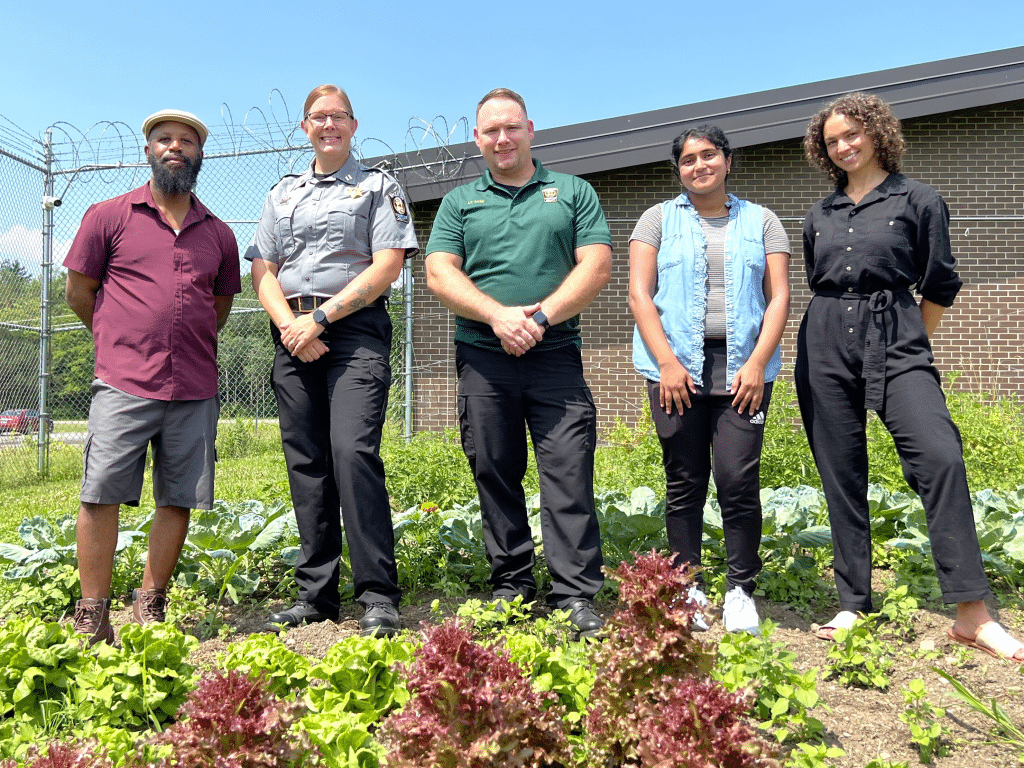
(From left to right): Taili Mugambee, director of Ultimate Reentry Opportunity (URO), Captain Lauran Harrison, corrections division supervisor at the Tompkins County Sheriff’s Department, Seth Case, lieutenant at the Tompkins County Sheriff’s Department, Anya Gowda, a Cornell University student interning for URO, and Sadie Crusade, operations and administrative manager for URO, at the Jail Garden at the Tompkins County Jail in Ithaca.
On a recent balmy afternoon, pear trees, marigolds and a wide variety of vegetables soaked in the sun at the most unexpected of places: The Tompkins County Jail.
The seeds of the garden were germinating well before they took root in the plot of land tucked away behind the large brick building on Warren Road in Ithaca. Thanks to Ultimate Reentry Opportunity, Cornell Cooperative Extension and volunteers, the seedlings were started in the warmth of a greenhouse so they could have a head start in the spring.
The Cooperative Extension donated seeds and pots and threw a “planting party” where volunteers could help. One of the officers from the jail assisted at the party as well.
The gardening program began in 2012, but the jail paused it when the COVID-19 pandemic began. The jail brought it back last year, and this year it really hit the ground running.
“It’s been a very wonderful partnership,” said Captain Lauran Harrison, corrections division supervisor at the Tompkins County Sheriff’s Department, of working with URO.
URO also worked with Early Bird Farm, located off of Route 13 in Newfield, to purchase additional plants at a 40% discount.
“They only sat for a couple of days,” Harrison said of the seedlings.
Several officers helped to rototill the earth and transfer the plants into the ground with two incarcerated individuals, and the garden took off. On a recent sunny afternoon, the garden was full of squash plants, green bell peppers, and different kinds of lettuce.
Currently, four incarcerated individuals weed the garden twice a week.
“They’re out here learning how to take care of the vegetables, plants, the fruit trees, so that they have an additional skill that they can use once they are no longer in custody,” said Harrison, who added that working in the garden could inspire them to grow their own vegetables once they are back in the community.
“It really does give them hope, and it gives them that knowledge for maybe betting on themselves once they’re out of jail,” Lieutenant Seth Case said.
“It’s something to break up the day, from being stuck in their housing units and to actually get some fresh air while they’re out here,” Harrison said, adding that the supervising officers enjoy the time outside as well.
The other major advantage to the program is that the vegetables are used in the jail’s kitchen.
“They’re going to be actually used in recipes and for different items for meals,” Harrison said. “Our head cook has always been very supportive of it, having it come in and supplement the menu items that she currently serves.”
Any extra fresh produce will be donated to local organizations who will then give it to community members in need.
“We are part of the community and we want to assist, too,” Harrison said.
Cornell University experts were consulted on the layout of the garden so that plants could be arranged in a way that would maximize growth and pest reduction.
“There is a thought process behind it, with the companion plants that should to be planted next to each other, and which should not be planted next to each other,” Harrison said.
Lemon balm and bee balm were planted to attract pollinators.
“Each year, we’ll expand it and make it better,” Harrison said. “It’s our goal.”
The garden could even expand to include a greenhouse, mushroom logs, a compost system, bees and chickens, said Sadie Crusade, operations and administrative manager for URO.
A partnership that puts an emphasis on health
Taili Mugambee, director of URO, learned about the importance of a healthy diet for those struggling with repeated involvement in the justice system when he spoke with a local medical examiner.
“Her job is to not just look at the body, but look at the contents of the home,” Mugambee said. “One of the things she said was, ‘Taili, you need to keep pushing this because these inmates, most of them are dying from the diseases that we predicted, from hypertension, high blood pressure, heart attack. …When she went and looked in the refrigerator for what they were eating, she said, ‘It looks like they’re eating the exact same things that they got from the commissary.”
The jail population is already at increased risk of several diseases such as diabetes and hypertension.
“So you can only imagine while they’re incarcerated and they don’t have healthy options of food to choose from, their chronic medical conditions get worse by the time they get up because they don’t have access to these foods, which is why I think the jail garden project is really phenomenal, because not only does it give them something to do — a healthy way to get exercise and spend their time outside — it also provides them with healthy fresh foods, and this replaces a lot of the junk or unhealthy food,” said Jeroen Goulbourne, doctor of osteopathic medicine at Cayuga Medical and participant in the Physicians Connection Program.
The garden goes hand in hand with other programs that the jail c with URO to bring to incarcerated individuals, such as educational classes taught by residents from Cayuga Medical Center through the Physicians Connections Program.
“They have a series of five different health education classes that they teach,” Harrison said, adding that includes the topic of harm reduction, covering substance use disorders as well as NARCAN use and preventative care of harm reduction.
They are also planning on holding classes in diabetes, high blood pressure, women’s health and more.
“A lot of the people in a jail don’t have a primary care physician,” said Judith Griffin, Program Director for the Cayuga Primary Care Internal Medicine Residency Program. “Most of the health care they access is either not at all or in the emergency department. …Our clinic is located at the mall, so it’s actually not far from where the jail is physically located.”
She added that it is also close to public transportation.
“So, we’re trying to let people know that they can access health care and primary care, and that they will receive high-quality care,” Griffin said, “and to talk about things like substance use disorder and harm reduction, which has been really high-impact in terms of the conversations we’ve had with folks at the jail.”
Reducing stigma within the justice system
For Mugambee, the project is about much more than just a garden. He hopes that URO and the jail can track the amount of food produced, the amount of produce donated to the community, how much actually hits the tables at the jail, and whether or not inmates see an improvement in the quality of the food as a result.
The accountability piece of the partnership with the jail is key, Mugambee said, “and hopefully helps the system behave differently, because our population — the reason why we’re in this — is because they’ve been largely dehumanized.”
Another facet of URO’s goals for the project is to shift the dynamic in the relationships between the jail officers and those who are incarcerated.
“This structure behind these walls, across these walls in different counties within our state,” Mugambee said, gesturing to the jail building, “are dehumanizing spaces. So this is a way of humanizing not just them, but the relationship between them and the folks that work here, right? So, if we’re growing food together, and there’s preparation in the kitchen, and I know that you help cultivate that, there’s going to be a different relationship when I see you and engage with you.”
A healthy body and brain-gut connection
Most people know that vegetables are an essential part of a healthy diet, but new research is showing that consuming a variety of vegetables can also boost mood.
Bacteria in the gut are connected to the brain through the vagus nerve. A diet rich with fiber and nutrients leads to a healthier gut filled with more diverse bacteria.
“The gut is actually responsible for creating 90% of serotonin, which is a mood neurotransmitter,” said Anya Gowda, a Cornell University student earning her master’s degree in public health who is interning for URO. “It also creates 50% of dopamine, and that’s your happy chemical.”
“I strongly believe that there’s a close connection between the gut, or the entire nervous system, as we call it, and just overall mental health,” said Jeroen Goulbourne, doctor of osteopathic medicine at Cayuga Medical. Goulbourne works within the jail’s Physician Connection program.
Healthy foods help provide a steady state in the mind, Gouldbourne said.
“Your energy is not really up and down,” he said.“It’s slowly digested and absorbed.”
Author

Related Articles

“A Silent Force”: Gail Belokur brings creative leadership to the United Way
Gail Belokur, a Hometown Hero, brings compassionate and creative leadership to the United Way of Tompkins County.
Cayuga Medical Center nurses to rally, alleging anti-union tactics by hospital management
CMC nurses plan a rally, alleging unsafe staffing and illegal anti-union tactics as the hospital highlights recent patient-safety gains.