
Town of Ithaca lowers spending, raises tax levy 4% in 2026 budget
The Town of Ithaca budget cuts spending while raising the tax levy and funding key projects.
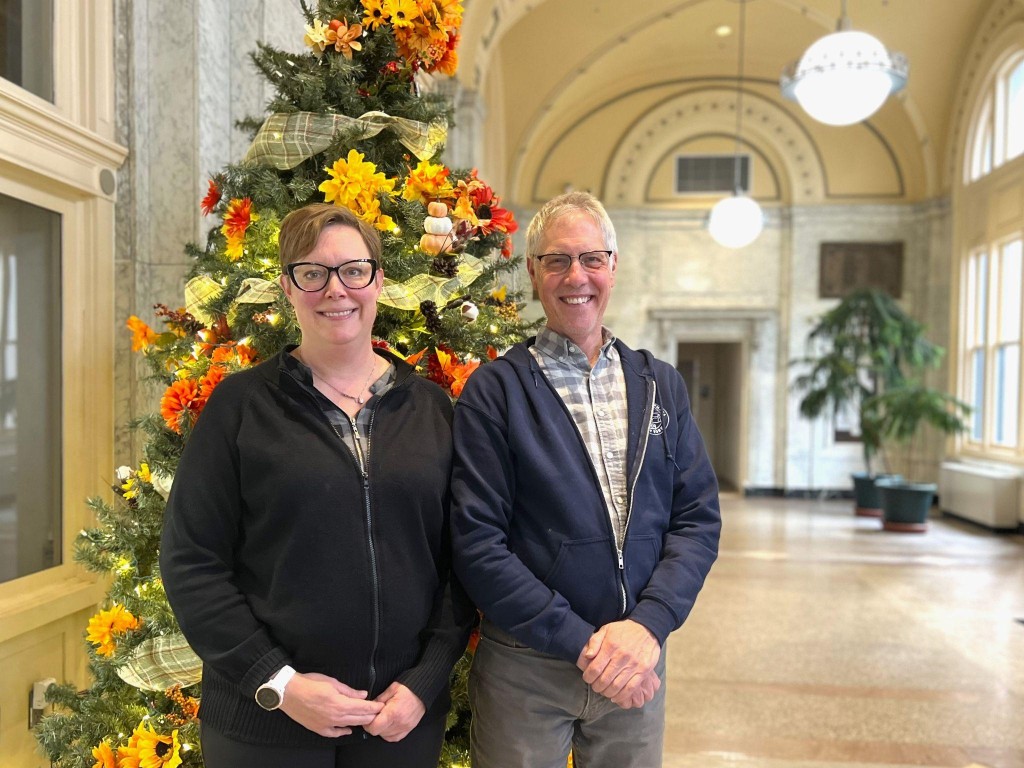
Kelly Anderson, finance officer for the town of Ithaca, with Rod Howe, Ithaca town supervisor, in the lobby of the Ithaca Town Hall.
The town of Ithaca’s newly adopted 2026 budget lowers overall spending by nearly $1 million while the property tax levy went up 4%, resulting in modest tax increases for most homeowners as the town continues investing in infrastructure, public safety and long-term capital improvements.
The total Ithaca town budget decreased by nearly $1 million, from roughly $32.16 million to roughly $31.24 million, or 2.9%.
The total property tax levy (including water/sewer benefit assessment fees) is $11.76 million, an increase of $482,000, or 4.3% over the prior year’s total. This increase complies with the property tax cap limit for 2026.
The property tax bill for a typical residential property in the town outside of the village of Cayuga Heights, valued at $385,000, increases by $82 to $2,085, or 4.1%.
The property tax bill for a typical residential property in the village of Cayuga Heights, where the average-priced home is valued at $500,000, will go from $1,045 to $1,068, an increase of $23 per year, or 2.15%.
“The folks who live in the town outside the village — they’re receiving fire, water and sewer [from the town],” said Kelly Anderson, finance officer for the town of Ithaca. Anderson explained that this is why the town portion of their tax bill is generally higher than it is for those who live in Cayuga Heights, where the aforementioned services are not provided by the town.
Together, quarterly minimum town water and sewer charges have increased from $85.65 to $91.72, or by $24 a year.
Howe said that no members of the public came to town board meetings with concerns directly related to the town budget, and he takes that as an indication that the town is doing things right.
“Our approach,” Howe said, “is to try to meet the town’s needs while being fiscally responsive and conservative.”
The levy will go up in 2026 in large part because a higher percentage of the fund balance was used to keep the tax rate steady within the 2025 budget.
In addition, following historically high interest earnings, rates have begun to decline and are expected to continue to fall heading into 2026; these earnings represent about 4% of the town’s estimated revenue.
“Rates have started to cool a bit,” said Anderson. “The town has earned healthy interests over the last several years by being able to take advantage of the municipal investment opportunities that have garnered close to $2 million, and it’s true that’s substantial. But that’s not something, historically, that we’ve been able to rely upon, and we may not be able to [rely on] it going forward.”
Personnel costs — salaries and wages — represent 19% of the budget and have increased by $570,000, or 11%, due in large part to an additional pay period in 2026 impacting hourly wage earners.
One additional position was funded to support the administrative functions of human resources, payroll, finance and tax collections.
Employee benefits total 10% of the town’s operational budget and have increased from $2,750,000 to $3,190,000, which is attributable to increased costs for health insurance and New York state retirement contributions.
Fire protection represents 18% of the total budget and has increased from $5,180,00 to $5,530,000, or 6.7%, due to the increased costs for fire protection services provided to town residents by the city of Ithaca and the village of Cayuga Heights fire departments.
“Right now,” Howe said, “our fire contract with the city ends at the end of December. So, we’re in the process of coming up with an agreement to continue the contract beyond Dec. 31.”
“We’ve had to make some guesses on what we think our share of that fire budget will be, but any guesses we make are based on past experience and past figures,” he added.
Capital projects total 10% of the budget, for a total of $3.1 million, down from $5.8 million, with a significant portion of the 2025 capital funds being encumbered for 2026 for projects that were bid late in 2025.
Together, water delivery and sewer treatment make up roughly 19% of the town’s expenditures, totaling over $6.1 million.
Capital improvement plan
The town’s capital improvement plan for 2026 to 2030 includes town hall weatherization construction, a multi-year endeavor that includes insulating the exterior walls, replacing single pane glass with insulated glass within the historic windows, replacing exterior doors, air sealing, replacement of lighting fixtures with LED fixtures, installation of lighting controls and other associated items.
Roads and bridges projects that are expected to move forward in 2026 include Lower Stone Quarry design, acquisition and construction. The multi-year project’s objectives are to improve drainage, sight lines, crash zones and potential multimodal integration on the lower portion of Stone Quarry Road within the town.
The following roads are slated for improvement in 2026: Penny Lane, Winners Circle, Lois Lane, Stone Quarry Road (approximately from house #353 south to the intersection of King Road West), Dove Drive, Pheasant Lane and King Road West.
The Wildflower neighborhood in the East Hill area of the town has experienced a high number of water main breaks, and in 2026 the town will replace approximately 1,100 feet of 8-inch water main, fire hydrants and fittings.
New budgeting software expected to be in use by 2027
The town will soon use a new software platform to develop its budgets.
“We’re still relying on spreadsheets that are prone to human error, and it’s going to be a lot of double-checking of things to make sure that it all syncs up properly,” Anderson said. “We’re moving toward an enterprise financial software system that integrates all of those pieces, which gives us more real-time numbers and assists in the preparation of the budget, as well.”
She said that the town authorized the purchase of the software in 2025, which allows the software company to start working on the conversion process.
“We probably won’t start using it until 2027, just because there is a lot that goes into it,” Kelly said, adding that the town will be using the same company for tax collection and personnel timekeeping, as well.
Anderson, who assumed her position with the town in January, said that the town’s ability to keep the tax rate steady, with few unexpected costs for residents, stems from its proactive strategy for maintaining its assets.
“That’s a very good way to be, and also why the tax rates are rather consistent,” Anderson said, “whereas in other municipalities, they might wait until that asset has totally deteriorated and needs to be replaced all at once at a huge cost, and then all of a sudden, they have to figure out what to do. I think by having a professional group of people that work for the town that are always tracking these things and staying ahead of it, it has really protected the town and its taxpayers.”
9 numbers to know
$31.24 million: Total 2026 town budget, down nearly $1 million from last year
$11.76 million: Total property tax levy, up 4.3%
$82: Annual tax increase for a typical home outside Cayuga Heights (valued at $385,000)
$23: Annual tax increase for a typical Cayuga Heights home (valued at $500,000)
$91.72: New quarterly minimum for combined water and sewer charges (up from $85.65)
11%: Increase in salaries and wages, driven partly by an extra 2026 pay period
$3.19 million: Employee benefit costs, up from $2.75 million
$5.53 million: Cost of fire protection services, a 6.7% increase
$3.1 million: 2026 capital project funding, down from $5.8 million
Author

Related Articles

Baden-Powell Council names Leslyn McBean-Clairborne Distinguished Citizen
Dr. Leslyn McBean-Clairborne is named the 2025 Tompkins County Distinguished Citizen for her decades of leadership, equity work, and community service.
Ithaca startup REEgen pushes toward cleaner future for rare earth mining
REEgen in Ithaca uses bacteria to recover rare earth elements, offering a safer, sustainable alternative to traditional mining methods.
Code Blue shelter opens amid praise, concerns and ongoing debate
Ithaca’s Code Blue shelter opens with larger space, showers, and case management to help residents during cold weather.