
Trash collector and student housing managers collaborate to donate left-behind food
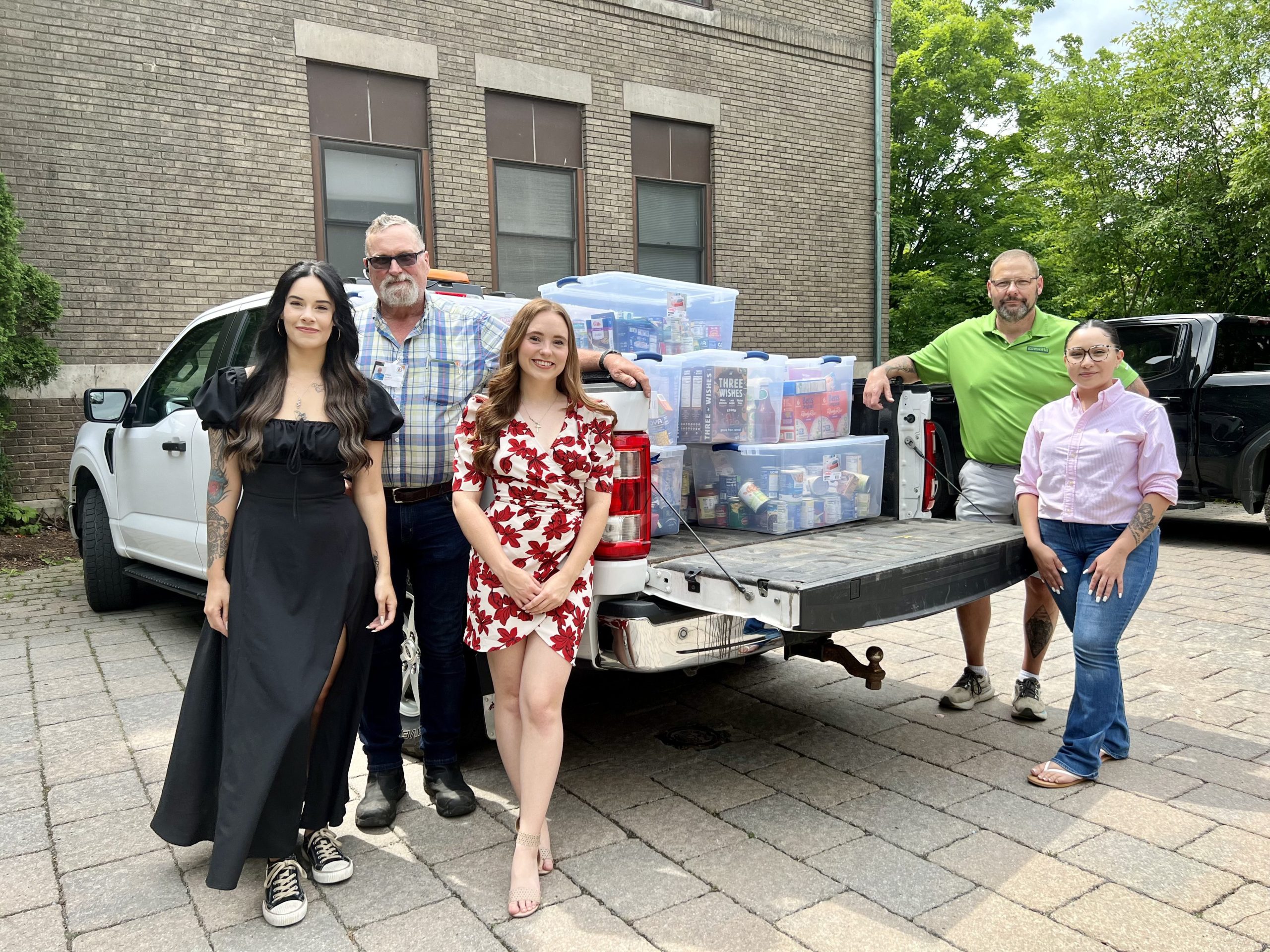
One thing that makes the residential buildings that comprise Collegetown Terrace Apartments different from the average collection of housing units is the huge amount of tenant turnover. Multiple times per year, students move out and head off to their hometowns or to pursue opportunities in another city, often leaving behind perfectly good food in the cupboard.
Recently, Collegetown Terrace partnered with its waste collection company, Casella, in an effort to keep all of that food out of the landfill and put it in the hands of Tompkins County residents who need it.

This time, the food will be donated to the Salvation Army Ithaca Corps, but the hope is to donate to different local organizations, as the efforts will continue as students move in and move out multiple times every year.
The effort began with Dustin Carnes, operations manager with Casella Waste, which provides trash hauling services for towns and villages throughout the county.
“Really, Casella came to us,” said Emmanuelle Bataille, leasing manager at Collegetown Terrace Apartments, which provides student housing at multiple buildings located on Valentine Place, South Quarry Street and East State Street. On a recent afternoon, Bataille, Carnes and other members of the team spearheading the collection efforts met in a conference room at one of Collegetown Terrace’s apartments and discussed how the project has been going so far.
Bataille said she and her Collegetown Terrace colleagues had long lamented the large amount of unopened food left behind by tenants, especially international students, who often fly home and are unable to take any extra items with them.
“When they’re leaving, to try to put all of that on a plane — you can’t do it,” Bataille said. “So, they’re stuck. Then we’re stuck with it, so it just goes to the landfill. It’s a terrible process.”
When Carnes approached Bataille and her team about setting up food boxes next to the building’s entrances during the turnover season, when students move out, the idea quickly took hold.
“As soon as [Casella] came to us, we were on board,” said Bataille, adding that the Collegetown Terrace employees who clean out the apartments collect much of the abandoned food themselves.
Carnes said the project just makes sense. “Tompkins County loves reusing,” he said. Still, “I’ve been with Casella for 18 years, and this is the first time we’ve done it.”
The initial collection efforts from the most recent apartment turnover yielded 300 to 400 pounds of food total from both Collegetown Terrace’s apartments, which have 1,245 total beds, and the other Ithaca student rental properties owned by Collegetown Terrace’s umbrella company, Integrated Operations. These other locations include apartment buildings located at 301, 312 and 125 College Ave. and 238 Linden Ave.
“In 36 years of working here, the food that gets thrown out …” said John Marsh, maintenance supervisor for Collegetown Terrace, shaking his head.
“—is sickening,” Carnes said, completing Marsh’s thought.
The two men nodded in agreement. “One of the huge benefits is it’s not going to the landfill and taking up space,” Carnes said. “It’s going into somebody’s belly.”
“I’m very glad that we’re able to give back to the community,” agreed Tansy Sanchez, operations employee for Casella.
The majority of the food that was saved from the dumpster was canned food. Pasta was another commonly collected item. The project organizers encouraged anyone living in the apartments to use the collection bins to dispose of nonperishable food they no longer want, whether they are moving out or not.
For Collegetown Terrace, the assistance from Casella was crucial to making the food collection possible during a very busy time for the company’s staff.
“Operational efficiencies are really important during this time, so it’s great that they came to help us,” Bataille said. “They saw this issue that we saw, and the fact that it’s going back to the community is just incredible.”
It takes about two hours every day to go to each facility and check for donations. “Sometimes there’s a bunch; sometimes there’s none,” said Carnes.
Marsh said that the busy move-out season is ending, so their efforts will most likely taper off for a bit and resume later in the summer.
“July and August should be pretty heavy,” Marsh said.
When Integrated Operations completes construction on the new Collegetown student housing complex Catherine Commons, which is slated to open next year, Carnes looks forward to expanding his efforts to those apartments, as well.
Carnes said that Casella is also looking for opportunities to partner with other student housing companies. He said he would rather see the food donated than in the landfill, and the efforts are noticeable for the apartments, as well.
“Even our team sees a difference, too, looking at the dumpsters, which are not as full, which is really nice,” Bataille said, adding that Collegetown Terrace saves money on waste disposal by not having to pay to haul all of those heavy canned goods.
She said Ithaca Collegetown Terrace is hoping to work with Ithaca Reuse to pick up clothes and other items. As the group spoke about how the project is going, there was enthusiasm for ways to further their efforts.
“Let’s talk about it, in the future, to do the clothing and furniture and all of that,” Carnes said. “We’ll make resources for it. We’ll make it happen.”
“The biggest thing is clothes,” said Bataille. “Bins and bins of clothes.”
Clothes and furniture are frequently abandoned in student apartments, though community partners would need to step up to make donations in those areas possible. Casella does not have the resources to clean clothes before they are donated, for example, though Carnes said the company would be happy to haul clothes to a dry cleaner willing to donate its services.
“This is just a call to action to the community to help us continue these efforts,” Bataille said. “The more people we can get involved, the more we can have an impact on our community.”
Author

Related Articles
Town of Ithaca lowers spending, raises tax levy 4% in 2026 budget
The Town of Ithaca budget cuts spending while raising the tax levy and funding key projects.
Conference center operator sues Asteri developer over safety, security issues and lost revenue
Asteri Ithaca conference center sues Vecino Group for unsafe conditions, lost revenue, and repeated security issues.
End of an era: Sisters and family say goodbye to Royal Court
Royal Court restaurant Ithaca closes after 50 years, ending a family-run legacy built by sisters Marilyn Ryan and Dorothy Sturtevant.