
Trumansburg author and activist speaks out about ‘Unionizing the Ivory Tower’
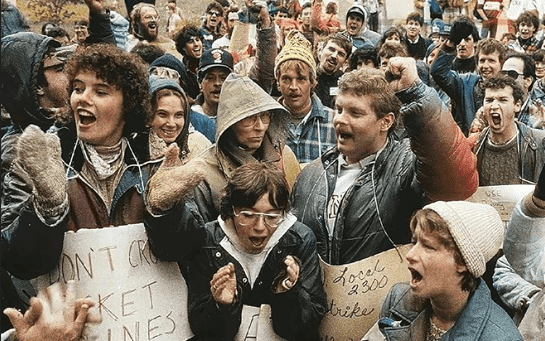
Al Davidoff of Trumansburg has come a long way since arriving at Cornell University in 1976, a kid from a working-class industrial suburb of Buffalo.
In his senior year, Davidoff became a custodian and an activist in an alliance of many of the lowest-paid service workers at Cornell, banding together to achieve fair wages and benefits from Cornell, a well-endowed and powerful employer.

On February 24, 1981, a majority of 1,000 eligible Cornell workers voted “yes” to forming a new union, Local 2300 UAW (United Automobile, Aerospace and Agricultural Implement Workers of America). The union went on to negotiate many contracts, engaging in creative strikes and rallies in the fight for livable wages and respect.
Recently, many readers have relished Davidoff’s account in “Unionizing The Ivory Tower,” via Cornell University Press. As fellow organizing hero Carl Feuer reflects: “This is a great read. Honest, exciting, and important local history. The brotherhood and sisterhood of Labor with activism reflected in Al’s book is especially current, as we see how fragile and precarious democracy is, not only in America, but globally.”
Recently, Davidoff focused his passion and his skills to assist other workers realize their power as equitable partners with management in the workplace and in the community.

Since 2017, Davidoff has served as Director of Organizational and Leadership Development at the Solidarity Center, in Washington, DC.
“The Solidarity Center, allied with the AFL-CIO, is the largest U.S.-based international worker rights organization,” he said. “Our 400 staff come from and work in 60 countries, with more than 900 partners including 500 trade unions, worker associations and community groups. Our programs focus on human and worker rights, union skills, occupational safety and health, economic literacy, human trafficking, women’s empowerment and bolstering workers in an increasingly informal economy. Solidarity Center programs support and contribute to the global movement for democracy and labor rights.”
Davidoff also serves as the cofounder of the National Labor Leadership Initiative, which is housed in the Worker Institute of Cornell’s School of Industrial and Labor Relations and has graduated 500 labor and community leaders. This past semester, he has also looked at labor organizing from a new vantage point: professor.
“It was a wonderful experience working with an incredibly diverse mix of students, [graduate] students, staff, nontraditional students with families, a sitting Common Council member and a student trustee,” Davidoff said. “We worked with the story of Local 2300 organizing to explore how unions organize, how to run effective campaigns and build effective coalitions with the community over issues we all care about, like fair wages, equitable sharing of opportunities, the university contributing its fair share to the broader community.”
Davidoff said that he was pleasantly surprised when the class had double the enrollment he was told to anticipate.
“I am hopeful, based on the interest, that there will be an opportunity to teach it again,” he said. “I’d love to see even more staff and community take it alongside students.”
He shared his take on global labor organizing while babysitting his napping grandson.
“Locally, a significant union election was just won, when over 3,000 Cornell [graduate] student workers unionized by an over 90% margin,” he said. “This instantly becomes one of the biggest victories nationally and an important force on campus and in our community.“
“Students and community were also able to persuade Cornell to drop Starbucks, which was an important labor and moral victory, as pressure needs to mount on Starbucks to stop breaking the law, illegally shuttering stores like those in Ithaca, and negotiate with the thousands of their workers who have voted to unionize,” he added. “Cornell will be bargaining with Local 2300 UAW this year, and hopefully that will produce a solid contract for over 1,000 workers in our community.”
Nationally, there has been a huge wave of successful strikes — from actors and writers to autoworkers, Davidoff said, adding that the new national UAW leadership won major improvements in bargaining with the largest auto companies. The UAW has just announced the most ambitious organizing campaign in the U.S., working with 150,000 nonunion auto workers, many in the South, to join the UAW and fight for higher standards and a fair share of profits.
“Polling shows the highest levels of support for unions in the U.S. in 50 years. Younger workers want to form unions by over a 75% margin. Most importantly, these are more than opinions,” Davidoff said. “The activity levels are high, and new leaders are emerging to lead labor. This comes at a time when the absence of unions has made many workers too-easy targets for the MAGA right wing, preying on racism and immigrant-bashing.”
Davidoff said that unions provide opportunities for workers to get more balanced information and to come together democratically to debate and engage. In his view, a stronger labor movement is a bulwark against antidemocratic threats, hate and division.
“Globally, as in the U.S., workers face multiple crises: inequality and poverty, the climate crisis and the ongoing loss of civil society and democratic norms,” Davidoff said. “Workers can only advance with the community, together confronting challenges and supporting these basic human needs. In most countries in the global south, unions are part of important social and political coalitions fighting inequality and defending democracy.”
The Solidarity Center has launched a global version of the leadership program. “In addition to bringing labor and community leaders together from Africa, Asia and Eastern Europe, the center has run the program in Spanish in the Americas, and in Arabic in the Middle East,” Davidoff said.
“I am spending some of my time responding to requests to discuss the issues raised in my book, ‘Unionizing the Ivory Tower,’ and helping labor leaders and other activists think about building power as they create healthy organizations,” he said. “As I spend more time in Tompkins County, I look forward to working with the community that shaped me and has been my home for most of my life.”
Related Articles
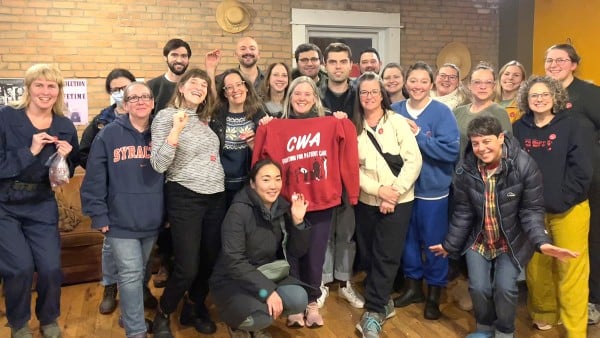
Cayuga Medical Center nurses to rally, alleging anti-union tactics by hospital management
CMC nurses plan a rally, alleging unsafe staffing and illegal anti-union tactics as the hospital highlights recent patient-safety gains.
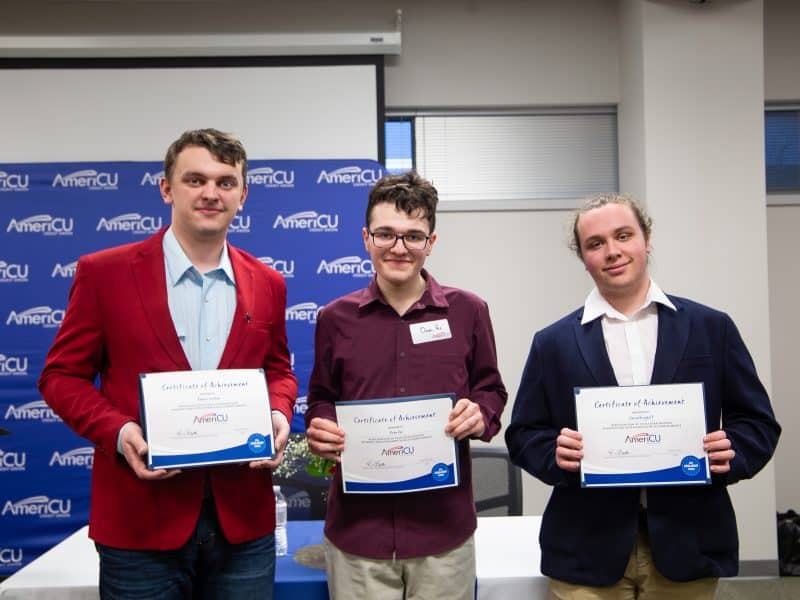
AmeriCU proudly connects students with annual scholarship opportunity
AmeriCU scholarship program awards $1,000 to students pursuing college or vocational education. Applications are open through March 15.
Street Beat: What’s one of the best holiday gifts you ever received?
We asked five random people. Here’s what they had to say.