
Trumansburg Community Nursery School finds new home
Trumansburg Community Nursery School moved into its new location at Crescent Way in January.
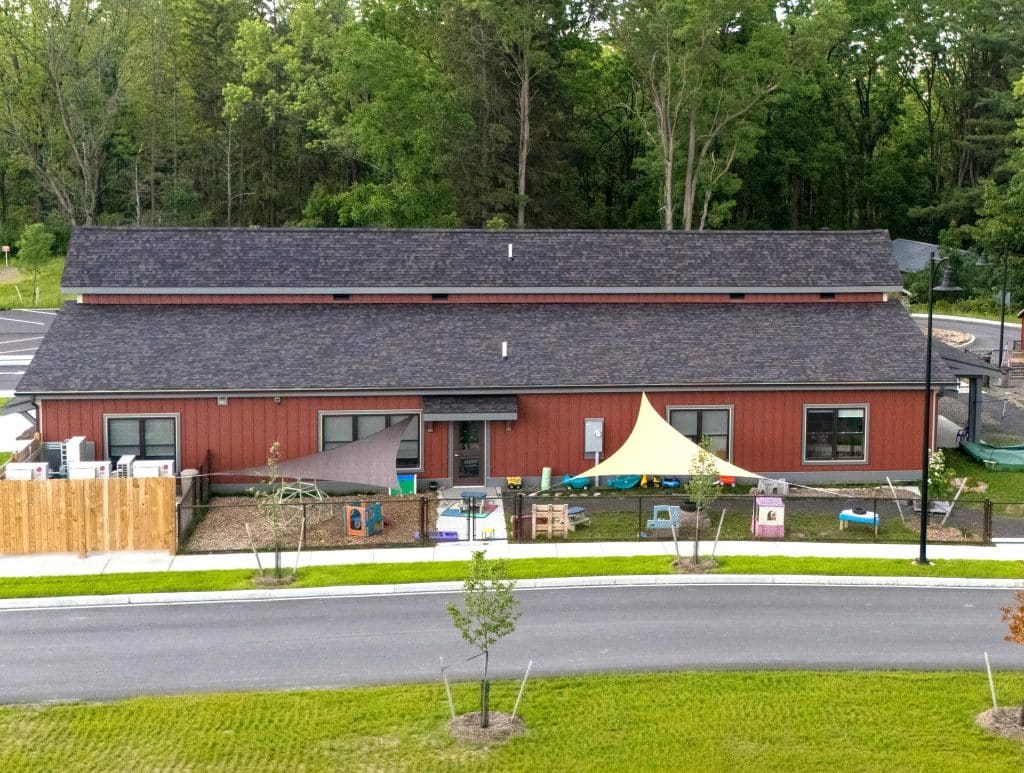
The new location of Trumansburg Community Nursery School recently opened on Crescent Way.
The Trumansburg Community Nursery School (TCNS) has moved to its new building on Crescent Way and will seek to remain a pillar of the Trumansburg area’s day care community during challenging times for child care providers.
Debra Austic, director of the school, provided an update to the Ulysses Town Board at its July 8 meeting. She noted that there is an ongoing summer camp, but the school will ramp up its child care offerings post-summer. The school moved from its former location at 69 E. Main St. in the village of Trumansburg to a new building at 6 Crescent Way.
TCNS is a play-based, parent-cooperative nursery school for 2-5 year olds. The school offers affordable two-, three- and five-day programs in a convenient location, according to the organization’s Facebook page.
Austic has extensive experience with TCNS; she became involved with the school in 1998 as a parent and board member when her children attended TCNS. She began working there as a teacher in 2002 and has been director since 2007.
“We finally got into our new building in January, and finally, just about three weeks ago we finished all of our licensing work,” Austic told the board. “So, we are very excited, up and running, ready to welcome any little kids in our community.”
The new location is at the site of the recently opened Village Grove Housing development. The $27 million development, owned by Ithaca Neighborhood Housing Services (INHS), sought to bring affordable child care by partnering with TCNS. The mixed-income project includes nine market rate lots, 10 affordable for-sale townhomes and 46 rental units.
All in all, the school has space for 48 students.
“That is when we are maxed out: 12 toddlers, 36 preschoolers,” Austic said.
Austic thanked the town board for its support of the school’s mission. As part of a community grants program from the town, TCNS was able to provide $10,000 worth of scholarships. Around $2,000 of that scholarship program came from a town of Ulysses grant, Town Supervisor Katelin Olson said.
That money went to 11 different families, with awards depending on whether students would attend the school for a half or a full year.
“We work really hard to make sure anybody can afford to come,” Austic said. “We don’t turn anybody away. If they have to, they pay what they can.”
For the fall, TCNS has 35 families enrolled.
“And when I say 48 spots, it’s probably gonna end up being like 60 to 70 families, because some of them come two days, three days, five days,” Austic said. “So, it’s a really big community of people.”
Austic said the school prides itself on its flexibility for parents.
“That’s one of the things that’s very important to us, is to offer different schedule options for parents — just some flexibility, whether they want a half a day or full day,” Austic said.
Olson asked Austic what were some of the trends she has observed in recent years.
“Have you seen an uptick in scholarship needs?” Olson asked.
Austic said that she has noticed an increase in financial assistance needs, as well as a declining level of income from families in need.
“Now also being licensed, we can accept child care subsidies from New York state, so that’s another thing that will help some of it,” Austic said.
On Feb. 6, the office of State Comptroller Thomas DiNapoli released a report about child care needs and challenges in New York. The comptroller’s conclusion was that there are areas with no child care providers, chronic workforce issues and sky-high costs for families.
“The pandemic’s disruption of the state’s child care industry is far from over,” DiNapoli said in a press release. “Prices in New York are among the highest in the nation, while child care workers earn wages well below the state’s median, making it hard to attract and retain the workforce needed to provide services. An effective child care system is integral to the state’s economic future and must remain a priority for policymakers.”
The report indicates that more than 60% of the state’s census tracts were child care deserts in 2023, with at least three children under the age of five per available slot in registered home-based providers or day care centers.
The number of day care services dropped by about 20% in 2020, according to the report. In it, DiNapoli writes that the industry has not recovered.
“On top of the demanding work requirements and lower than average pay, many child care workers don’t get other benefits, such as employer-provided health insurance, paid time off or pensions,” the comptroller wrote in his report.
Prices are also high, he noted.
Data from the New York State Department of Labor indicate that county-level costs of infant center-based care can range from 10.2% to as high as 36.6% of median family income.
Author

Related Articles

Tristan Parker wins Preserverance Award
Tristan Parker received OAR’s Deb Dietrich Perseverance Award for triumphing over addiction, homelessness, and incarceration to rebuild his life, maintain three years of sobriety, and pursue a nursing career.

Ithaca’s Monica Franciscus: Art on the road…to landfills
Local artist Monica Franciscus transforms discarded car bumpers into towering sculptures that spotlight climate change, consumer waste, and society’s dependence on fossil fuels while gaining national and international recognition for her environmental art.
‘Gigantic monstrosity’: Newfield residents speak out against NYSEG infrastructure project
Newfield residents raise concerns over NYSEG’s infrastructure project, citing property impacts, aesthetics, safety, and communication issues.