
Trumansburg board weighs sidewalk expansion, deer program
The Trumansburg Board of Trustees discusses sidewalk expansion projects and renews its successful deer management program for 2025–26.
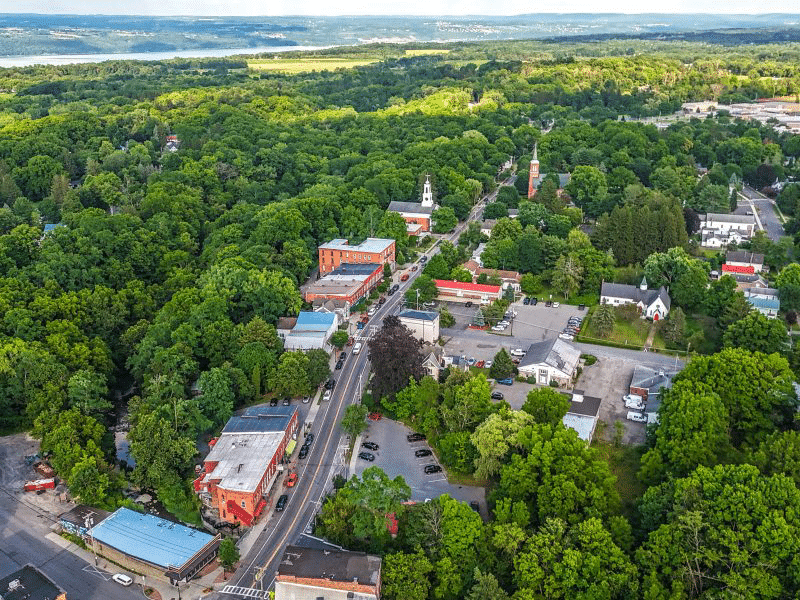
The village of Dryden’s Department of Public Works has been mulling over how to expand sidewalks or improve existing sidewalks.
The Village of Trumansburg Board of Trustees discussed adding more sidewalks to the village at its Sept. 8 meeting.
Trustee Ben Darfler said that the village’s Department of Public Works has been mulling over how to expand sidewalks or improve existing sidewalks in Trumansburg.
“There’s a desire to continue to invest in sidewalks, and [it’s] also unclear exactly where the best place to focus is,” he noted.
The village, Darfler added, should have more sidewalks, but there should not be an expectation for every road to have them.
“I think that’s way too expensive, both from the standpoint of maintenance and installation,” Darfler said. “We have been considering: where does it really make sense for sidewalks, versus where does it actually make sense to make the street more of a multipurpose street, and therefore require people to slow down?”
Trustee Marcia Horn said that she would like to see sidewalks between the Elm Heritage House bed and breakfast and the Juniper Manor apartment complex.
“Last Saturday, I picked up an elderly lady who was walking on the road with a cane. She was on her way to Saint James [the Apostle Church]. It was not a safe place for her to walk, so I pulled over and gave her a ride.”
Trustee Ben Carver said that he would like to prioritize maintenance of sidewalks before overseeing the construction of new ones. He said the sidewalks on Main Street are a good example of an area that could use maintenance. Those sidewalks are experiencing brick sag, which makes them uneven.
The village has been awarded grants in the last decade to improve and build out sidewalks. Mayor Rordan Hart said that a new part of the projects funded by a grant could be done in spring of 2027.
“Effectively, once the West Main Street sidewalk is done — let’s call it spring of 2027 — the village will be responsible for sidewalks on Seneca Road to the intersection of West Main Street all the way down Main Street through the downtown core,” he noted. “That’s all part of the grant, or grants, and one of the stipulations of the grant funding is that the village has to maintain these sidewalks.”
The board also discussed and approved the renewal of its deer management program (DMP) for another year.
The program, which started in 2014, is meant to reduce the deer population in the village. As of last year, the program had removed more than 400 deer from the area. Wildlife experts and village officials say that the removal of deer helps with deer overpopulation problems and thus can help with the preservation of local plant species, as well as mitigate the proliferation of Lyme disease and other illnesses carried by deer ticks.
The program was devised in conjunction with Cornell University’s Integrated Deer Research and Management program, as well as the village’s Nuisance Wildlife Committee and the village’s DMP Oversight Committee.
The program has been a model for other municipalities interested in reducing the local population of deer.
“These are mostly the same properties in the village, mostly the same participants,” Hart said. “The program has been very successful. I had another request from a municipality elsewhere. They would like to speak with us about the program because they’re trying to stand up something similar. This is the third or fourth time in the last few years that this has happened. So, we’ve become something of a municipal model. The [New York State Department of Environmental Conservation (DEC)] is constantly telling people to come talk to us if they want to do this correctly.”
As part of the program, local hunters use bows at baited locations. The village has designated 10 or more properties to conduct the culling.
The program is not considered regular hunting, but instead is a low-cost method preferred by the DEC, using proficient bow hunters at baited locations.
Corn bait will be placed 15 to 30 yards away from tree stands to attract deer to the locations. Trail-monitoring cameras will also be set up to monitor deer activity. It is up to landowners to restrict the number of hunters on their property, as well as to set the times or dates individuals are allowed on their property.
All shot deer will be removed discretely from the properties. Samples of internal organs and blood may be submitted to the Animal Health Diagnostic Center at Cornell’s College of Veterinary Medicine to assist in various research projects.
Participants can consume the harvested deer, or the deer can be donated, such as to local food banks and pantries or to families that can benefit from the meat.
The program will run until March 31 of next year.
Author

Related Articles

Holiday traditions bring community cheer
Tompkins County holiday traditions light up homes, farms, and schools with festive cheer and community spirit.

Trumansburg schools consider regionalization as TST BOCES plan advances
Trumansburg school regionalization remains undecided as TST BOCES outlines goals for shared services and student learning.

Trumansburg Community Chorus readies inspiring winter concerts
The Trumansburg Community Chorus performs “I Dream A World” this December, celebrating hope, reflection, and community in inspiring winter concerts.