
Two local Grow-NY finalists share stories
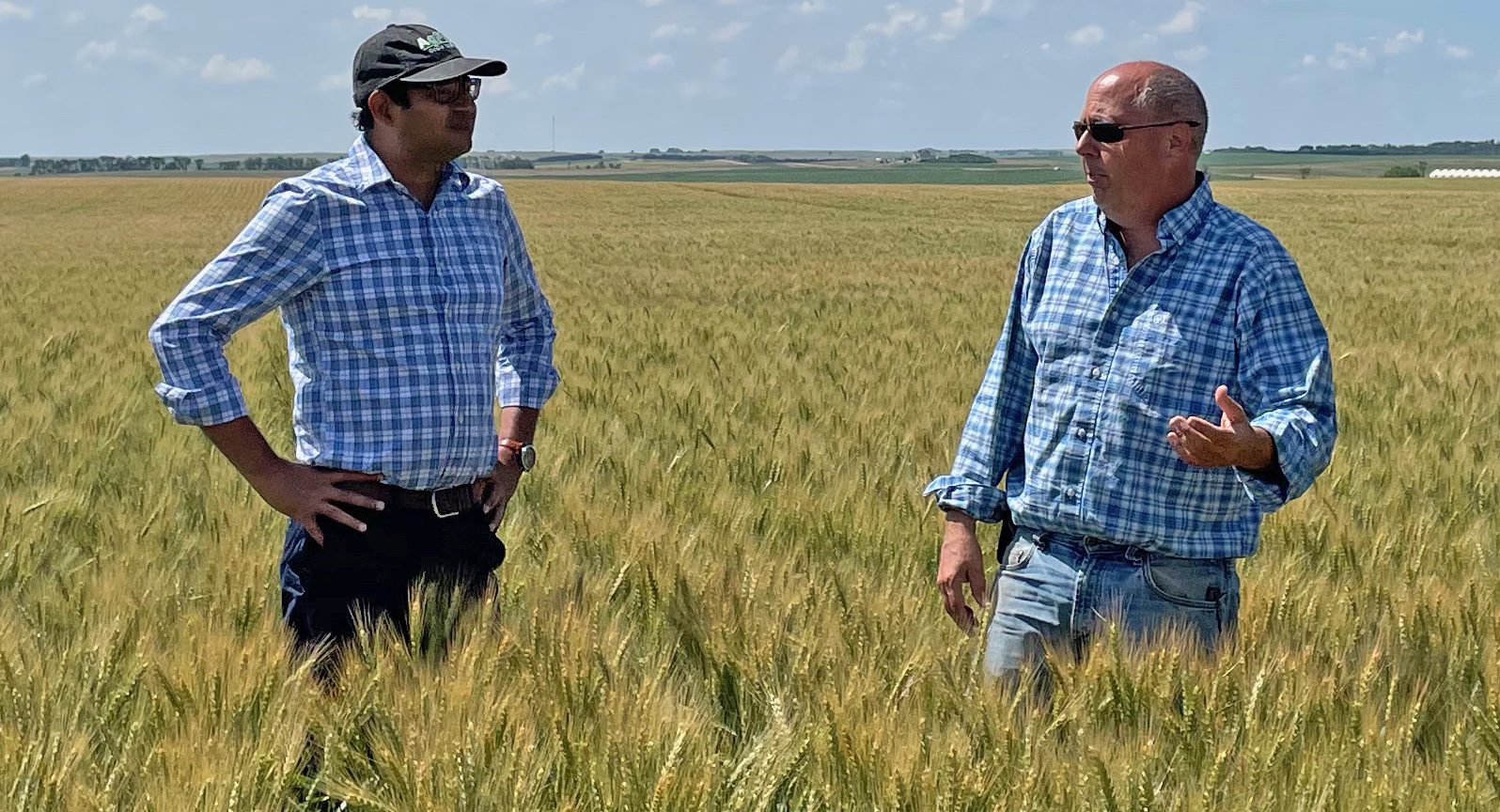
Last month, Empire State Development and Cornell University’s Center for Regional Economic Advancement announced the 20 finalists for 2021’s Grow-NY, described in a recent press release as “a food innovation and agriculture technology business challenge focused on enhancing the emerging food, beverage and agriculture innovation cluster in Central New York, the Finger Lakes, and the Southern Tier.”
This is Grow-NY’s third year (read about 2019’s competition at t.ly/C1xW), and after a virtual competition last year, finalists are looking forward to the in-person Grow-NY Food and Ag Summit in November. At that summit, Grow-NY will award a total of $3 million in prize money to seven winners, including a $1 million top prize, two $500,000 prizes and four $250,000 prizes.
Among the 20 finalists announced last month were Ithaca companies Ascribe Bioscience and Heat Inverse.
Ascribe, according to the release, “uses naturally occurring signaling molecules from the soil microbiome to produce a novel class of broad-spectrum, non-toxic biopesticides that prime the plants’ immune systems to enhance resistance to pathogens and increase crop yields.”
Heat Inverse has “developed a photonic metamaterial that offers cooling solutions with none of the energy input or waste heat associated with conventional cooling — it has the power to revolutionize cooling technologies in agriculture and food production,” according to the release.
Both companies have origins from well before 2021. Ascribe was founded in 2017 by Frank Schroeder, Daniel Klessig, Murli Manohar and Jay Farmer. Farmer, who earned his Ph.D. in chemistry from Cornell University, described himself as a “serial entrepreneur,” having been involved in a variety of startups before helping to found Ascribe.
As Farmer explained, Ascribe was founded after the discovery of a molecule from the soil produced by microorganisms naturally living in the soil.
“This molecule that acts like a vaccine for plants,” he said. “So, plants can perceive this molecule in their environment, and it’s a signal to the plant that there’s a threat, that there’s a pathogen nearby that might attack the plant. And in response, the plants respond by upregulating their immune systems, essentially, so they can defend themselves from that pathogen.”
As far as the team side of things, Farmer met Schroeder in graduate school, and the two became fast friends. That friendship ultimately led to Ascribe, Farmer explained.
“It was sort of a proverbial water cooler conversation between the two co-founding faculty members, Dan and Frank,” he said. “It’s the perfect intersection of these two academic research areas. So, Frank was focused on identifying classes of molecules produced by these micro-organisms. Some of the organisms that produce the molecules he was evaluating are plant pathogens. So, through this discussion with Dan, the idea naturally arose that hey, maybe plants can respond to these molecules as well. There was already precedent in the literature that other organisms do respond to these microbe-produced molecules.”
Thus, Ascribe’s products consist of small molecules that are scalable, stable and industry compatible, helping farmers have a better alternative to common pesticides.
“It has a lot of advantages in that, rather than killing the pathogen, we’re relying in the power of the plant to protect itself, really unleashing the power of plants’ immune systems to protect the crops rather than spreading toxic chemicals to kill the pathogens,” Farmer said.
Where Ascribe is focused on plant pathogens, Heat Inverse is focused on refrigeration. Heat Inverse has developed “patent-pending thin films [for] the outside of refrigerated truck trailers” that reduce fuel costs related to transporting temperature-sensitive food and beverages, said founder and CEO Romy Fain.
Fain earned her undergraduate degree at the University of California, Berkeley in mechanical engineering, and after graduation, she worked as a prototyping and manufacturing entrepreneur for over 12 years in the San Francisco Bay area. Later, she moved to Tompkins County to earn her Ph.D. at Cornell in electrical engineering.
“What we’re doing with this is very much a crossover of all of that background, where we are making very durable,scalable, practical material that is a hyper-emitter to dissipate heat more effectively,” she said.
Fain and Farmer both shared that their businesses faced relatively few challenges due to the pandemic, but there have been some hold-ups.
Fain, for example, said that Heat Inverse recently received funding from the National Science Foundation to scale up its materials to a large enough format to be deployed onto refrigerated trailers. Heat Inverse staff is working on pilots in both cold-chain refrigerated trucking and the power industry, and the pandemic slowed down that process.
“We needed these large-area-format materials in order to start doing those pilots, and with everybody closing down, that delayed that project,” Fain said. “We have scaled up to large-area format now, but at smaller volumes. … We were able to get the tests that we needed to be a success in order to get this last part of the materials done. So, now, … we’ll be doing enough to put on trucks or put onto these inverters or better energy storage systems and solar panels.”
Fain added that the pandemic has also affected her supply chain.
“We lost some of our suppliers,” she said. “We have one material supplier from China, and getting things shipped from there right now is very difficult. So, we have to pay for air freight if we want to get it anytime soon. And it’s just a lot of expense, especially for a startup. And it’s changing all the time. So, that’s part of what makes it difficult is you don’t know how much it’s going to cost, even if you have a quote. So, you just have to try and figure it out as it comes.”
Both Fain and Farmer were well aware of Grow-NY before applications opened earlier this year and jumped at the chance to compete.
“It’s a fantastic opportunity to get additional funding,” Farmer said. “And we’re at a juncture in the commercialization of our technology that I think really fits Grow-NY very well. So, we’re working on field trialing, but also, we’ll be scaling up the manufacture of this product. We’d like to have a small manufacturing facility here in the Ithaca area. So, we would manufacture and formulate this product and then perform all the other activities necessary to really bring this to market.”
Fain shared similar goals should her business win the competition or any of the smaller prizes.
“We are ideal for this kind of a program because we are definitely a triple–bottom–line–focused company,” she said. “Our mission is to revolutionize cooling technologies and profitably reduce greenhouse gas emissions by at least a gigaton at full deployment. And we’re doing that in a way that is socially equitable, meanwhile making it sustainable, because we are looking at getting close to software margins on these materials early on.”
Fain and Farmer, along with all the other finalists, will be judged based on five criteria: viability of commercialization and business model; customer value; food and agriculture innovation; regional job creation; and team. Both Farmer and Fain said they not only meet these criteria but also exceed them.
Overall, both business owners are looking forward to the final summit next month and hope the resulting prize money will help give their business a big push toward commercialization. To learn more about the Grow-NY competition, visit grow-ny.com.
Related Articles

‘Gigantic monstrosity’: Newfield residents speak out against NYSEG infrastructure project
Newfield residents raise concerns over NYSEG’s infrastructure project, citing property impacts, aesthetics, safety, and communication issues.

Cayuga Medical Center nurses to rally, alleging anti-union tactics by hospital management
CMC nurses plan a rally, alleging unsafe staffing and illegal anti-union tactics as the hospital highlights recent patient-safety gains.