
Ulysses landowners hope to make park dreams a reality
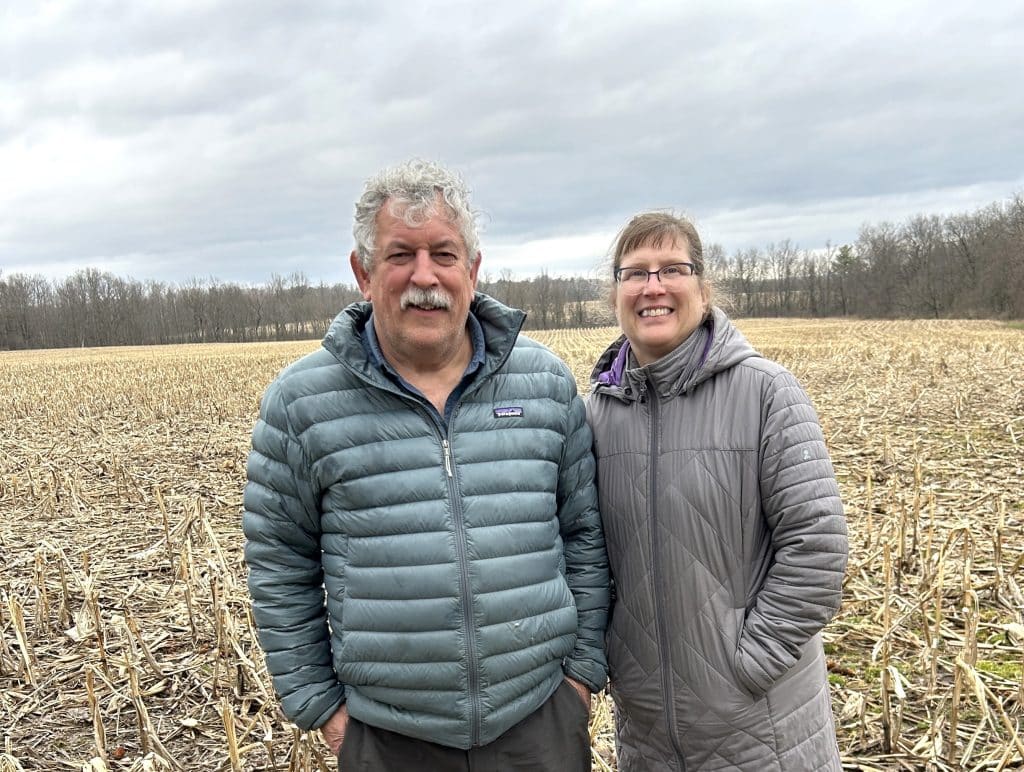
Marvin and Allison Pritts at the site of the proposed public park in Ulysses.
Editor’s note: This article has been updated from its original version to reflect a pubic hearing that occurred April 9, after our print publication deadline.
Update April 10: The Ulysses Town Board hosted a public hearing on April 8 whether the town should accept a land donation made by Marvin and Allison Pritts for the town to establish its first public park. Town Supervisor Katelin Olson said the public hearing was not mandatory but that it was a great opportunity for residents to provide public input on the donation of the land.
Community input was mixed throughout the session, which went on for slightly more than an hour. Some residents said the potential park could bring community members together and offer recreational places for residents of all ages. Some said the Pritts’ parcel on Cold Springs Road could be used for athletic facilities.
Marlaine Darfler said the park is a shared community project and space. She added that that is something that is strongly needed in the area.
Other residents said they were concerned about an increase in foot traffic. Patty Porter said she is worried about the property value of her home in the area, and hopes that the town can set guidelines for a potential park like hours of operation.
Allison and Marvin Pritts are among the multitude of Ulysses residents who want the town to create the first local public park in its more than 231 years of history.

So much so that they decided to donate 15.234 acres of land to make it happen. The Prittses bought that parcel, which includes parts of 5150 and 5230 Cold Springs Rd., in 1997, almost a decade after moving to Tompkins County. Allison, a registered nurse, and Marvin, a professor of horticulture at Cornell University, first arrived in the county in 1988.
“We had a little over an acre of land, and the land behind us had been for sale for years,” Allison said. “We just wanted 16 acres. But she came back and said, ‘If you buy this whole 40 acres, I’ll give it to you for the same price you’re offering for the 16 acres.’ Our mouths dropped, and we said, ‘Okay.’”
The land was at one point a small strawberry farm. It also served another farm, where a local farmer grew soybeans and corn. That farmer, the Prittses said, is ready to retire, which prompted them to look for good uses of their land some years back. When the town proposed buying up land on Krums Corners Road for around $210,000 in 2023 to create the first park in Ulysses’ history, the Prittses got an idea. (That proposal ended up failing after voters rejected it overwhelmingly.)
“Our kids aren’t coming back to farm this land,” Marvin said. “We thought, ‘Hey, I think we might have a parcel that would be perfect for the community to use.’ That’s when we approached the supervisor about it. She came out with some of her colleagues and looked at it, and they said that they thought it would be perfect.”
The Prittses hope that a potential park can help the town develop its sense of community, as well as foster community pride.
“Both of us really want it to be a place where people can come together and enjoy the outdoors — whether you are young or old,” Allison said. “We want it to be enjoyed by everyone, regardless of whatever kind of configuration happens with a park … whether it is a food forest, or gardens, or walking paths, or ball fields. Whatever the community feels is the biggest need. … It is a gift,right?”
Marvin stressed that the Pritts family wants the community to decide the fate of the outdoor recreational project.
“The town is going to have a process where they engage the community and brainstorm, thinking about what the residents want,” Marvin said. “It’ll take a while to get financing for the project. The town has sort of committed to not using tax dollars to build this, so it’ll be slow. I just really like the people coming together in community and enjoying themselves outside. That’s sort of the bottom line for me.”
The land donation has already had the weigh-in of several residents. If public comment submissions are any indication, residents’ sentiments toward the establishing of a public park with the donated land seem overwhelmingly positive. Almost 60 comments in support of the measure have flooded the town clerk’s and supervisor’s inboxes. There are also seven comments rejecting the town’s plan for a public park.
On potential arguments against the park, Allison said that there are already other recreational features in the town that show a public park would be a desired amenity.
“We had the Black Diamond Trail go through here several years ago, and the people that lived along the Black Diamond Trail raised the exact same issues,” she said, noting that naysayers pointed to overwhelming refuse, foot traffic and a loss of privacy as potential negatives of the trail. “All those concerns never came to fruition. The Black Diamond trail is heavily used. I’ve not heard of any neighbor issues. And in fact, studies show that when you have a trail next to your property like that, you end up being the biggest user of the trail. So, I think the same thing is true here.”
Ulysses Connection appears every week in Tompkins Weekly. Send story ideas to editorial@vizellamedia.com. Contact Eddie Velazquez at edvel37@gmail.com or on X (formerly Twitter) @ezvelazquez.
In brief:
The town of Ulysses Bee Committee has the following recommendations for local residents who want to help the area’s native bees:
“Stem-nesting bee larvae in the hollow stems of perennials will feed on the pollen left by their mothers when the time is right. Ulysses Bee Committee wishes to share a few best practices for a bee and pollinator friendly spring.
“1. Cut back dead flower stalks leaving stem stubble of varying heights, 8-24 inches. The pithy, hollow stems of raspberry are a favorite! Female bees will start a new nest in the cut or naturally occurring open stems.
“2. Wait to rake leaves until the temperatures are consistently warmer. If you do rake and clean up in some areas, stack plant debris in a corner instead of immediately discarding it. This allows any hidden pollinators a chance to emerge.
“3. Leave some areas undisturbed to provide ongoing habitat. Stacks of old wood and patches of bare or lightly covered dirt are essential for ground and cavity nesting solitary bees. Ground bees can find their way out through light leaf coverings but have a tougher time with heavier wood chips. https://beecityusa.org”
Author

Related Articles
Cayuga Medical Center nurses to rally, alleging anti-union tactics by hospital management
CMC nurses plan a rally, alleging unsafe staffing and illegal anti-union tactics as the hospital highlights recent patient-safety gains.
AmeriCU proudly connects students with annual scholarship opportunity
AmeriCU scholarship program awards $1,000 to students pursuing college or vocational education. Applications are open through March 15.
Street Beat: What’s one of the best holiday gifts you ever received?
We asked five random people. Here’s what they had to say.