
‘You’ve got to complete the mission’
Local American Legion members share their service experiences ahead of Veterans Day ceremonies across Tompkins County.
Legion members reflect on service ahead of Veterans Day
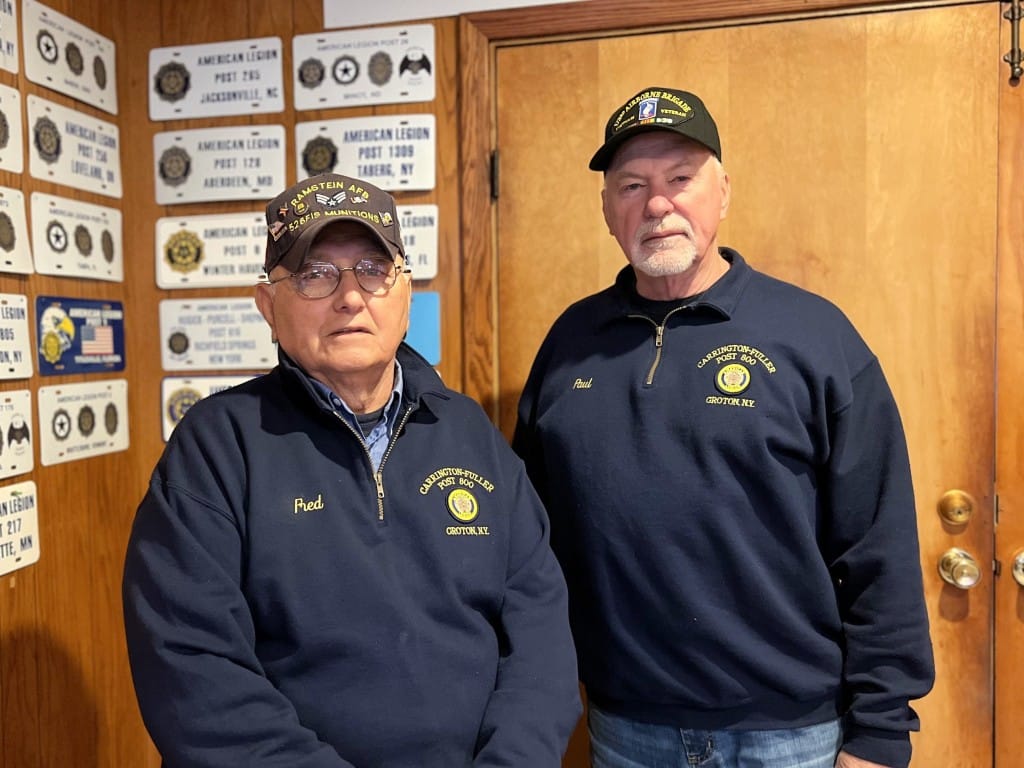
Frederick Youngs, Jr., (left) and Paul Koekebacker, vice commanders of the Carrington Fuller American Legion Post 800 in Groton, served in Germany and Vietnam, respectively.
Across Tompkins County, American Legion and VFW posts are preparing to honor all those who have served, as Veterans Day approaches on Nov. 11, with ceremonies planned in Ithaca, Dryden and Groton at the traditional hour of 11 a.m. For local veterans like Michael Moran of Slaterville Springs, the day is a time to reflect not only on those who made the ultimate sacrifice, but also on those who came home and continued building their lives and communities. “It’s honoring those who have come back and resumed their place in society,” said Moran, who served in the Vietnam War, adding that this is the distinction between Memorial Day and the upcoming holiday.
“Veterans Day is as much about living veterans as those who have passed on,” he said.
There will be remembrance ceremonies on Veterans Day at 11 a.m. in Dewitt Park in Ithaca, the village green in Dryden and at Carrington Fuller American Legion Post 800 in Groton.
The Groton American Legion, with its rich history, active membership and involvement in the wider community, is a source of pride and camaraderie for area veterans, including two who shared their stories with Tompkins Weekly. They both described their time in the service as demanding, rewarding and lifechanging, though they acknowledge others were not so lucky. Their thoughts return at this time of year to those who died in the line of duty or after returning home, as well as all those who struggled to resume normal lives after giving so much to their country.
Frederick Youngs, Jr., was 19 years old when he deployed overseas to Germany as an aircraft weapons specialist. “I loaded the bombs onto the aircrafts,” he said.
Of course, he didn’t know that he would be assigned that role when he signed up for the armed forces.
“I graduated high school in 1965, and there was a recruiter on my doorstep that day,” he said. “They were signing up anyone that wanted to go into the service.”
Youngs trained in Denver, Colorado, attending a top-secret school. “Everything was top secret,” he said.
An aptitude test identified his familiarity with guns. “They said, ‘You know a lot about guns,’ and I said, ‘Yeah, I grew up with them.’ And they said, ‘Okay, go to weapons school.’ So, that’s what I did,” Youngs said.
“At that time, the Cold War was going on, and we were playing games with the Russians,” Youngs said. “The Berlin Wall was still up, so the Russians would scramble their jets, and we would have to scramble our Zulu, and our mission was to keep the Russians from coming across.”
Twice he went into East Berlin. “Several of us went, and we could go across in our uniforms, and they couldn’t do anything about it,” Youngs said.
He said that being stationed overseas at such a young age was a formative experience that allowed him to see the world.
“It was interesting and exciting, and I also spent a lot of time living with a German family on weekends, where I learned to hunt and fish. … I hunted pheasants on a Strasburg ranch, hunted in Germany for Russian boar, so I made the best of it. The only time I came home was for my sister’s graduation in 1967.”
Youngs said he bonded with his crew right away. “I think I liked the camaraderie,” he said. “All us guys were like brothers and sisters. We all clicked and did things together.”
Being stationed at Ramstein Air Base in the late 1960s, things were relatively calm, he said. But in another part of the world, the Vietnam War had begun, and he lived close enough to Landstuhl Army Hospital that he could see wounded soldiers being brought in from Vietnam to be checked out and treated before they were sent home.
“Landstuhl was up on the hill, so I saw it, but I never went there,” Youngs said.
Overall, he said his experience was largely positive. “It helped me with my work ethic and all that. Military life — it’s good. I’m not saying every kid should do it, but a lot that do it come out a lot better.”
He acknowledged that this was far from the case for many who were stationed in combat zones.
“A lot of guys came back and are still not right,” he said. “A lot of guys make friends in the service, and they’re in a combat area with you one day and gone the next day.”
Like Youngs, Paul Koekebacker, who grew up in Freetown and Groton, joined the army when he was 19 years old. But because it was 1969, not 1965, he was drafted rather than recruited.
“It was no big surprise,” he said of being drafted. “I knew it was coming. It was, ‘OK, I’m off to join the army.’’’
He was sent to Fort Dix in New Jersey for basic training, then went to Louisiana for advanced infantry training.
“About the time I was finishing up at Fort Polk, Louisiana, an officer was looking for volunteers to go airborne, and I raised my hand. I still wasn’t too smart about volunteering,” he said with a laugh. “I did not know a lot about paratrooper training, but at that moment I thought, ‘It’s got to be better than Fort Polk, Louisiana.”
The conditions at Fort Polk were hot and muggy. “When it rains, everything that comes out of the ground bites,” Koekebacker said, adding that at the time, he didn’t realize just how similar those conditions were to the ones he would experience in Vietnam. But he knew that learning to jump out of planes sounded like a new adventure, and he would be earning an extra $55 per month.
“I ended up at jump school at Fort Benning, Georgia. And that was pretty strenuous,” he said. “Everything we did was running or pushing. We had a number of guys fall out [of the training program]. … I wanted to stick it out and, you know, finish it.”
While training was hard, jumping out of planes ended up being one of his favorite parts, especially when he got to jump with a line of fellow paratroopers out of a Lockheed C-141 Starlifter.
“That was really interesting,” he said. “I enjoyed it.”
He spent Christmas with his family and was sent to Vietnam in January, where he served in the 173rd Airborne Brigade for one year.
“There were good days and bad days,” Koekebacker said. He was assigned to a heavy mortar outfit. “I did what they called indirect firing.” That involved shooting weapons high in the air before they would come back down, hopefully on the enemy.
“[It’s a technique] which is very handy, if you have to put a round on the opposite side of a mountain,” Koekebacker explained.
His team would shoot mortar and white phosphorus. “You don’t want to get that on you,” he said. Getting it on you is like being on fire, and the burning doesn’t stop until you cut off any source of oxygen, usually by submerging yourself in water. “It’s nasty,” he said.
They would launch smoke bombs to help American soldiers escape from enemy territory and flares to help them see their targets at night.
It was a stressful situation often made worse by the fact that the rain was inescapable. The soldiers’ clothes were soaked all the time.
“I was wet every single day for a while,” Koekebacker said. “After a while you’re not happy about it, and that just seems to aggravate any other problems you’re having.”
A few major bright spots during Koekebacker’s time in Vietnam were visits from “Donut Dollies,” women working with the Red Cross who would fly in via helicopter to visit the troops.
“It was good to see a couple of other Americans,” Koekebacker said, adding that the women were risking their lives, as well, by flying into a war zone to see the soldiers.
Both Koekebacker and Youngs said that returning to the United States was not an easy adjustment, as they were expected to reintegrate into civilian life immediately without any kind of counseling provided by the army.
Both men eventually found their way. Youngs became a licensed electrician for 30 years, and Koekebacker embarked on a career with the state police that also lasted three decades, moving up through the ranks to sergeant and retiring as a senior investigator in 2004.
Koekebacker and Youngs are vice-commanders at Groton’s American Legion, which will host a Veterans Day dinner for all veterans and a guest on Nov. 8 at 5:30 p.m. Legion membership is not required, but reservations are, so those interested in attending are asked to sign up at the post’s bar, 307 Main Street, Groton.
The vice-commanders said that they encourage younger veterans to stop by; they would like to see the legion frequented by a new generation. The public is invited to the post’s many events, including Taco Tuesday, Thursday Grill Night and Trivia Night.
Koekebacker faces ongoing health problems due to Agent Orange exposure, namely various cancers that seem to keep popping up, keeping him in an endless cycle of diagnosis and treatment. He knows he is not alone; many other Vietnam veterans are fighting similar health battles.
“Medically, you know, we keep going,” he said. “You either treat it, or cut it out, or get something radiated, or whatever needs to be done to keep going. They used to tell you in Vietnam that, good or bad, you got to keep going. You got to complete the mission. So, that’s what you got to do. You got to complete the mission.”
Author

Related Articles
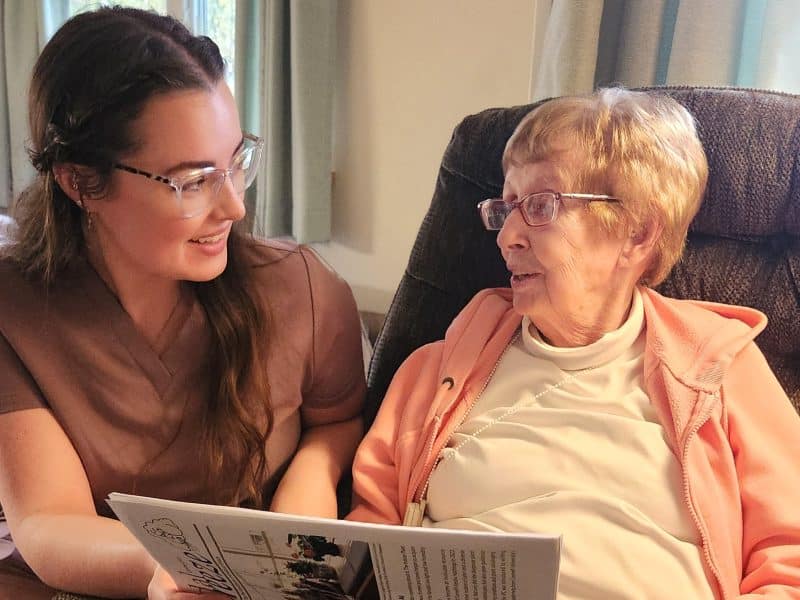
Kendal at Ithaca caregiver shares story on the honor of her profession
Kendal at Ithaca shares caregivers’ stories highlighting the compassion and dedication of CNAs and RCAs in resident care.
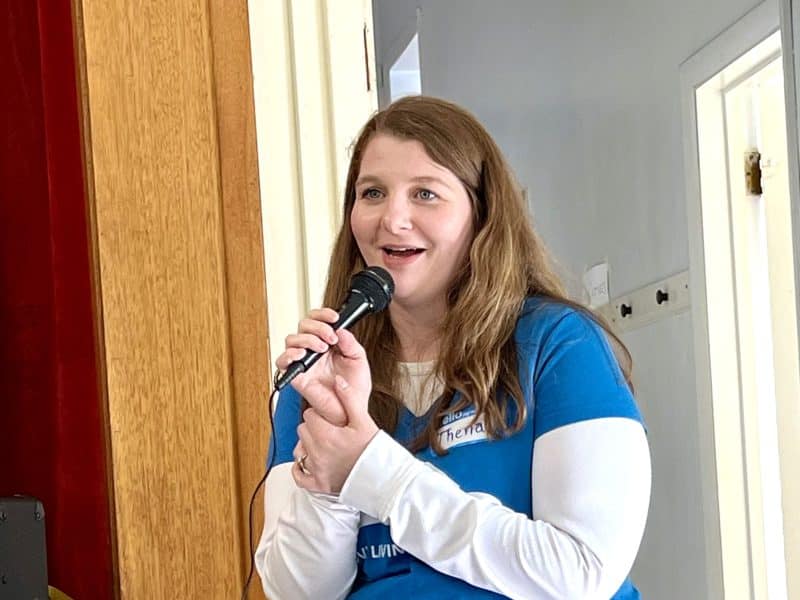
Love Living at Home: Growing a community village with 500 programs a year
Love Living at Home offers 500 programs a year and volunteer opportunities to connect and support older adults in Tompkins County.
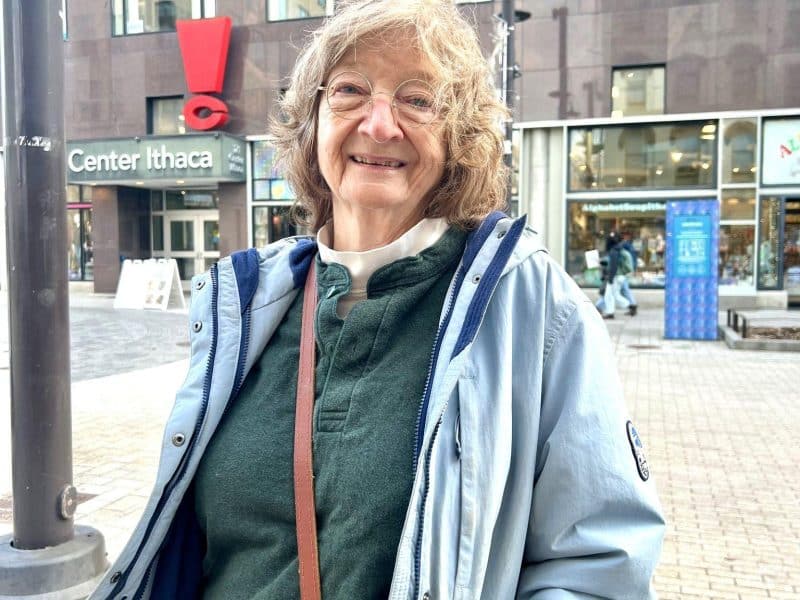
Street Beat: What are you thankful for?
We asked five random people. Here’s what they had to say.