
Green and affordable Trumansburg development begins with Village Grove
Village Grove in Trumansburg offers green, affordable housing for all. Explore the Crescent Way project’s first phase and impact!
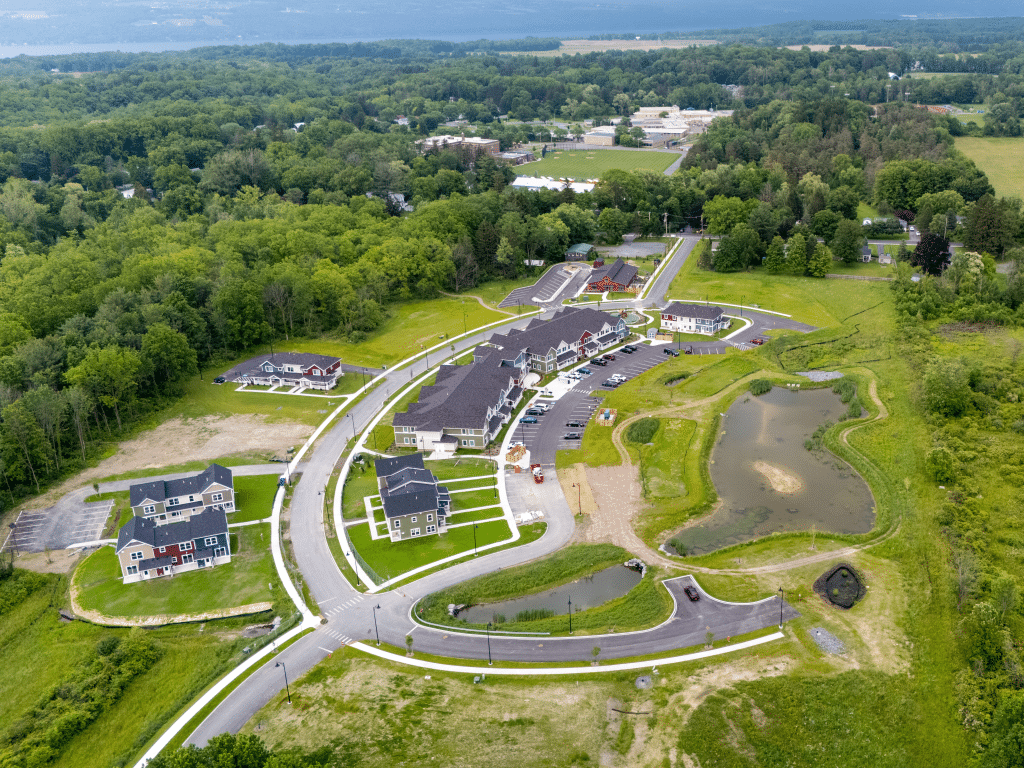
Village Grove, part of new Trumansburg housing development Crescent Way, is currently fully leased.
Community members gathered in Trumansburg last week at Village Grove Apartments, a new housing complex that offers affordable rental options, environmentally conscious design and inclusive housing for seniors, families, veterans and those with special needs. The crowd was there for a ribbon cutting celebrating the completion of the first phase of the Crescent Way subdivision.
Village Grove is a residential mixed-use, mixed income development comprising 46 rental units. Forty are located in a two-story elevator building, and the other six are two buildings with three townhomes each. The Village Grove apartments are currently fully leased.
The construction of the rest of the subdivision — 10 affordable for-sale homes that will be part of INHS’s Community Housing Trust — is now underway and scheduled to be complete by late 2025, though at the ribbon cutting Kate de la Garza, executive director of Ithaca Neighborhood Housing Services, mentioned that construction is ahead of schedule. There are also nine lots for market-rate construction that are available for purchase from Sundial Development.
De la Garza kicked off the day’s speeches. She took the attendees on a trip to the past in the “Wayback Machine,” as she put it, to describe how the new housing first took root.
The idea for the new community began in 2016 with the vision of Claudia Brenner, local architect and longtime partner with INHS. She came to the organization with “a bold and inspiring idea to transform a piece of land in the village of Trumansburg into a vibrant, mixed income, mixed-use, welcoming neighborhood,” de la Garza said.
Seven years later, after countless hours of planning, collaboration and perseverance, INHS and the project’s other partners broke ground on what would become one of the most ambitious and environmentally conscious developments in the region, “and I would say also the state,” de la Garza said, adding, “Today, we celebrate the realization of the first phase of this vision: Village Grove Apartments.”
Village Grove: A unique community
“INHS does not build cookie-cutter developments,” de La Garza said. “… I think you’ll see that the roofline of this project feels a lot more like townhomes than a large, boxy, multifamily building.”
De la Garza said that Village Grove was placed adjacent to South Street and Pennsylvania Street to encourage the residents of the different neighborhoods to mingle and get to know each other.
Katherine Stewart, who is originally from Horseheads, moved into Village Grove in January. Stewart, who has two sons and four grandchildren, moved to Trumansburg after her husband died. She put in an application at Village Grove. “I went through the process of filling out the paperwork, and it was very easy for me. I had no troubles,” she said, adding that she has enjoyed settling into her new home.
“I’ve met fabulous people — some that are older than me, some younger than me, some that are totally different than me — but we get together, click, and we’re starting to form friendships,” Stewart said. “And the best thing, I think, for me is this space. I can make it my own. … And the favorite thing for me is the porch.”
The development, complete with the porches that line many of the buildings, was the work of local firm HOLT Architects. It is the first multi-family housing project in Tompkins County to achieve Passive House Certification, underscoring a shared commitment to high-performance, sustainable and equitable community development, according to the HOLT website.
Maria Vakkas, who opened up her home to visitors during a self-guided tour after the ribbon cutting, said that she has made many friends since moving to Village Grove about three months ago.
Her husband of 53 years died last July, and she has been busy moving from her former residence, a house in Ithaca, to her new apartment, but she has still had time to get to know some of her neighbors, including families with children.
“It’s nice seeing a mix of ages and kids,” Vakkas said. “I love living here.”
Village Grove: An affordable housing option
The construction cost of the apartments was subsidized when they were built, but the rent is not subsidized, according to a Q&A on ithacanhs.com. By using local, state and federal housing programs, INHS reduces the amount of debt from conventional lenders. With less debt to pay, rents can be kept affordable.
“Building housing goes far beyond just the architecture and the physical space,” Chloë Moore, who appeared on behalf of New York State Senator Lea Webb, said during the ceremony. “It builds stronger, inclusive communities that we’re really proud to be a part of.”
All of the apartments are affordable to households making between 30% and 90% of area median income. This means Village Grove serves renters from a single household making roughly $20,000 a year to up to a six-person household making just over $100,000 annually.
De la Garza said that in phase two of the project, the 10 for-sale affordable townhomes will be sold into INHS’s Community Housing Trust, joining 71 homes already in the trust, a shared equity program that enables first-time home buyers of moderate income to purchase the home while the trust owns the land to reduce the long-term cost for the home buyer.
Mary Holland-Bavis, representing Assemblymember Anna Kelles, said that she is raising her family in Trumansburg and is heartened to see this new development so close to home.
“As a mom, I think about what it means for families to be able to put down roots here, to have access to housing that’s comfortable, healthy and sustainable, with predictable energy costs and safe, beautiful spaces to grow up in,” she said. “This is the housing that allows kids to stay, for seniors to age in place and for the people who work here to live here.”
Tompkins County Legislator Anne Koreman told a personal story about when she was 3 years old and her father died.
“I was living in downtown Albany with my mom,” Koreman said. “I had a 5-year-old brother, a 1-year-old sister, and we couldn’t afford to live in the city anymore, where we could walk to parks and walk to shopping and everything.”
“I’m going to ask you to visualize this,” she continued. “We went into affordable housing, a project. … It was between Albany and the suburbs, spread in between. And it was in the middle of nowhere. And so, imagine bare concrete buildings, and looming over our heads was the highway overpass.”
“And the bus came in a couple of times a day, and we didn’t have a car. There wasn’t day care,” Koreman said. “There was nothing. And now, we have this wonderful project where we have the nursery school. We have shops, we have businesses, we have grocery stores. We have wonderful neighbors in a community that is welcoming this development here and the folks here. And what struck me was that this community is in the middle of somewhere.”
Alexa Sewell, senior vice president of Multifamily Finance from New York State Homes and Community Renewal, attended the event to represent Governor Kathy Hochul and State Housing Commissioner Ruthanne Visnauskas.
“I mean, it’s coming to life very quickly,” Sewell said of Crescent Way. “That’s going to bring a lot of housing and services, but also new sewer, water and other infrastructure upgrades. We really love that because that’s what every economic or housing investment should spur, that additional investment.”
Trumansburg Village Mayor Rordan Hart, who owns a home on the village’s Main Street where he resides with his wife, Lindsay, and children, thought about how different the housing market is today compared to when he purchased his home.
“We bought our house in 2010,” Hart said. “Earlier in our careers, we got a really good deal on a really nice house. We’re blessed, and we’re fortunate to live there. But that was 15 years ago. That house today is almost triple what we paid for it. The reality is that 2010 Rordan and Lindsay Hart would not be able to afford today the house we actually live in.”
“Anything that can be done […] that can give people the opportunity to live in a beautiful home, in a beautiful community, is something worth celebrating,” he said.
Deb Austic, Trumansburg Community Nursery School director, said that over the years she has met many families who plan to move to Trumansburg and eventually enroll their children in the Trumansburg Central School District.
“They’re trying to move to Trumansburg. They’re looking for a house in Trumansburg. They can’t find a house in Trumansburg, or they cannot afford a house in Trumansburg,” said Austic. “So, this development goes a long way to making our community more accessible to people and to grow and thrive, which is what we really want.”
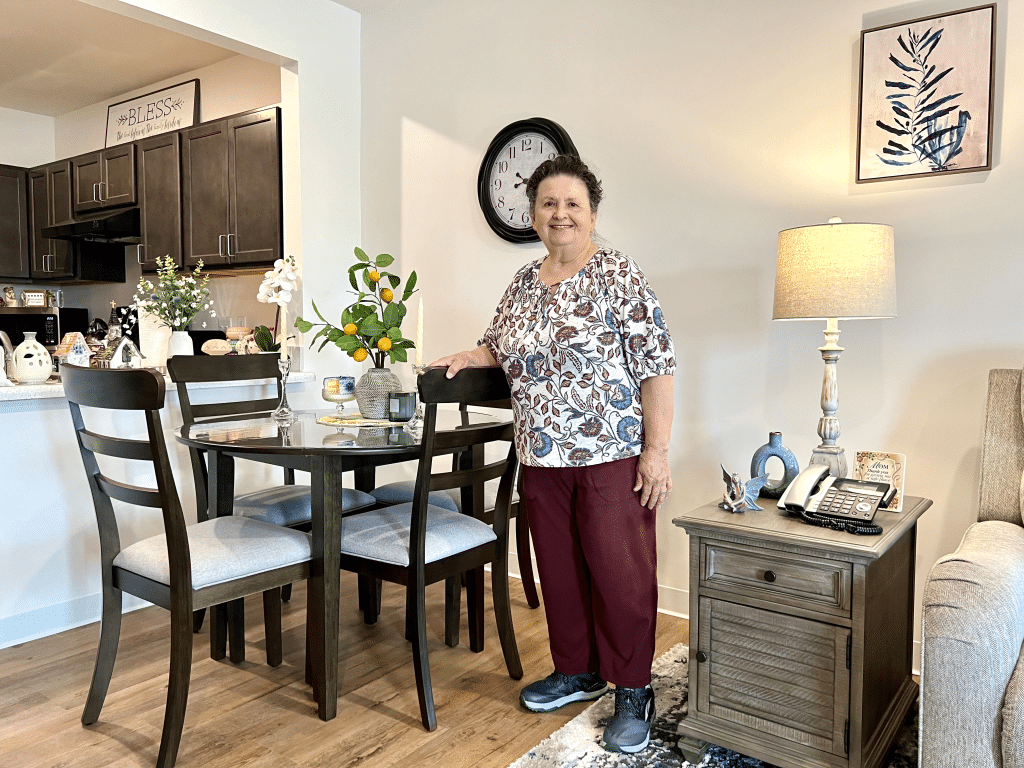
Maria Vakkas in her new Village Grove apartment in Trumansburg.
Village Grove: A safe place to land
Three of the homes are fully adapted for individuals with mobility impairments, and one is tailored for someone with a hearing or vision impairment. Several homes are reserved for vulnerable community members transitioning out of homelessness.
“These folks have the greatest need for a safe, stable place to live. Here, I just want to take a moment to thank the Salvation Army, our key partner in assisting these folks and supporting all of our residents,” de la Garza said.
Seven of the 46 units at Village Grove are set aside for disabled veterans, and three are dedicated for survivors of domestic violence. The housing for veterans is part of the Empire State Supportive Housing Initiative (ESSHI).
“[ESSHI] is a model that New York state has embraced. … It’s something that allows us both a mixed-income community and the ability to create impact and positive outcomes for all, which is something that is super important for all of us,” de la Garza told Tompkins Weekly in December.
Services for the veterans and domestic violence victims will be provided by the Salvation Army Ithaca Corps, the Department of Veterans Affairs and the Advocacy Center “to make sure they thrive,” de la Garza said.
Linda Camoin, assistant director in the Bureau of Housing and Support Services at the New York State Office of Temporary and Disability Services (OTDA), said she was proud to be at the ribbon cutting as a representative of the governor and OTDA Commissioner Barbara Guinn.
She said she also is proud to represent OTDA’s commitment of funding to the Salvation Army and Advocacy Center through ESSHI for the seven supportive units and the staffing that will provide supportive services for the people living there.
“Thank you to INHS and the Salvation Army for your partnership with OTDA,” Camoin said. “Developing projects and bringing them to life is not an easy feat.”
Village Grove: A green community
Village Grove is INHS’s greenest development to date, holding both passive house and enterprise Green Community Certifications, two of the highest standards in sustainable development in the housing industry, de la Garza said. The homes are highly insulated, air-tight and designed with balanced ventilation systems, natural light and solar gain.
“They feature high-performance windows and climate-specific moisture control, all of which contribute to a healthier and more comfortable living space. But we did not stop there,” de la Garza said. “Village Grove is connected also to off-site community solar, further reducing our carbon footprint.”
There are electrical vehicle charging stations, in support of the transition to cleaner transportation.
“We’ve embraced all-electric systems, including geothermal heating and cooling in the main building and air source heat pumps in the townhomes and nursery school,” de la Garza added.
Crescent Way: The new home of the Trumansburg Community Nursery School
Trumansburg Community Nursery School has been a fixture of the community for 60 years, providing exceptional early childhood education, de la Garza said. Their new purpose-built facility meets the growing demand for affordable accessible child care in the region.
The school has been able to nearly double its enrollment, as well as increase the number of staff members in the new location. The school is now able to enroll younger children and has expanded its hours. Austic said that she is excited about being part of the Crescent Way development.
“It’s more than just a new home for us,” Austic said. “It’s more opportunity to build community within the school and within the development and the wider community of Trumansburg. This is just the beginning. We’re looking forward to another 65 years or more of building community in this location.”
Ulysses Town Supervisor Katelin Olson said that she has been on the nursery school’s board for six years. She also has two children who attend the school.
“We have been talking for years and years and years — and probably more years than that — about being able to develop our own property,” Olson said, “and it was just always right outside the feasibility for a small nonprofit organization, whose primary mission is teaching and educating, and a volunteer board.”
“INHS and all the community partners in New York state have made it possible for us to have a facility that is accessible,” Olson added. “Parents and grandparents and caregivers who want to come and work in the facility don’t have to climb down stairs.”
As a parent of young children, Olson said she is grateful to have the school in her community. Few things can match “the joy of a mom who has a lot of work to do, who is happily, joyfully passing on her children to a phenomenal program,” she said.
For more information on purchasing a market-rate lot to build your own home, contact Claudia Brenner at cbrenner@claudiabrennerdesign.com.
For more information about Village Grove, visit ithacanhs.org/villagegrove.
Author

Related Articles
Cayuga Medical Center nurses’ vote for unionization approaches
The Cayuga Medical Center nurses union vote approaches as nurses cite workplace concerns, leadership changes, and national labor issues.
Holiday traditions bring community cheer
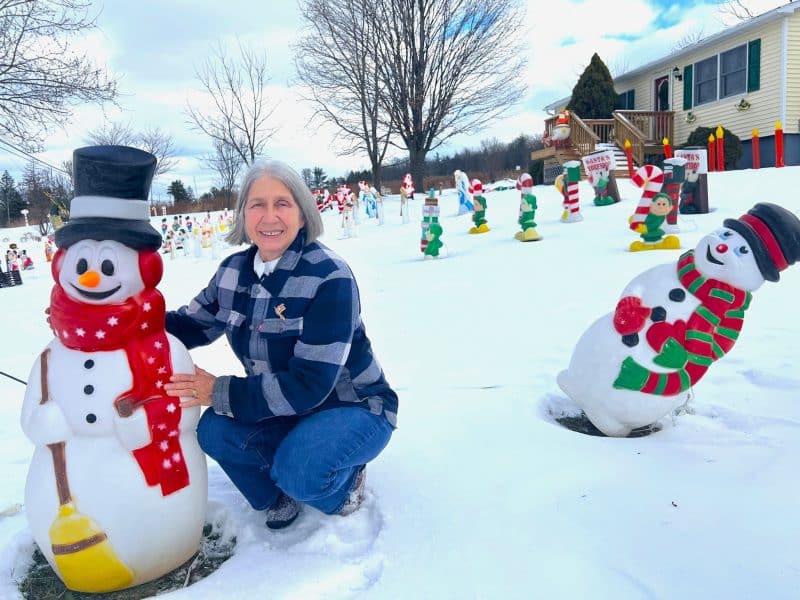
Tompkins County holiday traditions light up homes, farms, and schools with festive cheer and community spirit.