
Village of Lansing climate task force releases waste reduction and energy efficiency reports
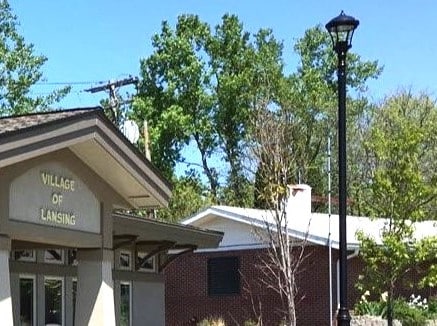
The Village of Lansing office building has reduced its GHG emissions intensity by almost 24% since 2019 and reduced its building energy use intensity by the same figure during the same time frame.
In March, the village of Lansing’s Climate Smart Communities (CSC) Task Force released two new reports related to the village’s ongoing efforts to reduce waste and seek more efficient energy usage for its municipal buildings.

The village’s CSC Task Force’s two reports were released as Lansing looks to attain a bronze-level certification through the state’s CSC program. The reports give recommendations to residents on how to reduce waste, as well as contribute to the village’s study of energy consumption at its municipal buildings.
The energy consumption report can be found here: https://www.vlansing.org/Reports/Village%20of%20Lansing%20Building%20Energy%20Use%20(2019-2024).pdf.
The waste reduction report can be found here:
https://www.vlansing.org/Reports/Village%20of%20Lansing%20Waste%20Reduction%20Opportunities.pdf.
“The building energy usage data is tracked by the CSC Task Force to allow the village government to determine if changes to buildings’ envelopes or heating/cooling systems provide better energy usage and lower municipal energy costs,” Mayor Ronny Hardaway said. “For example, the village of Lansing’s Department of Public Works [DPW] garage required a new shop-floor heating system recently. Tracking energy usage following the heater replacement will show if our investment improved heating efficiency and (hopefully) lowered the energy cost. Decreasing energy usage is one of the village’s CSC-related goals.”
Municipal buildings have a lower greenhouse gas (GHG) emissions intensity and energy use intensity figures since 2019, the report shows. The village offices building has reduced its GHG emissions intensity by almost 24% since 2019 and reduced its building energy use intensity by the same figure during the same time frame.
The DPW garage and the old village offices building have had a decrease of almost 12% in GHG emissions intensity since 2019. Similarly, their building energy use intensity is down by almost 14%.
The waste reduction report is informational for residents and businesses.
“The report shows that the village of Lansing staff and officials believe that waste reduction is important to environmental impacts and health, and it is meant to lead village residents and businesses by example,” Hardaway said.
Some of the report’s recommendations include:
- The village hall at 2405 N. Triphammer Rd. in Ithaca has a food scraps drop-off spot run by Tompkins County Recycling and Materials Management. Residents can bring in their food scraps on Saturdays from 10 a.m. to 1 p.m., and the scraps will be properly composted.
- Finger Lakes ReUse has a group called the Fixers Collective, which offers free repair of household items like electronics, furniture, small appliances and more. The Fixers Collective is open every Saturday from 3 p.m. to 5 p.m. at the ReUse Megacenter at Triphammer Marketplace.
“Two of our CSC goals — use climate-smart materials management and inform and inspire the public — are supported by this report,” Hardaway said.
The state’s CSC program began in 2009 as an interagency initiative of New York state, jointly sponsored by the following agencies:
- The State Department of Environmental Conservation (DEC), which administers the program
- Energy Research and Development Authority (NYSERDA)
- Department of Public Service (DPS)
- Department of State (DOS)
- Department of Transportation (DOT)
- Department of Health (DOH)
- Division of Homes and Community Renewal (HCR)
- Power Authority (NYPA)
The statewide program supports local efforts to meet the economic, social and environmental challenges of climate change. Through the program, municipalities can access leadership recognition, grants and free technical assistance.
These localities participate by signing a voluntary pledge and using the CSC framework to guide
progress toward creating attractive, healthy and equitable places to live, work and play.
The program goals include the reduction of greenhouse gas emissions, supporting an economy built on green innovation, increasing energy security and reliability, improving public health and safety, building resilience to resist the impacts of climate change and saving taxpayer dollars.
Municipalities in the program receive free technical assistance from regional CSC coordinators to aid with clean energy and climate initiatives. They can also enter a network of state grant and rebate opportunities, such as the municipal zero-emission vehicle program, which reduces the cost of electric vehicles and charging stations. Other grants can go toward funding climate change mitigation and adaptation projects.
To become certified, communities must adopt resolutions and take a CSC pledge. To further advance in the program and unlock more opportunities to reach their climate change goals, localities complete actions recommended by the state. These actions can determine whether a locality is in the “bronze” or “silver” tier, which showcases a municipality’s progress toward its goals.
The state has 437 registered CSC localities. There are 12 in Tompkins County, including the villages of Cayuga Heights, Dryden, Lansing and Trumansburg. The towns of Lansing, Enfield and Danby are also part of the county’s CSC delegation.
In the county, the towns of Dryden, Caroline, Ulysses and Ithaca, as well as the city of Ithaca, are registered as bronze-level communities, something that Hardaway said the village is working toward. The road to becoming certified requires around 120 points derived from certification actions. Said actions include building a CSC task force, which the village of Lansing has already fulfilled.
“In November, 2019 the village chose to pursue the CSC incentives and designations because the New York state program provided a wealth of defined actions that would allow our municipality to prepare for and mitigate future climate-related impacts to our residents, businesses and municipal buildings and properties,” Hardaway said. “We took advantage of the program’s extensive list of possible actions to improve our village municipal campus, green spaces, walkways and parks.”
Lansing at Large appears every week in Tompkins Weekly. Send story ideas to editorial@vizellamedia.com. Contact Eddie Velazquez at edvel37@gmail.com or on X (formerly Twitter): @ezvelazquez.
In brief:
The Lansing Community Library is looking for donations to its prom closet. They are currently accepting donations of formal wear, including dresses, dress shirts, suits, shoes, belts, purses and jewelry.
Gently worn or new formal attire and accessories can be dropped off at the library’s circulation desk during open hours.
The closet, located in the teen room on the lower level of the library, is open to all students from the Lansing Central School District. Interested parties can freely browse the dresses, try them on in the library restrooms or take a few home to see what fits best, according to a post on the library’s website.
“If you’re attending prom, we hope you’ll stop by and check out what’s available,” the post reads. “You can enter through the downstairs entrance, explore the selection, pick what you like, and head out—no need to stop at the desk!”
Author

Related Articles
Local representatives push HEAP as winter nears
Lansing HEAP program applications are now open, helping low-income households cover heating costs and access energy assistance this winter.
Lansing’s $17M capital project advances amid construction challenges
Lansing Central School’s $17M BOBCAT capital project upgrades schools, athletic facilities, HVAC, and infrastructure.