
What does the future hold for Ithaca’s Block 14?
Developers and legislators at odds regarding plans for the area
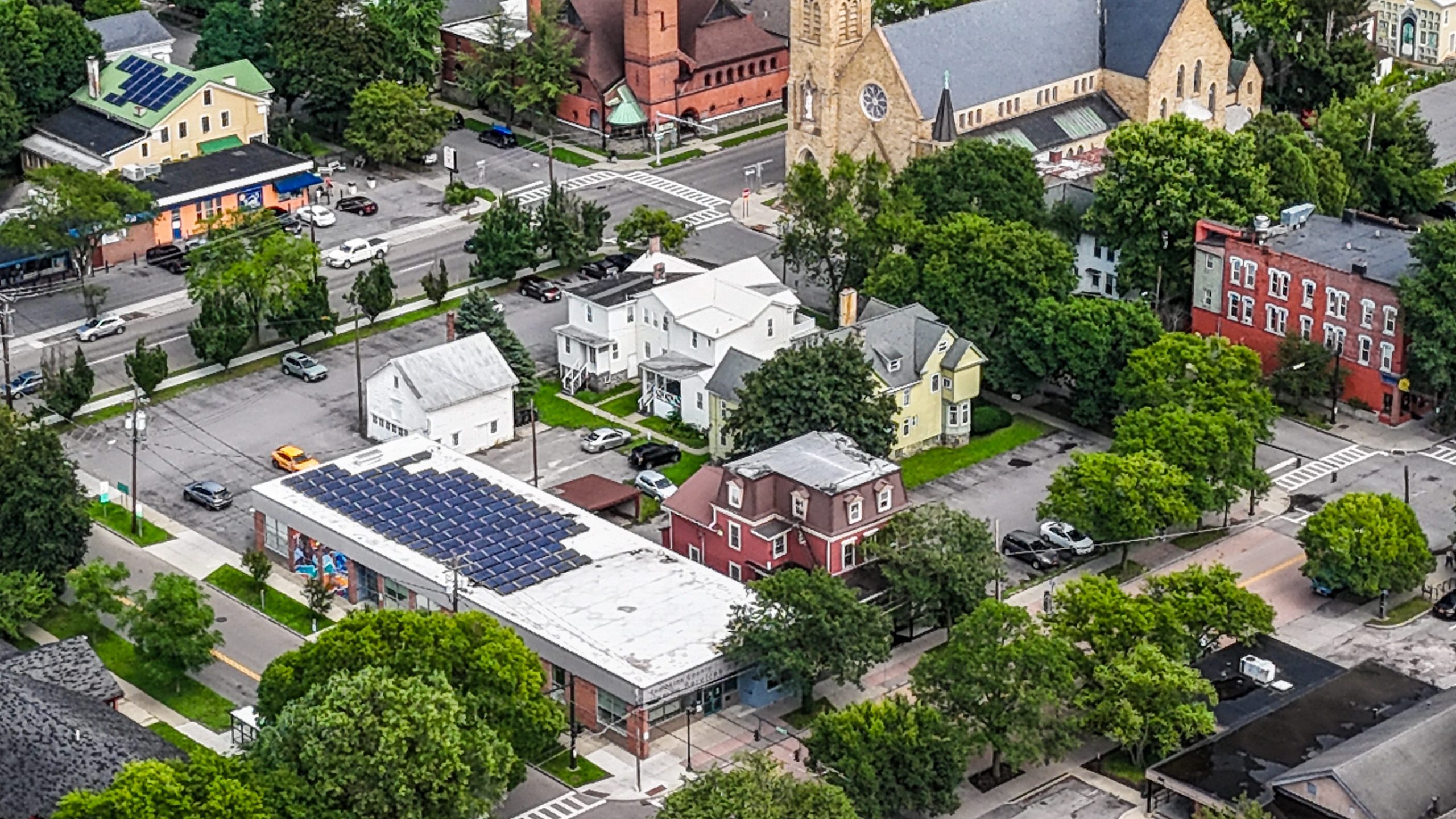
Ithaca’s Block 14, the downtown block bordered by North Geneva Street, North Albany Street, West Seneca Street and West State Street (Martin Luther King, Jr. Street), could be used for many things, according to a local group that has formed to explore its potential: market-rate or affordable housing, childcare, specialty tech office space, a transportation hub, parking, entertainment — the ideas put forth by the group are varied and currently vague, but the group recently received a $90,000 loan to look at how the block might best be transformed in a positive way for the city and its residents.

Managing Editor
“Ultimately, the idea is to understand if [redevelopment] is a viable option, and if it is, to come up with a game plan we can share with folks, along with all the facts and information people are going to need to make a reasonable and informed decision,” Gary Ferguson, former executive director of the Downtown Ithaca Alliance and member of Downtown Ithaca Local Development Corporation (LDC) 2, said Friday.
Block 14 includes the Tompkins County Human Services Annex, which houses the Office for the Aging and Department of Veterans Service Agency. The block also has two county-owned parking lots that currently accommodate county employees.
Ferguson; local developers Mack Travis and John Gutridge; and new member Nan Rohrer, chief executive officer of the Ithaca Downtown Alliance, currently comprise the LDC, which was formed to explore the possibility of redeveloping Block 14. The name of the LDC has a “2” after it because it is the second area LDC formed in recent years with the intention of redeveloping the city. The first was created for the property where the new Ithaca Downtown Conference Center now stands.
The goal of the LDC is to explore the opportunities for Block 14 in order to help facilitate the sale of the property to another entity that would develop the area.
“[The block] sort of sits in a very strategic position, and redeveloped in a way that might be very beneficial … it could be a very important property if it could be redeveloped in a holistic way, and that’s the question,” Ferguson said. “Can that happen in a reasonable and economically feasible way? And I think that’s what we’re trying to figure out.”
Redevelopment of whole city blocks is very rare, Ferguson said, and in the case of Block 14, there are only two owners: Tompkins County and the private property owner of two buildings on the block that take up about 40% of the land. The private owner has a purchasing option agreement with the LDC that expires at the end of 2024, according to Dan Klein (D-Danby), chair of the Tompkins County Legislature.
“There is potential for a community redevelopment effort there that could be significant,” said Ferguson, who described the area as a lynchpin of sorts—a connection between the traditional downtown area and the traditional west end area.
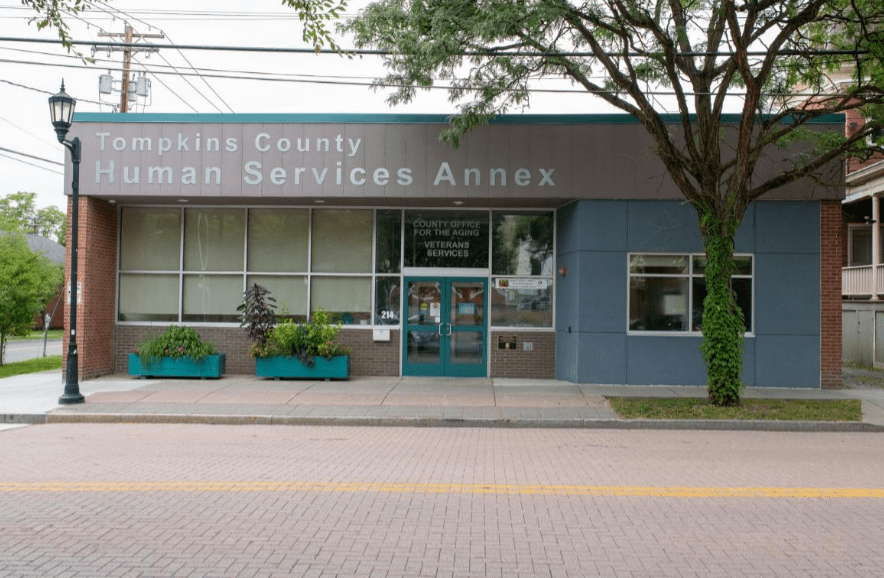
But the county has declared that for the foreseeable future, the property is not for sale.
Legislators were split on the issue but narrowly passed two resolutions about Block 14 at the legislature meeting July 16 in votes of eight in favor, six against. The first stated that the county’s land on Block 14 is not for sale at this time, and will not be for sale unless the legislature votes to declare the land no longer needed for county purposes.
Legislator Rich John (D-Ithaca), who is also the chair of the Tompkins County Industrial Development Agency (IDA), introduced a second, new resolution that stated Tompkins County agrees it will cooperate with the LDC in its predevelopment work to determine the feasibility of redevelopment of Block 14 and consideration of potential development scenarios, and, further, that for the avoidance of doubt, any further steps toward a commitment by Tompkins County in any redevelopment plan shall require future action by the legislature.
In June, the IDA granted the LDC a $90,000 loan to assist in covering predevelopment expenses pertaining to the assemblage, assessment and disposition of Block 14. In a memo proposing the loan, which was sent from the LDC to the IDA in March, the LDC indicated that IDA funding could assist the LDC in extending that purchase option agreement into 2025.
Klein said that this was partly what motivated the legislature to draft and vote on the resolution declaring the property not for sale for the foreseeable future and that this action was also prompted by the approval of the IDA loan.
“They never asked the legislature for input. Imagine someone interested in buying your home to develop the land said, ‘We’d like to buy your home,’ and you said, ‘No, thanks.’ Then, some public agency gives them a loan to lobby you, and they start soil testing.”
“The IDA is a public authority with certain powers and duties provided by the state of New York,” Heather McDaniel, administrative director of the IDA, stated to Tompkins Weekly. “The IDA does not have the authority to control land use nor to require any sale of land for any purposes. The IDA recognized the importance of this block and was in a position to assist in reviewing opportunities and identifying potential solutions. It will be the work of the LDC, and likely other stakeholders, to further discussion with the county and work towards solutions that benefit all parties involved.”
Even though three legislature members (John, Deborah Dawson [D-Villages of Lansing and Cayuga Heights] and Anne Koreman [D-Town of Ulysses and portions of towns of Ithaca and Enfield]) sit on the IDA board, Klein said he was not informed of the LDC’s application for funding until the day of the IDA meeting when it was granted.
“The IDA never came to the county legislature to say, ‘We’re giving a loan to these people who want to buy your land,’” Klein said. “I found out about it an hour before the vote. … I contacted the members of the IDA I had contact info for and told them I was completely opposed as the legislature had not weighed in.”
The response to Klein from the IDA: “They said [that] it’s just a study; no harm done,” Klein said.
Klein also pointed out that even though the funding is referred to as a loan, there is language in the agreement stating that the money may not have to be returned. Though the IDA was heavily involved in the process, the loan was technically issued by the Tompkins County Development Corporation (TCDC).
“The TCDC provided the funding as a loan to be disbursed in three installments as invoices and progress updates are provided,” McDaniel said. “At its sole discretion, the TCDC may forgive the loan after considering factors including: whether the funds were used appropriately to undertake the predevelopment process, the TCDC’s financial condition, whether a third party is found to redevelop the site, and the financial need to execute on the project redevelopment.”
Klein said he was hoping the legislature could convey with its first Block 14 resolution that the county is firm in its decision that the annex is not currently for sale; he believes the second resolution introduced at the meeting undermines this message. “It seems to indicate that we’re leaving the door open, but the door open to what?” he said. “I would not vote to sell our property, and I can’t think of any circumstances under which I would.”
Klein said parking is one of the biggest factors for him. “Everyone knows parking is tight downtown,” he said. The parking lots on Block 14 provide 20-plus spaces for county employees, and Klein said he does not see the county giving that up. “We could own the parking and they could build the building over it,” he said, “and I might be open to hearing that. But I didn’t wake up one day and say, ‘Hey, it would be great to build a building over our parking lot.’”
“This isn’t our project,” Klein added. “There are other willing sellers in Ithaca. Go find them. There’s two landowners, so that makes it easier to negotiate. I understand that. But we’re already using that land, so sorry. It’s not going to be on this block. That’s my view.”
Earlier this year, the legislature passed a resolution stating that the county would move the offices located in the annex into the new, yet-to-be-constructed Tompkins County Center of Government, and then sell the annex building.
“We just said it’s our intention to sell it but didn’t do anything to make it happen,” Klein said. “The Center for Government is years away, and all kinds of things keep popping up, slowing us down. So, to say now that we’re going to move out and sell it, so go ahead and start planning because that building will be for sale, is kind of premature.”
Klein said the New York State Historic Preservation Office (SHPO) has ruled that the county-owned buildings on North Tioga Street, which would need to be torn down for the construction of the Center of Government, contribute to the historic nature of the neighborhood.
The ruling was a surprise to the county, Klein said, as the buildings — professional law offices and the former KeyBank — are mid-20th century and not nearly as old as the nearby buildings that are protected as historic structures.
“Other buildings in that district are 1800s and early 1900s,” Klein said.
Currently the county has a request for proposals out for a company to manage the entire process of building the Center of Government, including applying for a state exemption that would allow the county to take down its old buildings.
This unexpected hurdle regarding the historic district could lead to a delay in the construction of the new Center ofGovernment, creating many unknowns, Klein said. He also said he believes that right now there are better ways to spend IDA funding.
Other members of the legislature are in favor of the LDC’s efforts and support the IDA’s decision to grant the group a loan.
“As far as selling the property, we are not giving any exclusivity to this LDC,” Koreman said. “This does not commit us to that. It just helps give us more opportunities to look at if we decide to sell it, and I think we owe it to us — I think we owe it to the residents of the county — that we keep all options on the table.”
“All of this information that will be gleaned through the LDC will be information that we could use later when and if — if — we’re thinking about selling the property. It will tell us more about the property that’s there. It will help us with our current use of the property, and if we decide to keep it, we’re going to know more information about the property.”
Ferguson said that the LDC will move forward, backed by its new loan, mindful of the legislature’s passing of its recent resolutions about the area they wish to redevelop.
“What we’re trying not to do is put this on [the county’s] shoulders but say, ‘Let us do some work and come back to you,’” Ferguson said. “We believe it’s important to go down this path and see if this is a legitimate opportunity.”
Author

Related Articles
Holiday traditions bring community cheer
Tompkins County holiday traditions light up homes, farms, and schools with festive cheer and community spirit.
The gift of an experience: Local businesses offer hands-on holiday fun
Holiday experience gifts in Tompkins County include candle making, gourd crafts, and pottery workshops for creative seasonal fun.
Code Blue shelter opens amid praise, concerns and ongoing debate
Ithaca’s Code Blue shelter opens with larger space, showers, and case management to help residents during cold weather.